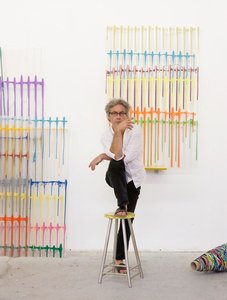
Om kunstneren
A Dialogue Between Order and Chance: The World of Beat Zoderer
Beat Zoderer, born in Zurich, Switzerland, in 1955, is an artist whose work embodies a fascinating tension—a delicate balance between meticulous construction and the embrace of serendipity. His journey began with a formal training as an architectural draftsman, a foundation that instilled within him a deep understanding of spatial dynamics and geometric principles. However, Zoderer’s path diverged from traditional architecture in 1979 when he committed himself fully to independent artistic creation. This shift marked not a rejection of his earlier discipline, but rather a liberation—a chance to explore the underlying structures that inform both built environments and abstract forms. He currently divides his time between Wettingen, Switzerland, and Genoa, Italy, locations that subtly influence his material choices and aesthetic sensibilities.
From Architectural Draftsmanship to Abstract Sculpture
Zoderer’s early work involved a deconstruction of everyday objects, a process of dismantling the familiar to reveal its inherent components. This initial phase evolved into a fascination with readily available materials—PVC sheeting, building boards, rubber bands, metal strips, and even office supplies sourced from hardware stores and stationery shops. What sets Zoderer apart is not simply *what* he uses, but *how* he uses it. He doesn’t transform these humble elements into representations of something else; instead, he allows their inherent qualities—their color, texture, and structural potential—to dictate the form. His sculptures are often described as geometric arrangements that extend into space, blurring the boundaries between two-dimensional surface and three-dimensional object. The artist himself speaks of an interest in “the holes in a grid or system,” suggesting a deliberate introduction of imperfection and ambiguity within seemingly ordered structures. This concept is central to understanding his artistic philosophy—a playful questioning of visual conventions and a rejection of rigid formalism.
Influences and Artistic Development
While Zoderer’s work is distinctly contemporary, echoes of earlier movements resonate throughout his oeuvre. The influence of Constructivism, with its emphasis on geometric abstraction and industrial materials, is readily apparent in the clean lines and precise arrangements that characterize many of his sculptures. However, he avoids a direct imitation of this historical style, instead using it as a springboard for his own unique explorations. He draws inspiration from historic works of geometric abstraction but consciously introduces an arbitrary element into each piece, preventing them from becoming overly systematic or predictable. This deliberate embrace of chance is further informed by his interest in the relationship between art and everyday life—a duality he terms “bi,” exploring the tension between banality and dignity, economy and waste. His installations often engage with space in a dynamic way, extending beyond the confines of traditional sculpture to create immersive environments that challenge viewers’ perceptions.
Recognition and Major Achievements
Throughout his career, Beat Zoderer has received numerous accolades recognizing his innovative approach to sculpture and installation art. He was awarded the Manor Art Prize of the Canton of Aargau in 1995, followed by the Recognition Prize of the Max Bill and Georges Vantongerloo Foundation in 1998—a testament to his commitment to concrete and constructive artistic principles. In 2018, he received the prestigious Willy-Reber Art Prize, further solidifying his position as a leading figure in the Swiss art scene. A particularly notable achievement was his collaboration with landscape architects Hager Partner AG on the design of the courtyard of the Berlin Parliament Building in 2012—a project that demonstrated his ability to integrate art seamlessly into public spaces. His work has been exhibited internationally, including at the Museum of Modern Art in New York and the Centre Pompidou in Paris, reaching a broad audience and influencing a new generation of artists.
Historical Significance and Lasting Impact
Beat Zoderer’s contribution to contemporary sculpture lies in his ability to elevate everyday materials into objects of aesthetic contemplation. He challenges traditional notions of artistic value by finding beauty and complexity in the mundane, prompting viewers to reconsider their relationship with the built environment and the objects that surround them. His work is not merely about form; it's about process—a dialogue between intention and chance, order and chaos. He has successfully continued this engagement in public and semi-public interventions, realizing art-in-architecture projects in many cities. Zoderer’s lasting impact can be seen in the growing number of artists who are exploring similar themes of deconstruction, materiality, and spatial dynamics. He remains a vital force in contemporary art, continually pushing boundaries and challenging conventional wisdom with his innovative sculptures and installations. His distinctive objects, paintings and installations continue to inspire and provoke, solidifying his place as a significant figure in the landscape of modern art.


 Forhåndsvisning
 Send
Send Del
Del
 Vis detaljer
 Utskriftsvennlig guide

 Last ned bilde
 Liknende objekter
 Røntgenundersøkelse
 Lysbildefremvisning
 Spørsmål og svar
 Statistikk
 Vis hele teksten
 Bytt til trykk





































 Glassalternativet er kun tilgjengelig i størrelser under 110 cm