Få en utskriftsklar fil som går langt utover forhåndsvisningen på nett. Hvert digitale bilde vi selger er hentet fra en høyoppløselig master i vår database – vanligvis mellom 5 000 og 15 000 piksler bred – slik at du kan trykke stort, beskjære tett eller gjenskape fine detaljer med full trygghet.
Ingen filer forlater studioet vårt uten å bli bearbeidet. En digital ekspert kontrollerer fargene mot det originale maleriet og korrigerer dem ved behov, for deretter å forbedre klarhet og detaljrikdom med profesjonelle retusjeringsverktøy — alltid tro mot kunstnerens penselstrøk og stil. Resultatet er et bilde som fremstår som selve maleriet, ikke som en skann med filter.
Du godkjenner før ferdigstilling: vår ekspert sender bildet på e-post til din vurdering innen 72 timer. Ikke fornøyd? Be om forbedringer eller korrigeringer, eller be om refusjon dersom kvaliteten ikke svarer til forventningene.
Dette er kvaliteten forlag, designstudioer, gallerier og trykkerier stoler på.
Last ned en høyoppløselig fil til personlig bruk, utskrift og kreative prosjekter. ( Bytt til trykk Kjøp håndmalt maleri)
Når du velger WahooArt.com, får du ikke bare et bilde – du mottar et profesjonelt etterbehandlet digitalt kunstverk, skapt med presisjon og med en garantert tilfredshetsgaranti. Her er alt som automatisk følger med din bestilling:
Din høyoppløselige digitale bildefil sendes til din e-post innen 72 timer etter bestilling – klar til umiddelbar bruk.
Ditt kunstverk blir profesjonelt optimalisert ved hjelp av avanserte AI-verktøy og manuell redigering, noe som sikrer maksimal detaljrikdom, klarhet og fargegjengivelse.
Har du ved et uhell slettet eller mistet filen din? Ingen bekymring – vi sender den på nytt når som helst, helt gratis.
Nyt ditt kunstverk umiddelbart uten toll, avgifter eller leveringskostnader – digitale nedlastinger er alltid avgiftsfrie.
Vi sikrer at det digitale bildet gjenspeiler de originale fargene så nøyaktig som mulig ved hjelp av profesjonelle verktøy og fargehåndtering.
Hvis du ikke er fornøyd med ditt digitale bilde, vil vi revidere det eller refundere 100% innen 100 dager – uten spørsmål.
Ikke fornøyd? Få full refusjon innen 100 dager etter at du har mottatt din digitale fil – uten spørsmål.
Kjøp 3 bilder, spar 10% - Kjøp 5, spar 15% - Kjøp 10+, spar 20%. Ideelt for kreative prosjekter, gallerier og byråer.
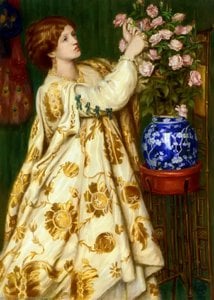
Anthony Frederick Augustus Sandys's “Grace Rose,” painted in 1866, is more than just a portrait; it’s a meticulously crafted tableau vivant, a shimmering glimpse into the opulent world of Victorian society and infused with the evocative spirit of the Pre-Raphaelites. This captivating work, now housed at the Yale Center for British Art, reveals Sandys's profound understanding of color, texture, and symbolic detail – elements that elevate it beyond a simple likeness to a richly layered exploration of beauty, femininity, and the allure of antiquity.
The subject herself, Grace Charlotte Rose, was a woman of considerable social standing, the daughter of Captain Winterton Snow and wife of Sir William Anderson Rose. Sandys’s choice to depict her in such exquisite detail speaks volumes about the importance placed on lineage and status within Victorian society. However, it's not merely a celebration of wealth; rather, the painting subtly hints at a deeper narrative woven through carefully chosen motifs. The elegant pose, the delicate lace trim, and the shimmering pearls all contribute to an atmosphere of refined grace, while simultaneously grounding the portrait in a tradition of aristocratic portraiture.
Sandys’s technical mastery is immediately apparent. He employs a rich, velvety impasto technique, building up layers of paint to create a tactile surface that invites close inspection. The delicate rendering of Grace's silk dress, the subtle sheen of her jewelry, and the intricate details of the antique vase all demonstrate his exceptional skill in capturing texture and light. Notably, Sandys deliberately avoids the stark realism favored by earlier portraitists, instead opting for a softer, more atmospheric approach—a hallmark of Pre-Raphaelite painting.
The composition is carefully orchestrated to draw the viewer’s eye through a series of interconnected elements. The green marble parapet, reminiscent of Italian Renaissance architecture, provides a dramatic backdrop for Grace and establishes an immediate connection to classical antiquity. The arrangement of the pink, crimson, and yellow roses within the vase isn't merely decorative; it speaks to themes of beauty, love, and fleeting moments—a common preoccupation in Pre-Raphaelite art. The inclusion of Japanese painted screens, a popular motif during this period (Japonisme), further enhances the sense of exoticism and adds another layer of visual richness.
“Grace Rose” occupies a fascinating space between the Pre-Raphaelite Brotherhood and the burgeoning aesthetic movement. Sandys, like many artists of his time, was drawn to the Pre-Raphaelite’s emphasis on beauty, detail, and mythological subjects, but he also embraced the aesthetic movement's fascination with decorative arts and exotic influences. The painting’s opulent details—the gold jewelry, the intricate vase, the Japanese screens—reflect this dual sensibility.
The choice of a Japanese screen as a backdrop is particularly significant. It represents a deliberate attempt to incorporate elements of Eastern art into a Western context, aligning with the aesthetic movement's interest in creating visually stimulating and emotionally evocative works. Furthermore, Sandys’s use of color—the rich reds, greens, and golds—is deliberately heightened, creating a sense of dramatic intensity that is characteristic of both Pre-Raphaelite and aesthetic paintings.
Ultimately, “Grace Rose” transcends its formal elements to evoke a powerful emotional response. The portrait captures not just Grace’s physical appearance but also her inner grace and dignity. The subtle gaze, the delicate expression, and the overall atmosphere of quiet elegance suggest a woman of considerable intelligence and refinement. It's a painting that invites contemplation—a reminder of the beauty and complexity of Victorian society and the enduring power of art to capture the essence of human experience.
"Grace Rose" av Frederick Sandys kan lastes ned fra verkets Last ned digitalt bilde-side, som nedlasting av et digitalt bilde i høy oppløsning.
En reproduksjon i Medium anbefales for "Grace Rose" av Frederick Sandys. Størrelsen kan justeres mens proporsjonene opprettholdes.
Fargeidentiteten til "Grace Rose" av Frederick Sandys: en Earthy-palett, dominert av Walnut (#7f5827).


1829 - 1904 , Storbritannia
 Forhåndsvisning
 Send
Send Del
Del
 Vis detaljer
 Utskriftsvennlig guide

 Last ned bilde
 Liknende objekter
 Røntgenundersøkelse
 Lysbildefremvisning
 Q&A
Q&A Statistikk


 Vis hele teksten