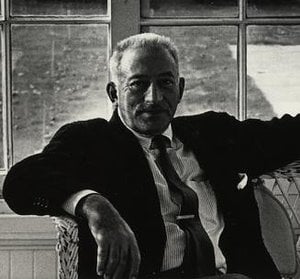
Kunstnerbiografi
A Pioneer of Abstract Expressionism: The Life and Art of Adolph Gottlieb
Adolph Gottlieb, born in New York City in 1903, emerged as a pivotal figure in the burgeoning landscape of American Abstract Expressionism. His journey was one of constant exploration—a relentless pursuit to distill universal human experiences into a visual language that resonated with both ancient symbolism and modern anxieties. Growing up as the son of Jewish immigrants, Gottlieb’s early life instilled within him a sensitivity to cultural displacement and the search for meaning in a rapidly changing world, themes that would profoundly shape his artistic vision. He received foundational training at the Art Students League and Parsons The New School for Design, but it was his subsequent travels through Europe during the 1920s that truly ignited his aesthetic sensibilities. Immersing himself in the art and philosophies of Germany and France, he absorbed influences from Constructivism and Surrealism, laying the groundwork for his future innovations.
Early Influences and Artistic Formation
Gottlieb’s formative years were marked by exposure to European avant-garde movements—particularly Surrealism—which challenged traditional artistic conventions and championed dreamlike imagery and psychological exploration. He was captivated by artists like Giorgio Morandi and Ernst Ludwig Kirchner, whose works conveyed a profound sense of melancholy and alienation—feelings that would become recurring motifs in Gottlieb’s own oeuvre. His initial experimentation with representational painting quickly yielded to abstraction as he sought to express inner emotions and ideas beyond the confines of visual depiction. This shift was driven by a desire to communicate directly with the viewer, bypassing intellectual interpretation and tapping into primal instincts. He honed his skills through rigorous studio practice and embraced innovative techniques—particularly collage—which allowed him to juxtapose disparate materials and textures, creating layered compositions that conveyed complex narratives.
The New York Artists Painters Group and Collaborative Spirit
A crucial turning point in Gottlieb’s artistic trajectory arrived in 1935 when he joined forces with fellow artists Mark Rothko, John D. Graham, Franz Kline, Barnett Newman, Philip Guston, Lester Thomson, William Lehrer, Ivan Zakish, Robert Delaunay, and George Porter to establish “The Ten,” later known as the New York Artists Painters group. This collective was instrumental in fostering a distinctly American voice within the international art scene—a defiant rejection of European artistic dominance and an embrace of experimental approaches. Recognizing the importance of dialogue and shared vision, The Ten actively debated stylistic concerns and conceptual ideas, pushing each other to explore new frontiers of abstraction. Their collaborative spirit fueled innovation and solidified their commitment to challenging established norms—a legacy that continues to inspire artists today. Gottlieb’s participation in the Federal Art Project during the Great Depression provided invaluable support for his artistic endeavors—allowing him to pursue his creative ambitions amidst economic hardship.
Arizona Landscapes and Ancient Symbolism
Between 1937 and 1938, Gottlieb undertook a transformative journey to Arizona—a region that captivated him with its stark landscapes and rich cultural heritage. He spent considerable time studying the monumental rock formations of Sedona and Monument Valley, immersing himself in the traditions of Native American cultures. This experience profoundly impacted his artistic sensibilities—awakening a fascination with primal symbolism and prompting him to explore the relationship between inner vision and external reality. Gottlieb sought to capture not merely the visual appearance of the desert—but its emotional resonance—a sense of vastness, isolation, and spiritual power. He incorporated elements of Navajo weaving patterns and geometric designs into his paintings—demonstrating a deliberate engagement with ancient artistic traditions.
The Pictographs Series: Exploring Universal Archetypes
Gottlieb’s most iconic series, the *Pictographs* (1940s), embodies this exploration of universal archetypes. These paintings feature biomorphic shapes and symbolic forms arranged within rectangular fields—resembling ancient hieroglyphs or tribal markings. He deliberately drew inspiration from diverse sources—classical mythology, Amerindian art, African motifs—creating a compelling dialogue between modernity and ancient traditions. The *Pictographs* weren’t simply abstract compositions; they were attempts to tap into primal instincts—to express fundamental human emotions and ideas beyond the limitations of visual representation. Gottlieb utilized a reductive approach—eliminating color and detail—to focus on essential forms and textures—creating paintings that conveyed profound psychological depth. He achieved this effect through meticulous layering of materials—often incorporating collage elements—which added textural complexity and reinforced the symbolic significance of his imagery.
Legacy and Recognition
Throughout his prolific career, Gottlieb exhibited extensively in both the United States and Europe—receiving critical acclaim for his distinctive artistic vision and unwavering commitment to abstraction. His work is now represented in major museum collections worldwide—including the Museum of Modern Art (MoMA) in New York City and the Tate Modern in London—a testament to its enduring power and influence. Gottlieb was awarded numerous honors and accolades—solidifying his place as one of the most significant abstract painters of the 20th century. His legacy extends beyond his individual paintings—he played a pivotal role in shaping the landscape of postwar American art—inspiring generations of artists to embrace experimentation, symbolism, and cultural influences. Gottlieb’s unwavering belief in the transformative potential of art—and his dedication to exploring universal themes—continue to resonate with audiences today. His work remains a powerful reminder that art can transcend cultural boundaries and speak to the deepest recesses of human consciousness.



 Se i rommet
 Bestill håndmalt reproduksjon
 Del som digitalt kort
 Del
Del
 Detaljer
 Studentguide

 Last ned
 Liknende objekter
 Røntgen
 Lysbildefremvisning
 Besøksstatistikk


 Les mer






































 Glassalternativet er kun tilgjengelig i størrelser under 110 cm


![Abstract Composition [triptych] — Vaclav Vytlacil, Abstract Expressionism](/media/artworks/images-thumb/08/3c/083c0675045645fd42d4e6c6d63f1ced.jpg)