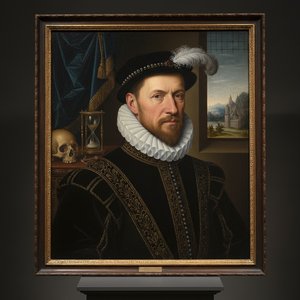
Sir Thomas Wriothesley: A Tudor Statesman & Patron
Early Life and Education
- Born on December 21, 1505, in London, Sir Thomas Wriothesley was the son of William Wriothesley, York Herald, and Agnes Drayton.
- He received his early education at St Paul's School, London, demonstrating a strong aptitude for learning.
- Wriothesley continued his studies at Trinity Hall, Cambridge, where he focused on law under the tutelage of Stephen Gardiner. This legal foundation would prove crucial to his future career.
Rise to Power & Service to Henry VIII
- Wriothesley’s ascent began under the patronage of Thomas Cromwell, a powerful figure in King Henry VIII's court. He became closely associated with Cromwell and served as a loyal instrument during the English Reformation.
- He held several key positions, including Clerk of the Signet (1524-1534) and Secretary to the Privy Council (1540), steadily gaining influence within the Tudor government.
- As a reward for his service, Wriothesley was granted extensive lands between Southampton and Winchester, confiscated from the dissolved abbeys of Beaulieu and Titchfield.
Key Positions & Political Influence
- Wriothesley’s career reached its zenith with appointments to some of the most important offices in England:
- Lord Chancellor (1543-1547): He oversaw the legal system and administration of justice.
- Lord High Admiral (1542-1550): He commanded the English fleet, a vital role during a period of naval expansion.
Artistic Legacy & Patronage
- Although not an artist himself, Wriothesley’s legacy is visible through his patronage of the arts and architecture.
- Sudeley Castle in the Cotswolds stands as a prime example of his architectural interests. The castle boasts an impressive collection of artworks, including pieces by renowned artists like Paul Nash and Leonardo da Vinci (though ownership history is complex).
- He commissioned works that reflected his status and contributed to the cultural landscape of Tudor England.
Controversies & Later Life
- Wriothesley’s later years were marked by controversy, particularly regarding his involvement in the persecution of Calvinists and other Protestants during a period of religious upheaval.
- He also played a role in the downfall of Anne Boleyn, contributing to her eventual execution – a decision that remains debated by historians.
- Sir Thomas Wriothesley died on July 30, 1550, leaving behind a complex legacy as a powerful and influential figure in Tudor England.
Historical Significance
- Wriothesley was a pivotal figure in the English Reformation, navigating the turbulent religious landscape of his time.
- His administrative skills and political acumen were instrumental in consolidating royal power under Henry VIII.
- As a patron of the arts, he contributed to the flourishing cultural scene of the Tudor period, leaving a lasting mark on England’s artistic heritage.
Vraag en antwoord
Hoe heeft de kunst van Sir Thomas Wriothesley zich in de loop der tijd ontwikkeld?
De carrière van Sir Thomas Wriothesley ontvouwt zich periode voor periode op de Loopbaanoverzicht pagina van de kunstenaar: een horizontale tijdlijn van de kunstwerken, gegroepeerd in hoofdstukken per carrièreperiode.
Kan ik het kleurgebruik van Sir Thomas Wriothesley in al het werk bestuderen?
De Kleurenpalet van de kunstenaar van Sir Thomas Wriothesley presenteert het kleurprofiel van het oeuvre van de kunstenaar.
Kan ik de werken van Sir Thomas Wriothesley bekijken op basis van kleurenpalet?
De werken van Sir Thomas Wriothesley kunnen op basis van kleurpalet worden bekeken op de Op kleurpalet pagina van de kunstenaar.