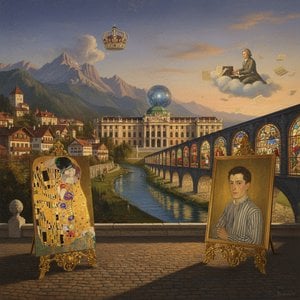
Siegfried Anzinger: A Chronicle of Intense Color and Existential Exploration
Siegfried Anzinger, born in Weyer, Austria, on February 25, 1953, is a pivotal figure within the “Neue Wilde” movement – a group that challenged established artistic norms with its raw emotion, vibrant color palettes, and often unsettling subject matter. His work, deeply rooted in Austrian identity yet resonating globally, explores fundamental human experiences: love, pain, sexuality, loneliness, and ultimately, mortality. Anzinger’s career is characterized by an almost obsessive engagement with his chosen medium, a relentless cycle of creation and re-creation that results in paintings layered with complexity and imbued with a palpable sense of urgency.Early Years and Artistic Formation
Anzinger's artistic journey began at the Academy of Fine Arts in Vienna (1971-1977), where he studied under Professor Maximilian Melcher. This formative period laid the groundwork for his distinctive style, though it was a conscious departure from traditional academic training. He sought to dismantle conventional approaches and forge his own path, driven by a desire to push the boundaries of painting itself. Following his time in Vienna, Anzinger relocated to Cologne in 1981, immersing himself within the burgeoning avant-garde scene of West Germany. This move proved crucial, exposing him to new influences and solidifying his position within the “Neue Wilde” collective – a group that prioritized direct emotional expression over meticulous representation.The "Neue Wilde" Aesthetic: Color, Texture, and Raw Emotion
Central to Anzinger’s artistic identity is his association with the “Neue Wilde.” This movement, emerging in the late 1970s and early 1980s, rejected the polished surfaces and intellectualism of previous generations. Instead, it embraced a visceral approach, utilizing bold colors, broad brushstrokes, and often fragmented compositions to convey intense emotional states. Anzinger’s paintings are immediately recognizable for their saturated hues – fiery reds, deep blues, and acidic yellows – applied with a frenetic energy that suggests both urgency and exhaustion. His technique is characterized by a layering process; he repeatedly adds and subtracts paint, building up complex textures and creating an illusion of constant evolution within each work. This “non-finito” quality—a deliberate avoidance of completion—is not simply a stylistic choice but reflects the artist’s engagement with the inherent instability of human experience.Key Exhibitions and Recognition
Anzinger's work has been consistently recognized through numerous solo and group exhibitions both nationally and internationally. A significant milestone occurred in 1988 when he participated in the Austrian Pavilion at the Venice Biennale, a testament to his growing recognition within the art world. His inclusion in documenta 7 (1982) further cemented his position as a leading contemporary artist. Throughout his career, Anzinger has exhibited at prestigious galleries and museums worldwide, including the Gemeentemuseum Den Haag and the Max Weber Gallery. In 2003, he received the Austrian State Prize for Fine Arts, acknowledging his enduring contribution to Austrian art.Themes of Existentialism and Personal Reflection
Beneath the vibrant surface of Anzinger’s paintings lies a profound exploration of existential themes. He frequently tackles subjects such as love, pain, sexuality, loneliness, fear, and death – fundamental aspects of the human condition that he approaches with unflinching honesty. His work is not didactic; it doesn't offer easy answers or resolutions. Instead, it presents these complex emotions in a raw and immediate manner, inviting viewers to confront their own experiences of vulnerability and uncertainty. As one source notes, his paintings “deal with basic existential problems such as love, sexuality, pain, loneliness, fear and death.” His oeuvre is a testament to the enduring power of art to grapple with the most challenging aspects of our shared human experience.- Notable Works: Untitled (1997) – A layered oil painting exploring atmospheric hues and subtle figures.
- Influences: John van ‘t Slot, Bacon
- Current Status: Still actively creating and exhibiting.
For further information, please refer to the resources listed below:
- Siegfried Anzinger - Untitled (1997)
- Siegfried Anzinger
- Siegfried Anzinger - Biography (Giese & Schweiger Kunsthandel)
- SIEGFRIED ANZINGER - Galerie Elisabeth & Klaus Thoman
- Siegfried Anzinger (1953) - FTN-blog
Vraag & Antwoord
Kan ik de werken van Siegfried Anzinger bekijken op basis van stemming?
De Sfeerruimte van Siegfried Anzinger is een pagina waarop de kunstwerken van de kunstenaar zijn gerangschikt op stemming.
Waar zijn de kunstwerken van Siegfried Anzinger georganiseerd op kleur?
De werken van Siegfried Anzinger kunnen op kleur worden verkend op de Spectraal index pagina van de kunstenaar.
Is er een tijdlijn van de werken van Siegfried Anzinger?
De Tijdlijn kunstwerken pagina van de kunstenaar presenteert de werken van Siegfried Anzinger, chronologisch geordend per jaar.
Wat zijn de geboorteplaats en het geboortejaar van Siegfried Anzinger?
Siegfried Anzinger werd geboren in Weiz in 1953.
In welke stromingen heeft Siegfried Anzinger gewerkt?
De stromingen waarin Siegfried Anzinger werkte, zijn te vinden op de Alle stromingen-pagina van de kunstenaar, waar de kunstwerken per stroming zijn gegroepeerd.
Waar komt Siegfried Anzinger vandaan?
Siegfried Anzinger werd geboren in Austria.
Kan ik het kleurgebruik van Siegfried Anzinger in al het werk bestuderen?
Het kleurgebruik van Siegfried Anzinger in de werken die op deze website worden vermeld, kan worden bestudeerd op de Paletgenoom pagina van de kunstenaar.
Hoe populair zijn de kunstwerken van Siegfried Anzinger?
Er bestaat een Statistieken-pagina voor Siegfried Anzinger, met statistieken over de kunstwerken van de kunstenaar op deze website.