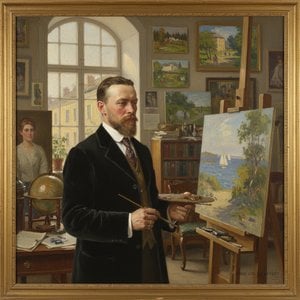
Early Life, Family and Training
Born in Copenhagen, Denmark, on 8 October 1844, Peter Alfred Schou grew up in a family of merchants. His brother, Ludvig Abelin Schou, was also part of this merchant household. While his family roots were tied to trade, Schou’s path was not immediately set on the canvas. Following the lead of his father, he initially looked toward the world of business and attended a trade school to prepare for a life of commerce.
The pull toward art appeared in stages, often during the quiet intervals of his youth. He began to spend his summers attending classes at the Dresden Academy of Fine Arts, finding his way toward painting even as he maintained his family's interests. This period of study allowed him to test his inclinations against the formal training of the academy.
By 1876, Schou moved to Paris to deepen his understanding of the craft. It was there that he studied under Léon Bonnat, a significant step in his development as a painter. This period of formal instruction in France helped shape the technical foundation he would carry with him throughout his career.
Life and Career in Hamburg
In 1865, Schou moved to Hamburg to look after his family's interests. His life there was defined by a period of practical labor that stood in contrast to his artistic inclinations. He worked as a bookkeeper and eventually took on a role as an agent, managing affairs across Germany and Scandinavia. These years were spent navigating the complexities of trade and commerce, a far cry from the quiet studios of Paris or the academies of Dresden.
By 1882, he was established in Hamburg, living a life that balanced his professional duties with his passion for drawing. During this time, he ran a small drawing school, sharing his technical knowledge with others while maintaining his own connection to the craft. This period of his life was marked by a certain restlessness; he lived a nomadic existence as an agent, moving through different regions, yet he remained anchored to the practicalities of his family's business interests.
Artistic Circles and Exhibitions
Schou’s professional life was marked by a desire for creative freedom. After facing rejection from the censorship committee for the Charlottenborg Spring Exhibition, he returned to Hamburg. This setback led him to establish the "Aktclub," a dedicated venue where artists could paint nude models without the constraints of academic rules. It became a space for others to work, including Arthur Siebelist, Julius von Ehren, and Julius Wohlers.
His presence in the exhibition circuit grew steadily over the years. He saw his first exhibition at the Salon in 1880, and later, between 1894 and 1898, he exhibited at the Kunsthalle. These years were spent navigating the different artistic landscapes of Germany and Denmark, finding his place among his contemporaries through both formal shows and private gatherings.
Upon returning to Denmark in 1902, he became a regular fixture in the local art scene. He participated in several annual exhibitions, including the Charlottenborg Spring Exhibition from 1902 to 1914. He was also a frequent contributor to the Artists' Autumn Exhibition between 1904 and 1913. These appearances ensured his work remained part of the public conversation in Copenhagen until the end of his life.
Technique and Artistic Style
Schou’s approach to painting was marked by a profound simplicity. He often focused on quiet, interior scenes, frequently placing only one or two figures within the frame. His work leaned toward a dark, Post-Impressionist style, using shadow and subdued tones to set a specific mood. There is a heavy stillness in these compositions, which often capture moments of sadness or quiet suffering. One of his most recurring themes was the bedside of a young man suffering from tuberculosis, a subject that allowed him to explore the fragility of life through a somber lens.
While these melancholic interiors are perhaps his most recognizable subjects, his range extended to other quiet observations. He also turned his attention to portraits and still-lifes, applying the same restrained touch to his subjects. Whether he was painting a person or an object, his work remained focused on the weight of the moment rather than decorative flourish. His paintings do not seek to overwhelm the viewer, but rather to invite a slow, steady contemplation of the human condition in its most private and vulnerable states.
Vraag en antwoord
Waar zijn de kunstwerken van Peter Alfred Schou gegroepeerd per techniek te vinden?
De werken van Peter Alfred Schou kunnen per medium worden bekeken op de Alle technieken pagina van de kunstenaar.
Waar kan ik de kunstwerken van Peter Alfred Schou ontdekken, ingedeeld op onderwerp?
De Onderwerpsindex van Peter Alfred Schou biedt een overzicht van de kunstwerken van de kunstenaar, ingedeeld op onderwerp.
Waar kan ik de kunstwerken van Peter Alfred Schou bekijken, gesorteerd op kleur?
Op de Sorteren op kleur-pagina zijn de kunstwerken van Peter Alfred Schou gesorteerd op kleur.