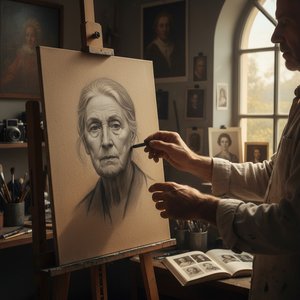
The Hand of the Portraitist
In the early decades of the eighteenth century, within the Kingdom of Great Britain, a painter named P. Trampon practiced the art of capturing the likeness of men. While the specific details of his early years remain obscured by the passage of time, his presence is felt through the oil on canvas he left behind. He worked during a period when the depiction of status and character through portraiture was a vital necessity for the rising merchant and naval classes. His brush moved with a purpose, seeking to fix a moment of a subject's life upon the fabric of a painting.
His skill is most clearly seen in his ability to render the dignity of those who commanded the seas. He did not merely paint faces; he painted the weight of responsibility and the quiet authority of men who navigated the vast, unknown reaches of the globe. Through his work, we catch a glimpse of a world defined by maritime expansion and the individual lives that drove it forward.
A Notable Commission
The most significant evidence of Trampon's hand survives in a portrait that speaks of a life lived in service to the East India Company. This work, dated 1711, offers a window into the era of maritime commerce and the men who steered its course. The painting depicts Captain Robert Knox, a man of the East India Company, and it remains a vital piece of historical record.
- The subject of his primary known work is Captain Robert Knox of the East India Company, 1641-1720.
- The portrait was executed in 1711.
- The work is held within the National Maritime Museum, London.
In this specific piece, the artist left his mark directly upon the scene, inscribing his name upon the chair within the composition. Such a detail suggests a painter who was confident in his place among his contemporaries. The canvas captures the subject at the age of sixty-six, a time of seasoned experience and established standing.
Historical Presence
Though the name P. Trampon does not command the same recognition as the giants of later eras, his contribution to the visual history of Great Britain is undeniable. He belonged to a generation of painters who documented the faces of an empire in its formative stages. His work provides the texture of reality to the historical narratives of the eighteenth century, turning names in a ledger into living, breathing figures of oil and pigment. He remains a painter of the early eighteenth century, a man whose brush helped define the likeness of his age.
Vraag en antwoord
Waar kan ik de kunstwerken van P. Trampon in chronologische volgorde bekijken?
Er bestaat een tijdlijn van de werken van P. Trampon: op de Chronologie kunstwerken pagina van de kunstenaar staan de kunstwerken in chronologische volgorde van creatie.
Waar komt P. Trampon vandaan?
P. Trampon werd geboren in Kingdom of Great Britain.
Hoe populair zijn de kunstwerken van P. Trampon?
De Statistieken-pagina van P. Trampon bevat statistieken die zijn berekend op basis van de kunstwerken van de kunstenaar die op deze website staan vermeld.
Is er een volledige lijst met kunstwerken van P. Trampon?
Alle werken van P. Trampon op deze website zijn te bekijken op de Alle kunstwerken pagina van de kunstenaar.