A life of shifting borders
Michael Kmit began his years in Stryi, Lviv, within the borders of Ukraine. His early training took him to the Academy of Fine Arts in Kraków, but the movements of war eventually pulled him away from his homeland. He found himself a displaced person in Innsbruck, Austria, where he met Dorothea. After moving through Bregenz and studying under Fernand Léger in Paris and Carlo Carrà in Italy, he arrived in Australia in 1949 as part of an immigration scheme.
The early years in Australia were marked by manual labor. During the day, he worked at a cement factory in Villawood and later served as a railway porter and cleaner. He painted at night. This period of heavy work coincided with his emergence in the Sydney art scene, where he began to win prizes such as the Blake Prize in 1952 and the Sulman Prize in 1957 and 1970.
The neo-Byzantine hand
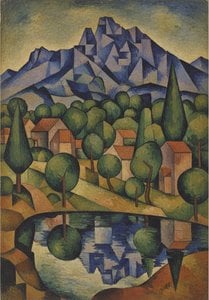
His paintings carry a specific weight, often using thick impasto and textures that suggest mosaic tiles. He developed what became known as a neo-Byzantine style, pulling from the tradition of religious icon painting to inform his modern subjects. This approach integrated stylized portraiture with geometric forms and patterns derived from Cubism and Constructivism.
The surfaces of his works often feature:
- Bright, heavy layers of oil on canvas or board.
- Geometric shapes that break up the human figure.
- A use of color that includes intense blue shadows and neon yellow highlights.
- Patterns reminiscent of Ukrainian folk art and mosaics.
In works like Woman and Girl from 1957, the application of color mimics the structured arrangement of a mosaic. His portraits often look beneath the skin, using speckled shades of flesh to explore the character of the sitter.
Later years and lasting marks
After living in the San Francisco-Bay Area for several years, Kmit returned to Australia in 1965. This return brought a period of change; his style shifted, and some critics met his new direction with caution. However, by the time he painted Cassandra in 1979, he had regained the energy found in his earlier decades. He remained active in the art community until his death in Sydney in 1981.
His influence reached through the Merioola Group and left a presence in several major collections, including:
- The National Gallery of Australia.
- The Art Gallery of New South Wales.
- The National Gallery of Victoria.
- The Art Gallery of Western Australia.
Vraag en antwoord
In welke stad en welk land is Michael Kmit geboren?
Michael Kmit werd geboren in Stryi, in Ukraine.
Waar kan ik de kunstwerken van Michael Kmit bekijken, gesorteerd op kleur?
Op de Sorteren op kleur-pagina zijn de kunstwerken van Michael Kmit gesorteerd op kleur.
Hoe populair zijn de kunstwerken van Michael Kmit?
Er is een Statistieken-pagina voor Michael Kmit, met statistieken over de kunstwerken van de kunstenaar op deze website.
Waar kan ik de kunstwerken van Michael Kmit in chronologische volgorde bekijken?
Er bestaat een tijdlijn van de werken van Michael Kmit: op de Chronologie kunstwerken pagina van de kunstenaar staan de kunstwerken in chronologische volgorde van creatie.