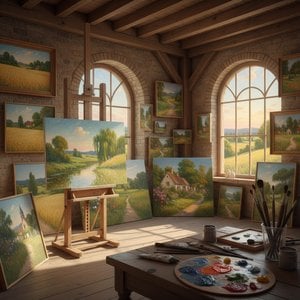
The Soul of the Granite City
To wander through the works of Eric Auld is to embark on a deeply personal pilgrimage through the heart of North-East Scotland. Born on January 3, 1931, in the coastal village of Boddam, Auld was a painter whose very essence was intertwined with the landscapes he immortalized. He did not merely observe the world; he felt the texture of its granite and the shifting light of its skies. Growing up within an intrinsically creative lineage, art was his native tongue. His father, Alexander, was a painter and decorator, while his mother, Margaret, was a prolific floral painter and portraitist. This domestic atmosphere, saturated with color and form, nurtured a talent that would eventually earn him the affectionate moniker "Mr. Aberdeen."
Auld’s artistic journey began in earnest at the Gray's School of Art in Aberdeen, from which he graduated in 1953. His early years were marked by a restless curiosity and a drive to master various mediums, a pursuit bolstered by receiving the prestigious Robert Brough Travelling Scholarship. This opportunity allowed him to traverse the great art centers of Europe—France, Spain, Italy, and Holland—absorbing the light of the Mediterranean and the atmospheric nuances of the Low Countries. These travels infused his work with a sophisticated understanding of composition and color that would later define his signature style, making his depictions of the Scottish landscape feel both intimately local and universally resonant.
A Legacy of Light and Landscape
The true magic of Auld’s oeuvre lies in his ability to find extraordinary beauty within the familiar. While many artists sought the dramatic peaks of the Highlands, Auld found his muse in the rugged, silver-grey charm of Aberdeen and its surrounding Shire. His paintings are evocative chronicles of a specific place and time, capturing everything from the historic architecture of Old Aberdeen to the rolling hills and windswept fields of the countryside. He possessed an uncanny ability to bring color to granite, transforming the heavy, stoic stone of his home city into something luminous and alive through his imaginative treatment of light.
In the 1960s, Auld became a central figure in a vibrant local art movement as part of the ABBO group. Alongside fellow artists Donald Buyers, Bill Baxter, and Bill Ord, he sought to promote a new wave of contemporary art in the region. This period was characterized by an experimental spirit, where abstract forms and bold textures began to emerge alongside his more traditional landscapes. His commercial success during these decades was immense; his works were highly sought after by diverse patrons, ranging from local businesses and oil companies to prestigious social clubs, ensuring that his vision of Aberdeen was woven into the very fabric of the city's civic identity.
Beyond his landscapes, Auld’s versatility extended to profound portraiture and historical commemorations. One of his most poignant achievements was a commission for the Gordon Highlanders regimental museum, where he captured the harrowing history of the regiment through a lens of personal connection, portraying his own father as a soldier in the trenches of the Great War. This ability to blend personal memory with historical narrative gave his work an emotional depth that resonated far beyond the borders of Scotland.
As we reflect on the life of Eric Auld, we see more than just a painter; we see a custodian of heritage. His contributions to the art world are marked by several enduring honors:
- Fellow of the Royal Society of Arts (FRSA), signifying his standing in the international artistic community.
- Burgess of the Guild of the City of Aberdeen, reflecting his deep-rooted connection to his home city.
- The Davidson Gold Medal, awarded during his formative years at Gray's School of Art.
- A lasting presence in both private and public collections across the globe, ensuring his "portrayal of Aberdeen" continues to inspire new generations.
Though he passed away on December 24, 2013, Auld’s vision remains undimmed. His sketches, spanning from his childhood in 1941 to his final years, serve as a testament to a lifetime of observation. Through his brush, the granite of Aberdeen remains forever bathed in a light that never fades.