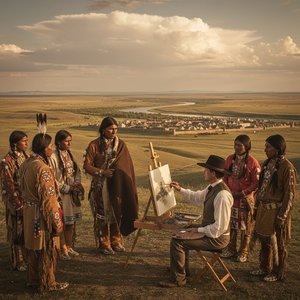
A Life Between Two Hemispheres
Benjamin Duterrau arrived in Van Diemen's Land in August 1832, a man of sixty-five years who had already seen the bustling streets of London and the rigorous training of an English apprenticeship. Born in Soho to Anglo-French parents, his early life was shaped by the precision of an engraver’s craft and the artistic shadows of masters like Thomas Gainsborough and William Hogarth. He did not seek a quiet retirement in the colonies; instead, he brought with him a drive to lecture on the civilizing influence of art at the Hobart Mechanics' Hall only months after his arrival.
His transition from the established art circles of England to the rugged landscape of Tasmania was marked by a singular purpose. While many migrants sought fortune through trade, Duterrau sought to document a world in flux. He settled in Hobart, establishing a studio where he could apply the meticulous observation learned in London to the faces and environments of a new territory. His work as a painter, etcher, and sculptor allowed him to capture the nuances of a society undergoing profound colonial shifts.
The Documentation of a Vanishing People
Duterrau’s most significant contribution lies in his sensitive treatment of the Indigenous Tasmanian population. Working alongside figures such as George Augustus Robinson, he found himself positioned at the intersection of colonial expansion and the survival of Aboriginal culture. He did not merely paint subjects; he recorded individuals with a level of dignity that was rare for the 1830s. His etchings and portraits of Aboriginal men and women provided a visual record of people whose lives were being irrevocably altered by settlement.
His technical approach often relied on a realistic style, prioritizing ethnographic accuracy. In works such as his depiction of "Timmy, a Tasmanian Aboriginal, throwing a spear," he utilized layered brushstrokes to build physical presence and texture. He possessed a particular skill for capturing the tension of a moment, such as the muscular focus of a hunter or the quiet strength in a sitter's expression. These portraits remain vital historical documents for those studying the Nuennone and other tribes of the region.
Historical Weight and Artistic Legacy
The scale of Duterrau’s ambition is perhaps best seen in his larger-scale historical compositions. His painting "The Conciliation" (1840) depicts a formal meeting between European colonists and Aboriginal chiefs, utilizing light and color to convey the gravity of the encounter. This work was intended as a study for an even more expansive project titled "A National Picture," an epic canvas that remains lost to history. Despite the disappearance of his largest intended works, his presence in the Tasmanian colonial narrative is firmly established through his surviving sketches and etchings.
Duterrau’s life ended in Hobart in 1851, leaving behind a body of work that functions as both art and archive. His legacy is found in the collections of the Tasmanian Museum and Art Gallery, where his depictions of the landscape and its original inhabitants continue to provide insight into the nineteenth century. He remains a figure who used the tools of an engraver and painter to illuminate the human dimension of Australian colonization.