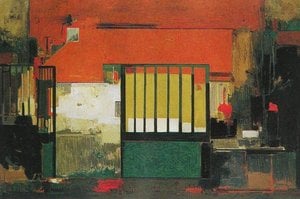
Alecos Kontopoulos: A Pioneer of Greek Abstract Expressionism
Alecos Kontopoulos (1904-1975) stands as a monumental figure in the evolution of Greek art, a bridge between traditional aesthetics and the radical experimentation of modern abstraction. Born in Lamia, Greece, his artistic journey was marked by a profound engagement with social realities, philosophical inquiry, and an unwavering pursuit of visual language that transcended representational forms. Kontopoulos’s career wasn't simply about stylistic shifts; it represented a fundamental reimagining of how art could engage with the complexities of the 20th century, solidifying his place as one of Greece’s most influential artists.
Early Influences and Artistic Training
Kontopoulos’s early artistic development was shaped by a confluence of influences. Initially apprenticed to the icon painter George Sarafianos, he gained a foundational understanding of Byzantine techniques and religious iconography – a discipline that instilled in him a meticulous attention to detail and a deep appreciation for color and texture. This traditional training provided a crucial counterpoint to the later explorations of abstraction. He then enrolled at the School of Fine Arts in Athens, where he studied under prominent figures like Georgios Iakovidis, Dimitrios Geraniotis, Pavlos Mathiopoulos, and Nikolaos Ransom. Crucially, his time in Paris from 1930 to 1932 proved transformative. Studying under P. Le Doux and H. Morisset exposed him to the burgeoning avant-garde movements of Europe – Cubism, Futurism, and early Abstraction – broadening his artistic horizons significantly. This period wasn't merely about absorbing new styles; it was a process of critical engagement, leading him to question established conventions and seek alternative modes of expression.
The Transition to Abstract Art: A Response to Social and Political Turmoil
Kontopoulos’s shift towards abstraction around 1947 wasn't a stylistic choice made in isolation; it was deeply intertwined with the turbulent political landscape of post-war Greece. Witnessing the hardships, social injustices, and the oppressive atmosphere of the occupation, he felt compelled to move beyond representational art as a means of conveying deeper truths. His abstract works became vehicles for expressing internal emotions, philosophical concepts, and critiques of societal norms. He began utilizing simplified geometric forms, bold colors, and often, a deliberate lack of tonal gradation – rejecting traditional notions of perspective and realism in favor of pure visual impact. This period saw the emergence of his most iconic pieces, characterized by their raw emotional intensity and symbolic weight. The influence of figures like Kandinsky and Malevich is evident, but Kontopoulos forged a distinctly Greek voice within this broader abstract vocabulary.
Key Themes and Artistic Techniques
Kontopoulos’s oeuvre is rich in symbolism and intellectual depth. Recurring themes include the human condition, social responsibility, spirituality, and the relationship between art and life. His works frequently explore concepts of faith, doubt, and the search for meaning in a world grappling with uncertainty. Technically, Kontopoulos was a master of color theory, employing vibrant hues to evoke specific emotions and create dynamic visual relationships. He often utilized layering techniques, building up complex compositions through multiple applications of paint, creating surfaces that shimmered with texture and depth. His later works are particularly notable for their use of “force,” a term he himself coined, referring to the inherent energy and dynamism within his paintings – an attempt to capture not just visual form but also the underlying currents of existence.
Legacy and Recognition
Alecos Kontopoulos’s impact on Greek art is undeniable. He played a pivotal role in introducing abstract expressionism to Greece, challenging established artistic conventions and paving the way for subsequent generations of artists. His work was exhibited internationally at prestigious venues such as the Biennales of São Paulo (1953, 1955, 1957), Alexandria (1959), and Venice (1960). He received numerous accolades, including the Guggenheim Prize in 1950 (which he famously declined as a protest against the Greek dictatorship) and the First State Prize in 1973. After his death in 1975, Kontopoulos’s legacy was preserved through the establishment of the Alekos Kontopoulos Library in Agia Paraskevi – a testament to his intellectual curiosity and commitment to artistic education – and the Alekos Kontopoulos Gallery in Lamia, which continues to showcase his work. Today, his paintings are held in prominent collections throughout Greece and internationally, ensuring that this visionary artist’s profound contribution to modern art endures.
Door de redactie van WahooArt.com
Test je oog
Er is slechts één goed antwoord op elke vraag.
Vraag 1:
Alecos Kontopoulos was primarily known for his contributions to which art movement?
Vraag 2:
In what year did Alecos Kontopoulos pass away?
Vraag 3:
Before his focus on abstract art, Kontopoulos initially trained under which type of artist?
Vraag 4:
During World War II, Alecos Kontopoulos actively participated in:
Vraag 5:
Which of the following best describes a key theme explored in Kontopoulos's later abstract works?
Ontdek de diepte van Abstract Expressionisme! Leer over iconische kunstenaars als Pollock & Rothko en de filosofische basis van deze invloedrijke beweging. Expertise, kwaliteit & inspiratie op WahooArt.
Welke kunstwerken van Alecos Kontopoulos worden het meest bekeken?
Statistieken over de werken van Alecos Kontopoulos zijn te vinden op de Statistieken-pagina van de kunstenaar.
Waar kan ik de kunstwerken van Alecos Kontopoulos in chronologische volgorde bekijken?
Er bestaat een tijdlijn van de werken van Alecos Kontopoulos: op de Chronologie kunstwerken pagina van de kunstenaar staan de kunstwerken in chronologische volgorde van creatie.
Waar kan ik de kunstwerken van Alecos Kontopoulos bekijken, gesorteerd op sfeer?
De werken van Alecos Kontopoulos kunnen per stemming worden bekeken op de Sfeercollectie pagina van de kunstenaar, waar de kunstwerken zijn gerangschikt op basis van hun vastgelegde stemmingen.
Hoeveel kunstwerken van Alecos Kontopoulos zijn beschikbaar om te bekijken?
U kunt 16 kunstwerken werken van Alecos Kontopoulos bekijken op de Alle kunstwerken-pagina.
Kan ik de werken van Alecos Kontopoulos bekijken per medium?
De pagina Alle technieken groepeert de kunstwerken van Alecos Kontopoulos op techniek.
Hoe kan ik alle kunstwerken van Alecos Kontopoulos bekijken?
Alle werken van Alecos Kontopoulos op deze website zijn te bekijken op de Alle kunstwerken pagina van de kunstenaar.
Waar kan ik de kunstwerken van Alecos Kontopoulos bekijken, gesorteerd op kleur?
Op de Sorteren op kleur-pagina zijn de kunstwerken van Alecos Kontopoulos gesorteerd op kleur.
Is er een overzicht van alle onderwerpen die Alecos Kontopoulos heeft geschilderd?
De Onderwerpsindex-pagina brengt de kunstwerken van Alecos Kontopoulos in kaart op basis van onderwerp.
Wat is het best beoordeelde schilderij van Alecos Kontopoulos op ArtsDot.com?
Hoi! Ik kan je helpen bij het kiezen van een kunstwerk, het volgen van een bestelling of het beantwoorden van vragen over de garantie. Waarmee kan ik je van dienst zijn?