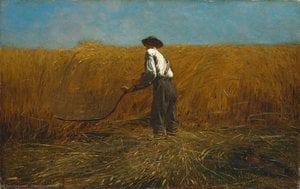
A Moment of Reflection in the Maine Woods: Winslow Homer’s “Woodsman and Fallen Tree”
Winslow Homer's "Woodsman and Fallen Tree," painted in 1891, isn’t merely a depiction of a man and a felled tree; it’s a profound meditation on labor, nature, and the quiet dignity of human existence. Currently residing within the hallowed halls of the Museum of Fine Arts in Boston, this watercolor masterpiece invites us into a serene yet subtly melancholic scene that speaks volumes about the American experience. Homer, a master of capturing the essence of everyday life, eschewed the grand narratives favored by many of his contemporaries, instead choosing to focus on the realities of rural New England – a decision that profoundly shaped his artistic vision and cemented his place as one of America’s most beloved painters.
The painting immediately establishes a sense of stillness. The woodsman, rendered with remarkable detail in Homer's signature watercolor technique, stands not actively engaged in work, but rather contemplating the immense tree he has just brought down. His posture is relaxed, almost meditative; his gaze directed towards the horizon, suggesting a quiet acceptance of his task and perhaps a reflection on its consequences. The fallen tree itself dominates the composition, a monumental presence that anchors the scene and symbolizes both the power of nature and the human effort to subdue it. The careful layering of washes creates an atmospheric depth, capturing the dappled light filtering through the trees – a testament to Homer’s mastery of color and texture.
Technique and Materials: The Language of Watercolor
Homer's choice of watercolor is crucial to understanding the painting’s emotional resonance. Unlike oil paints, which offer immediate brilliance and bold contrasts, watercolor allows for a gradual build-up of tones and colors, mimicking the subtle shifts in light and shadow found in nature. This technique lends the scene an ethereal quality, blurring the boundaries between reality and memory. The artist employs a loose, expressive brushstroke, avoiding overly defined lines – a deliberate choice that contributes to the painting’s sense of immediacy and vulnerability. Notice how he uses washes of green and brown to evoke the dense undergrowth, punctuated by the stark white of the fallen tree and the man's clothing. This delicate balance creates a captivating visual harmony.
The inclusion of the dog, positioned on the right side of the composition, adds an unexpected layer of warmth and companionship. It’s a small detail that subtly humanizes the scene, suggesting a connection between the woodsman and his animal companion – perhaps a shared understanding of the rhythms of rural life. The backpack resting at the base of the tree hints at the arduous nature of the work, grounding the image in the practical realities of survival.
Symbolism and Context: An American Narrative
"Woodsman and Fallen Tree" is more than just a landscape painting; it’s a poignant commentary on the relationship between humanity and the natural world. Homer, deeply rooted in his New England upbringing, possessed an intimate knowledge of the region's forests and its inhabitants. The woodsman represents not only a skilled laborer but also a symbol of resilience and self-sufficiency – qualities highly valued in 19th-century America. The fallen tree can be interpreted as a metaphor for the challenges and hardships faced by those who depend on the land for their livelihood, while the man’s contemplative stance suggests an acceptance of fate and a quiet dignity in the face of adversity.
Painted in the twilight years of his career, this work reflects Homer's growing interest in capturing the fleeting moments of everyday life. It aligns with his broader exploration of American themes – labor, family, and the beauty of the natural world – all rendered with a distinctive blend of realism and emotional depth. The painting’s enduring appeal lies in its ability to evoke a sense of nostalgia for a simpler time, while simultaneously prompting us to consider our own relationship with the environment and the legacy we leave behind.
Bringing “Woodsman and Fallen Tree” Home: Reproductions and Legacy
WahooArt.com offers meticulously crafted, hand-painted reproductions that faithfully capture the essence of Homer’s original watercolor. These high-quality reproductions allow art enthusiasts to experience the beauty and emotional depth of this iconic work in their own homes or offices. Whether you're a seasoned collector or simply seeking a stunning piece of American art, a reproduction of “Woodsman and Fallen Tree” is sure to become a cherished addition to your collection. Explore our selection at https://WahooArt.com to discover the perfect way to bring this timeless masterpiece into your life.



 Voorvertoning
 Bestel print
 Verstuur
 Delen
Delen
 Details bekijken

 Download
 Vergelijkbare items
 Röntgenonderzoek
 Diavoorstelling


 Lees meer






































 De optie voor glas is alleen beschikbaar bij een formaat kleiner dan 110 cm.