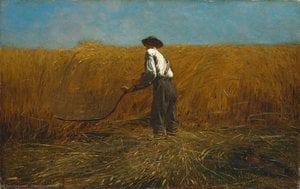
Winslow Homer’s “On the Beach, Marshfield”: A Moment of Quietude in American Realism
Winslow Homer's "On the Beach, Marshfield," painted in 1872, isn’t merely a depiction of a seaside scene; it’s a carefully constructed tableau of everyday life imbued with a profound sense of tranquility and observation. This oil on canvas masterpiece, housed within the collections of institutions like the Williams College Museum of Art, offers a rare glimpse into Homer's distinctive approach to capturing the American spirit – not through grand narratives or dramatic events, but through the subtle details of ordinary moments. The painting immediately draws the viewer in with its muted palette and the relaxed postures of the figures, inviting us to share their quiet contemplation by the water’s edge.
Homer's genius lies in his ability to render the commonplace extraordinary. He eschewed the romanticized depictions often associated with landscape painting, instead presenting a realistic portrayal of people enjoying a simple pleasure: a day at the beach. The three figures – a man standing near the left, another closer to the center, and a third on the right – are not posed dramatically; they’re engaged in quiet activities: walking, observing, perhaps lost in thought. An umbrella provides shade for those seeking respite from the sun, adding a touch of domesticity to this otherwise natural setting. The composition is remarkably balanced, creating a sense of harmony and stability that contrasts subtly with the restless energy of the ocean behind them.
Technique and Artistic Choices
The painting’s power resides not only in its subject matter but also in Homer's masterful technique. He employed oil on canvas to achieve a remarkable level of detail and luminosity, capturing the play of light and shadow with exceptional precision. Notice how he renders the texture of the sand, the sheen of the water, and the folds of the clothing – each element meticulously observed and faithfully reproduced. The use of color is particularly noteworthy; Homer favors a restrained palette of blues, greens, browns, and grays, creating a sense of atmospheric depth and reinforcing the painting’s overall mood of serenity. The brushstrokes are visible yet controlled, contributing to the painting's tactile quality.
Furthermore, Homer’s background is deliberately blurred, suggesting an infinite expanse of ocean – a common technique used by the artist to create a sense of space and distance. This deliberate choice directs the viewer’s attention to the foreground figures, emphasizing their connection to the natural world. The painting's scale also contributes to its impact; it’s a relatively small work, which lends it an intimate quality, as if we are privy to a private moment.
Historical Context and Homer’s Vision
"On the Beach, Marshfield" was created during a pivotal period in American art history. Following the Civil War, artists like Homer sought to document the realities of everyday life, moving away from the idealized subjects favored by earlier generations. Homer's work reflects this shift towards realism and social observation, while simultaneously retaining a distinctly American sensibility. He wasn’t interested in imposing his own interpretation on the scene; instead, he presented it as he saw it – with honesty, clarity, and a deep appreciation for the beauty of the natural world.
It's interesting to compare this painting to other works by Homer, such as "Waiting for an Answer" or “At the Window,” where he similarly captures fleeting moments of human interaction. The consistent thread running through his oeuvre is a fascination with ordinary people and their experiences, rendered without sentimentality or judgment. The influence of J.H. Bufford, Homer’s early apprenticeship in commercial lithography, can be seen in the painting's sharp lines and meticulous detail – skills honed during years spent illustrating for Harper’s Weekly.
Symbolism and Emotional Resonance
While seemingly simple, “On the Beach, Marshfield” is rich in symbolic meaning. The beach itself represents a space of escape and renewal, a place where people can reconnect with nature and find solace from the stresses of daily life. The figures’ relaxed postures suggest a sense of contentment and well-being – a rare commodity in an era marked by rapid industrialization and social upheaval. The painting evokes a feeling of nostalgia for a simpler time, a longing for connection to the natural world, and a quiet appreciation for the beauty of everyday moments. It's a testament to Homer’s ability to capture not just a scene, but also the very essence of human experience.
WahooArt offers exquisite hand-painted reproductions of Winslow Homer’s “On the Beach, Marshfield,” allowing you to bring this timeless masterpiece into your home or office. Explore our collection and discover the perfect way to celebrate the enduring legacy of one of America's greatest artists. Visit WahooArt.com for more information.



 Voorvertoning
 Schakel over naar print
 Verstuur
 Delen
Delen
 Details bekijken

 Download
 Vergelijkbare items
 Röntgenonderzoek
 Diavoorstelling
 Statistieken

 Lees meer






































 De optie voor glas is alleen beschikbaar bij een formaat kleiner dan 110 cm.