De Roos van William Morris: Een Bloem van de Victoriaanse Romantiek
William Morris’s “Rose” is more than just a textile; it's a window into the soul of an era, a testament to the Arts and Crafts movement’s profound reverence for nature and its deliberate rejection of mass-produced uniformity. This exquisite piece, created between 1862 and 1863, embodies Morris’s deeply held belief that art should be rooted in the organic world—a conviction born from his lifelong connection with the English countryside and a fascination with medieval romances. The design isn't merely decorative; it’s a carefully considered visual manifesto, a declaration of the moral superiority of natural forms over the cold precision of industrial creation.
At its heart lies a meticulous study of botanical detail. Morris and his team at Merton Abbey Studios employed a technique called *kataegis*, painstakingly recreating the intricate beauty of rose petals through multiple layers of dyed fabric. Each individual floret was printed in distinct colors, capturing not just the outward appearance but also the subtle variations in hue that define a real flower. This dedication to accuracy speaks volumes about Morris’s artistic philosophy – he wasn't interested in simply imitating nature; he sought to convey its very essence, its inherent vitality and beauty. The restrained color palette—muted pinks, yellows, and creams—evokes a sense of tranquility and understated elegance, perfectly aligning with the movement’s desire for a return to simpler, more harmonious aesthetics.
De Kunst van de Hand: Techniek en Craftsmanship
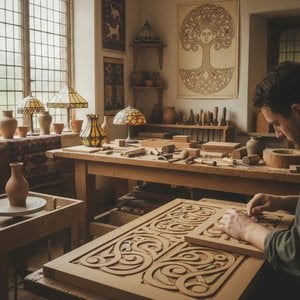
The creation of “Rose” is a powerful demonstration of the Arts and Crafts movement's core principles. The deliberate rejection of mechanized production is immediately apparent in the hand-printing techniques employed. Each color was applied by hand, ensuring an unparalleled level of control and artistic expression. This painstaking process resulted in a textile of exceptional quality—a tactile experience that speaks to the skill and dedication of its makers. It’s a far cry from the mass-produced goods dominating Victorian society, representing instead a commitment to artisanal craftsmanship and the celebration of human artistry.
Beyond the technical aspects, “Rose” is infused with symbolism. The rose itself has long been associated with love, beauty, and spirituality—themes central to Victorian romanticism. Morris’s choice of this emblem reflects his broader worldview: a belief in the restorative power of nature and its ability to inspire both aesthetic and moral contemplation. The incorporation of a bird within the design further enhances this symbolism, suggesting harmony between humanity and the natural world.
Een Historische Context: Morris en de Romantiek
William Morris’s life was inextricably linked to the artistic and intellectual currents of his time. Born in Walthamstow in 1834, he benefited from a privileged upbringing that allowed him to cultivate his passions for nature and art. Initially drawn to a clerical career at Oxford University, he soon realized that his true calling lay elsewhere—in creating beautiful objects that celebrated the natural world. Morris’s work was deeply influenced by the Gothic Revival movement, which sought to recapture the spirit of medieval craftsmanship and artistry. However, unlike the purely decorative aspects of earlier Gothic styles, Morris's designs were infused with a profound moral sensibility, reflecting his belief in the inherent goodness of nature and its capacity to uplift the human spirit.
To delve deeper into the world of William Morris and explore related works, we recommend visiting the William Morris Gallery in Walthamstow – a museum dedicated to preserving his legacy. Alternatively, you can discover other examples of his artistry through online resources like the WahooArt website (link) and explore further artistic inspirations such as “Fruit and a White Rose” by William James Glackens ( link).
Een Perfecte Reproduktie: Voor Uw Interieur
WahooArt offers meticulously crafted, hand-painted reproductions of William Morris’s “Rose,” allowing you to bring this iconic textile into your own home. Our skilled artists faithfully recreate the intricate details and rich colors of the original, ensuring that your reproduction captures the essence of this timeless masterpiece. Whether you're an art collector, a design enthusiast, or simply someone who appreciates exquisite beauty, a WahooArt reproduction of “Rose” is a stunning addition to any space – a tangible reminder of the Arts and Crafts movement’s enduring legacy.
Vragen & Antwoorden
Wie heeft "Roos" gemaakt?
"Roos" is gemaakt door William Morris. De informatie op deze pagina beschrijft het originele werk van William Morris.
Welk gevoel roepen de kleuren van "Roos" door William Morris op?
In "Roos" begeleiden Aardse tinten kleuren een Kalmte gevoel.
Is "Roos" in zijn geheel eerder licht of donker?
De vastgestelde waarden voor "Roos" door William Morris zijn: helder helderheid, Zachte luminantie luminantie.
Welke afdrukinstellingen worden aanbevolen voor "Roos" door William Morris?
Voor een afdruk van "Roos" door William Morris wordt een formaat van Medium aanbevolen in Staand formaat oriëntatie.
Waar komen de bezoekers van "Roos" door William Morris vandaan?
Statistieken over "Roos" door William Morris zijn te vinden op de Statistieken-pagina van het kunstwerk: maandelijkse weergaven van het kunstwerk, weergaven van de werken van de kunstenaar, en een uitsplitsing naar land en taal van recente bezoekers.
Welke stemming straalt "Roos" door William Morris uit binnen Arts and Crafts?
"Roos" draagt een Kalmte emotionele toon in zich binnen de Arts and Crafts-stroming."
Hoe komen medium en beweging samen in "Roos"?
"Roos" is vervaardigd in Textiel, in de Arts and Crafts-stijl.
Voor welke kamer wordt "Roos" door William Morris aanbevolen?
"Roos" door William Morris wordt aanbevolen voor een Woonkamer. Deze suggestie is gebaseerd op het onderwerp, de kleuren en de sfeer van het werk.



 Schakel over naar print
 Verstuur
 Delen
Delen
 Details bekijken
 Gids voor studentenkunstwerken

 Download
 Vergelijkbare items
 Diavoorstelling
 Statistieken


 Lees meer






































 De optie voor glas is alleen beschikbaar bij een formaat kleiner dan 110 cm.