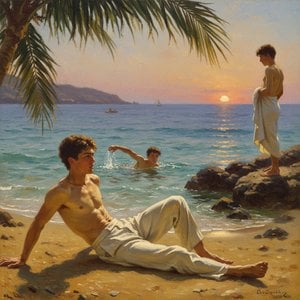
A Pioneer of the British Nude: The Life and Art of William Etty
William Etty, a name perhaps less instantly recognizable than his contemporaries like Turner or Constable, nevertheless occupies a pivotal position in 19th-century British art. Born in York on March 10, 1787, above his father’s bakery, Etty's journey from humble beginnings to Royal Academician was one marked by relentless dedication, artistic innovation, and no small measure of controversy. His early life offered little indication of the path he would forge. Apprenticed at age twelve to a printer in Hull, seven years were spent immersed in the practicalities of typography – a world far removed from the canvases that would eventually bear his signature. Yet, even amidst the mechanical demands of printmaking, Etty nurtured a burgeoning passion for drawing, an impulse that ultimately propelled him towards London and the hallowed halls of the Royal Academy Schools in 1807. There, under the tutelage of Thomas Lawrence, he honed his skills through diligent copying, laying the foundation for a career defined by masterful depictions of the human form.
The Rise to Prominence: Nudes and Controversy
Etty’s breakthrough arrived in 1821 with *Cleopatra's Arrival in Cilicia*, a painting that immediately ignited both admiration and scandal. The work, teeming with nude figures – women bathing, gossiping, and preparing for the arrival of Cleopatra – was exhibited to widespread acclaim, yet simultaneously earned him a reputation for indecency. This duality would become a defining characteristic of his career. He wasn’t merely depicting nudity; he was exploring the human form with an unprecedented realism and anatomical precision for a British artist of that era. His commitment to accurately rendering flesh tones, light, and shadow – influenced by his study of Venetian masters like Titian and Rubens during travels in Italy and France – set him apart. He meticulously observed the subtle nuances of skin, capturing the play of light on muscle and bone with remarkable detail. He continued to produce historical scenes populated with nudes, often drawn from classical mythology or literature, such as *The Sirens and Ulysses*. These works were not simply erotic displays; they were carefully constructed narratives imbued with psychological depth and dramatic intensity. They showcased a profound understanding of human emotion and the power of gesture. Despite the constant criticism – fueled by Victorian prudishness – he remained steadfast in his artistic vision, producing some of the most compelling and influential nude paintings of the era.
Beyond the Nude: Portraits and Still Life
While Etty is most celebrated for his nudes, his artistic range extended beyond this controversial domain. Recognizing the need to broaden his appeal – and perhaps secure a more stable income – he ventured into portraiture during the 1830s. His portraits were characterized by their psychological insight and subtle characterizations. He didn’t simply reproduce likenesses; he sought to capture the essence of his subjects, revealing their inner lives through carefully observed expressions and gestures. Furthermore, Etty became one of the first English painters to seriously engage with still life, demonstrating a keen eye for detail and a sensitivity to texture that rivaled the Dutch masters he admired. He meticulously rendered objects – fruit, flowers, drapery – capturing their materiality with remarkable precision. This diversification reveals a pragmatic side to Etty’s artistic practice, a willingness to adapt to market demands while remaining true to his core aesthetic principles. He continued, however, to return to the nude form throughout his life, driven by an unwavering fascination with its beauty and expressive potential.
Influences and Techniques
Etty's artistic development was shaped by a diverse range of influences. His early apprenticeship as a printer instilled in him a deep appreciation for craftsmanship and attention to detail – qualities he brought to his painting. The meticulous observation of classical sculpture at the Royal Academy Schools provided a foundation in anatomy and form. His travels through Italy and France exposed him to the works of Venetian masters like Titian and Rubens, whose use of color, light, and shadow profoundly influenced his technique. He was particularly drawn to the dramatic lighting effects employed by these artists, which he sought to emulate in his own paintings. Etty’s brushwork was characterized by its fluidity and responsiveness – a direct result of his extensive practice with charcoal and pen. He favored loose, expressive strokes that captured the movement and texture of the human form. He also demonstrated a remarkable ability to create atmospheric effects through subtle variations in color and tone.
Legacy and Rediscovery
William Etty died in York on November 13, 1849, leaving behind a substantial body of work that initially enjoyed considerable popularity. However, tastes shifted in the decades following his death, and his paintings fell into relative obscurity. By the late 19th century, his once-celebrated works were largely forgotten, dismissed as outdated or simply too shocking for Victorian sensibilities. A remarkable rediscovery began in the early 21st century. His inclusion in Tate Britain’s landmark *Exposed: The Victorian Nude* exhibition (2001–2002) sparked renewed interest in his art, prompting critical reevaluation and a reassessment of his place in British art history. The restoration of *The Sirens and Ulysses* in 2010 further cemented this revival, revealing the brilliance of his technique and the enduring power of his vision. Today, William Etty is recognized as a pioneering figure who challenged artistic conventions, celebrated the human form with unparalleled realism, and left an indelible mark on the landscape of British art. His works stand as testaments to his skill, dedication, and unwavering commitment to capturing the beauty and complexity of the human experience.
Key Works
- Cleopatra's Arrival in Cilicia (1821): The painting that launched Etty’s career and established his reputation for depicting nudes.
- The Sirens and Ulysses (1837): A dramatic depiction of Homer’s epic, showcasing Etty’s mastery of composition and anatomy.
- Reverend William Jay (c. 1836-40): An example of his portraiture work, demonstrating a keen eye for character.
- Standing Female Nude (date unknown): A study showcasing Etty’s exceptional skill in rendering realistic flesh tones and form.



 Bekijk op ware grootte
 Koop handgeschilderd kunstwerk
 Verstuur
 Delen
Delen
 Details bekijken
 Gids
Gids

 Download
 Vergelijkbare items
 Röntgenonderzoek
 Diavoorstelling
 Statistieken


 Lees meer






































 De optie voor glas is alleen beschikbaar bij een formaat kleiner dan 110 cm.