Voorvertoning Bekijk in AR Schakel over naar print Bestel handgeschilderde reproductie Verstuur
Details bekijken Toevoegen aan favorieten Download Vergelijkbare items Röntgenonderzoek Diavoorstelling Statistieken

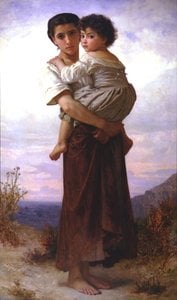
The Little Shepherdess

‘Shepherdess,’ created in 1889 by William-Adolphe Bouguereau, exemplifies Academicism style with Naturalism influences. This portrait depicts a serene woman holding a stick amidst a pastoral landscape featuring horses and birds—a testament to Bouguereau’s dedication to idealized realism.

Ontdek William-Adolphe Bouguereau (1825-1905), een meester van academische realisme! Bewonder zijn prachtige werken met mythologische en genretaferelen, en de ideale weergave van schoonheid.

Koop een digitale afbeelding in hoge resolutie met verbeterde kwaliteit, die veel superieur is aan de online voorvertoning.

Elk bestand wordt met uiterste precisie voorbereid door onze interne specialisten, met behulp van geavanceerde tools en deskundige handmatige retouche. Wij garanderen dat elke afbeelding een uitzonderlijke helderheid, nauwkeurige kleurweergave en verfijnde details bezit.

Het uiteindelijke bestand wordt binnen 72 uur per e-mail geleverd, geoptimaliseerd voor direct gebruik in professionele, redactionele en printomgevingen. Dit is dezelfde kwaliteit waarop vooraanstaande designstudio's, uitgevers en galerieën vertrouwen.

Digitale afbeeldingen

Download een bestand met hoge resolutie voor persoonlijke weergave, afdrukken en creatieve projecten. ( Schakel over naar print Bestel handgeschilderde reproductie)

Totaalprijs

$ 24,90

Inbegrepen bij elke bestelling van een digitale afbeelding

Professionele digitale levering, gegarandeerd

Wanneer u kiest voor WahooArt.com, ontvangt u niet alleen een afbeelding – u krijgt een professioneel verbeterd digitaal kunstwerk, met precisie vervaardigd en voorzien van een tevredenheidsgarantie. Dit is alles wat automatisch bij uw bestelling is inbegrepen:

shipping_icon
Snelle levering per e-mail

Uw hoogwaardige digitale afbeeldingsbestand wordt binnen 72 uur na bestelling naar u gemaild – klaar voor direct gebruik.

canvas_icon
AI-verbeterd digitaal bestand

Uw kunstwerk wordt professioneel geoptimaliseerd met behulp van geavanceerde AI-tools en handmatige bewerkingen, waardoor maximale details, helderheid en kleurnauwkeurigheid worden gegarandeerd.

insurance_icon
Gratis levenslange herlevering van digitale afbeeldingen

Je bestand per ongeluk verwijderd of kwijtgeraakt? Geen zorgen – we sturen het u op elk gewenst moment gratis opnieuw toe.

tax_icon
Geen invoerkosten – nooit

Geniet direct van uw kunstwerk zonder invoerrechten, belastingen of verzendkosten – digitale downloads zijn altijd belastingvrij.

color_icon
Garantie op kleurgetrouwheid

Met behulp van professionele hulpmiddelen en kleurbeheer zorgen wij ervoor dat uw digitale afbeelding de originele kleuren zo nauwkeurig mogelijk weergeeft.

return_icon
100 dagen tevredenheidsgarantie

Als u niet tevreden bent met uw digitale afbeelding, passen wij deze aan of storten wij 100% terug binnen 100 dagen - zonder vragen te stellen.

guarantee_icon
100% Geld-terug-garantie

Niet tevreden? Ontvang een volledige terugbetaling binnen 100 dagen na ontvangst van uw digitale bestand - zonder vragen te stellen.

discount_icon
Korting bij grote bestellingen

Koop 3 afbeeldingen, bespaar 10% - Koop 5, bespaar 15% - Koop 10+, bespaar 20%. Ideaal voor creatieve projecten, galerieën en bureaus.

Snelle feiten

  • Medium: Oil on Canvas
  • Notable elements or techniques: Detailed realism; luminous color palette
  • Title: The Little Shepherdess
  • Artist: William-Adolphe Bouguereau
  • Influences:
    • Raphael
    • Titian
  • Subject or theme: Rural pastoral scene
  • Artistic style: Idealized beauty

Kunstquiz

Er is slechts één goed antwoord op elke vraag.

Vraag 1:
What artistic style is William-Adolphe Bouguereau’s ‘The Little Shepherdess’ primarily characterized by?
Vraag 2:
According to the description, what prominent element contributes to the impression of serenity in the painting?
Vraag 3:
The image depicts a woman holding a stick. What does this gesture suggest about her character?
Vraag 4:
What artistic influences did Bouguereau draw upon during his training at the École des Beaux-Arts?
Vraag 5:
What is one notable feature of Bouguereau’s technique that contributes to the painting's luminous quality?

A Vision of Pastoral Serenity

In the luminous realm of William-Adolphe Bouguereau’s "The Little Shepherdess," completed in 1889, viewers are transported into a meticulously crafted world where innocence and pastoral beauty converge. This quintessential masterpiece of Academic Impressionism serves as more than a mere depiction of rural life; it is an invitation to witness a moment of profound tranquility. The painting portrays a young woman, her presence radiating a sense of purity and grace, seated amidst a verdant meadow. Beside her, the subtle presence of a shepherd boy gazing with quiet adoration adds a layer of tender narrative, suggesting the romanticized societal ideals of the Belle Époque. As the eye wanders through the composition, the inclusion of horses and the soft rustle of trees in the background reinforce a theme of timeless tradition and the harmonious coexistence of humanity and nature.

The technical brilliance of Bouguereau is nowhere more evident than in his masterful use of the glazing technique. By layering thin, translucent washes of color over a precise underpainting, the artist achieved a breathtakingly luminous quality that seems to emanate from within the canvas itself. Every texture—from the soft, tactile wool of the shepherdess's attire to the delicate, sun-drenched blades of grass—is rendered with an unparalleled realism that borders on the divine. His brushstrokes are nearly invisible, serving only to create a soft, diffused glow that bathes the figures in warmth. This meticulous attention to detail ensures that the skin tones possess a lifelike vitality, making the subject feel present and breathing, a hallmark of his commitment to the classical ideals of beauty.

Historical Resonance and Symbolic Depth

To understand "The Little Shepherdess" is to understand the cultural heartbeat of late 19th-century France. Created during an era fascinated by mythological narratives and the idealized representation of womanhood, the work draws deep inspiration from the Old Masters. Bouguereau’s reverence for Raphael is palpable, particularly in how he translates the spiritual weight of Renaissance frescoes into a modern, pastoral setting. The painting embodies the Victorian obsession with moral virtue and domestic tranquility, presenting an idyllic version of the countryside that offered a soothing escape from the rapid industrialization of the age. It is a window into a lost era of perceived simplicity and grace.

Beyond its visual splendor, the artwork carries a profound emotional weight that continues to captivate collectors and decorators alike. The symbolism of the shepherdess—often representing innocence and the untainted soul—resonates deeply within the domestic space. For the interior designer, this piece offers a sense of calm and sophisticated nostalgia, making it an ideal focal point for rooms intended to evoke peace and reflection. Whether viewed as a study in classical technique or an emotional journey into a sunlit meadow, "The Little Shepherdess" remains a timeless testament to the enduring power of beauty, offering a soulful connection to the heights of academic artistry.


Kunstenaarsbiografie

A Life Immersed in Beauty: The World of William-Adolphe Bouguereau

Born in 1825, amidst the vineyards and olive groves of La Rochelle, France, William-Adolphe Bouguereau’s life was destined to be a celebration of classical ideals and breathtaking realism. From an early age, his artistic inclinations were nurtured, leading him to Paris and the prestigious École des Beaux-Arts. There, under the guidance of François-Edouard Picquenot, he honed his skills, absorbing the lessons of the Old Masters – Raphael and Titian foremost among them. These influences weren’t mere imitation; they became the bedrock upon which Bouguereau built a unique artistic vision, one characterized by meticulous detail, luminous color palettes, and an unwavering commitment to portraying beauty in its most idealized form. He wasn't simply painting what he *saw*, but rather what he believed to be inherently beautiful, striving for a perfection that resonated with the aesthetic sensibilities of his time.

The Architect of Academic Perfection

Bouguereau’s artistic style is often described as academic realism, and rightly so. He possessed an unparalleled mastery of anatomy, light, and composition. His canvases are populated by figures rendered with astonishing precision – the delicate curve of a shoulder, the subtle flush of skin, the expressive depth of an eye. But his work transcends mere technical skill; it’s infused with emotion and narrative power. He frequently depicted mythological scenes, transforming ancient tales into vibrant, emotionally resonant moments. *The Birth of Venus*, for example, isn't just a depiction of a goddess emerging from the sea; it’s a celebration of feminine grace and ethereal beauty. Similarly, works like *Zenobia Found by Shepherds on the Banks of the Araxes* capture vulnerability and pathos with remarkable sensitivity. Beyond mythology, Bouguereau found inspiration in everyday life – shepherdesses tending their flocks, young girls at play, mothers cradling their children. These genre scenes, while seemingly simple, are imbued with a sense of dignity and tenderness that elevates them to the realm of art. *Faneuse (1869)* exemplifies this approach, portraying a young woman in a tranquil landscape with an exquisite attention to detail and atmosphere. His dedication to capturing innocence is particularly evident in paintings like *Child at Bath*, where the delicate rendering of skin and light creates a truly captivating image.

Influences and Artistic Development

Bouguereau’s artistic journey was profoundly shaped by his early exposure to the works of Raphael and Titian, whose mastery of composition, color, and idealized beauty served as enduring models. He also drew inspiration from the Neoclassical painters, particularly Ingres, appreciating their emphasis on anatomical accuracy and classical themes. However, Bouguereau’s style evolved beyond mere imitation; he developed a distinctive approach characterized by a heightened sense of lyricism and emotional intensity. He was deeply influenced by the Pre-Raphaelite Brotherhood, adopting their interest in medieval legends and romantic subjects, though he tempered their darker tones with a more optimistic vision. The influence of his teacher, François-Edouard Picquenot, who emphasized meticulous draftsmanship and careful observation, is also evident in Bouguereau’s work. Throughout his career, Bouguereau consistently sought to refine his technique, striving for an unparalleled level of realism and beauty. His early works were characterized by a more rigid adherence to academic conventions, but as he matured, he gradually introduced elements of Impressionism into his palette and brushwork, creating a unique synthesis of styles.

Major Achievements and Recognition

William-Adolphe Bouguereau achieved widespread recognition during his lifetime, becoming one of the most celebrated painters in France. He was awarded the prestigious Prix de Rome in 1850, which provided him with invaluable training in Italy and opened doors to the Parisian art world. His paintings were regularly exhibited at the Salon, the official exhibition of the Académie des Beaux-Arts, where he consistently garnered critical acclaim and commercial success. Bouguereau’s works were highly sought after by wealthy collectors, including American millionaires who recognized his talent and commissioned numerous portraits and genre scenes. He was elected to the Académie Royale de Peinture et de Sculpture in 1883, a testament to his artistic merit and influence. His paintings are now housed in prestigious museums worldwide, including the Musée d’Orsay in Paris, the Carnegie Museum of Art in Pittsburgh, and The J. Paul Getty Museum in Los Angeles. *Song of the Angels (1881)*, with its ethereal beauty and serene composition, remains a particularly celebrated masterpiece, embodying the artist's ability to evoke a sense of wonder and spiritual transcendence.

A Rediscovered Master

Despite his initial success, Bouguereau’s work fell somewhat out of favor in the early 20th century as modern art movements gained prominence. His meticulous realism and adherence to academic conventions were seen as outdated by artists embracing abstraction and experimentation. However, in recent decades, there has been a significant resurgence of interest in Bouguereau's oeuvre. Art historians have reassessed his work, recognizing its technical brilliance, emotional depth, and enduring beauty. Bouguereau is now widely regarded as one of the most important figures in 19th-century French painting, a master craftsman who deserves recognition alongside other great artists of his time. His legacy continues to inspire contemporary figurative painters, demonstrating the timeless appeal of classical ideals and the power of meticulous observation and artistic skill.

William-Adolphe Bouguereau

William-Adolphe Bouguereau

1825 - 1905 , Frankrijk

Belangrijkste feiten

  • Artistic Movement Or Style: Academic Realisme
  • Artists Or Movements Influenced By This Artist: ['Impressionisme']
  • Artists Who Influenced This Artist:
    • Raphael
    • Titian
  • Date Of Birth: 1825
  • Date Of Death: 1905
  • Full Name: William-Adolphe Bouguereau
  • Nationality: Frans
  • Notable Artworks:
    • De geboorte van Venus
    • Bergère 1886
    • Child at Bath
  • Place Of Birth: La Rochelle, Frankrijk