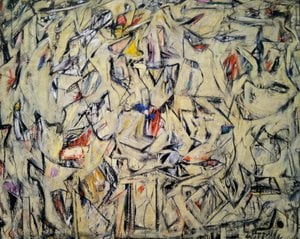
Biografie van de kunstenaar
A Life Forged in Abstraction
Willem de Kooning, een naam die synoniem staat voor de rauwe energie en emotionele diepte van Abstract Expressionisme, werd geboren in Rotterdam, Nederland, in 1904. Zijn vroege leven was gekenmerkt door een familieverschuiving – zijn ouders scheidden toen hij jong was – wat wellicht een gevoel van onrustig zoeken in hem verankerde dat zijn artistieke reis doordrong. Op twaalfjarige leeftijd verliet hij de formele schooling en leerde hij bij een commercieel kunstbedrijf, waardoor hij technische vaardigheid opbouwde terwijl hij tegelijkertijd een verlangen ontwikkelde om conventionele beperkingen te doorbreken. Avondlessen aan de Academie van Beeldende Kunsten en Technische Wetenschappen in Rotterdam boden verdere fundamentele training, maar het was een verlangen naar iets meer – een geduriger, expressiever taalgebruik – dat hem uiteindelijk in 1926 naar Amerika leidde. Zijn aankomst was niet zonder obstakels; hij stiekem naar een schip, waarmee hij de geest van een buitenstaander die op zoek was naar nieuwe horizonen uitstraalde. New York City werd zijn aangename thuis, en de levendige, vaak ruwe energie ervan beïnvloedde zijn evoluerende stijl diepgaand. Hij navigeerde verschillende banen – huis schilder, timmerman – terwijl hij onvermoeid streefde naar zijn artistieke visie, de stadse puls in zijn werk opnam.
Van Stedelijke Scènes tot Abstracte Woede
De vroege schilderijen van De Kooning weerspiegelden zijn directe omgeving: stedelijke landschappen en portretten die de dynamiek van het New Yorkse leven vastlegden. Echter, dit waren slechts tussenstappen naar een diepere verkenning van vorm en emotie. Een cruciale gebeurtenis was zijn connectie met Arshile Gorky, wiens invloed transformatief bleek te zijn. Gorky moedigde de experimenten van De Kooning aan met abstractie, waardoor een bereidheid ontstond om traditionele representatie af te breken in dienst van iets diepere. De jaren 30 zagen De Kooning betrokken bij sociaal realisme en muurschilderingen via de Works Progress Administration (WPA), een periode die zijn vaardigheden scherpte maar ook de beperkingen van puur representatie benadrukte. Hij voelde zich aangetrokken tot het werk van Stuart Davis en John Graham, kunstenaars die grenzen op hun eigen manier verlegden. Deze confluence van invloeden leidde geleidelijk naar een steeds abstracter vocabulaire. Het was geen plotselinge verschuiving, maar eerder een langzaam proces – een doelbewuste ontmanteling van gevestigde normen, aangedreven door intellectuele nieuwsgierigheid en een onverzettelijke zoektocht naar artistieke waarheid.
De ‘Woman’ Serie: Een Landmark Prestatie
Na de Tweede Wereldoorlog kwam De Kooning op als een centrale figuur in de groeiende Abstract Expressionist beweging. Deze periode markeerde een keerpunt, culminerend in zijn iconische “Woman” serie (1950-1953). Deze schilderijen – waaronder het monumentale *Woman I* – zijn niet alleen representaties van vrouwelijke figuren; ze zijn visceraal onderzoek naar vrouwelijkheid, seksualiteit en de complexiteiten van menselijke emotie. Karakteristiek voor de serie zijn agressieve penseelstreken, fragmentarische vormen en een jarring combinatie van kleuren. De “Woman” serie daagde conventionele opvattingen over schoonheid en representatie uit. Ze waren controversieel, zelfs schokkend voor sommigen, maar hun kracht lag in hun weigering om zich aan te passen. De Kooning was niet geïnteresseerd in het creëren van ideale beelden; hij zocht naar de rauwe, onbeheerste essentie van zijn onderwerpen vast te leggen. Naast de “Woman” serie toonden werken zoals *The Glazier* en *Excavation* zijn dynamische benadering van schilderkunst verder aan, waarbij een meesterschap in textuur, kleur en compositie werd getoond. Hij aarzelde niet om chaos of ambiguïteit te omarmen; hij beschouwde ze juist als integraal onderdeel van zijn artistieke taal.
Evoluerende Landschappen en Duurzaam Erfgoed
In de jaren 60 onderging De Kooning’s stijl een nieuwe, significante evolutie. Hoewel abstractie centraal bleef in zijn werk, begonnen landschapselementen een prominentere rol te spelen, vaak met een helderdere kleurenpalet en een losser, vloeiender penseelwerk. Hij experimenteerde voortdurend gedurende zijn leven, waarbij hij verschillende technieken en materialen verkende, nooit tevreden om op zijn laurels te rusten. Zijn latere werken tonen een buitengewone vermogen om zichzelf opnieuw uit te vinden terwijl hij trouw bleef aan zijn kernartistieke principes. Willem de Kooning’s historische betekenis is onbetwistbaar. Hij hielp New York City vestigen als een wereldwijd centrum voor kunst, Europese tradities uitdaagend en het pad vrijmaken voor toekomstige generaties kunstenaars. Zijn werk inspireert nog steeds bewondering en roept debat op, herinnert ons aan de kracht van abstractie om diepe emotionele waarheden over te brengen. De Kooning stierf in 1997, waardoor een uitgebreid en invloedrijk oeuvre achterbleef dat getuigt van zijn onwrikbare toewijding aan artistische innovatie en zijn blijvende nalatenschap als een van de meest belangrijke Amerikaanse kunstenaars van de 20e eeuw.



 Voorvertoning
 Bestel handgeschilderde reproductie
 Verstuur
 Delen
Delen
 Details bekijken

 Download
 Vergelijkbare items
 Röntgenonderzoek
 Diavoorstelling
 Statistieken


 Lees meer






































 De optie voor glas is alleen beschikbaar bij een formaat kleiner dan 110 cm.