Victor Vasarely’s “Zebras (orange)” – A Geometric Symphony
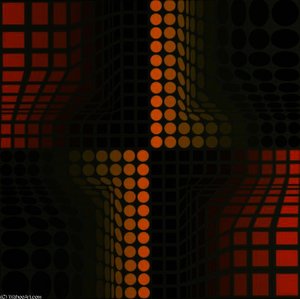
“Zebras (orange),” a captivating work by Victor Vasarely, transcends the simple depiction of animal forms; it's an immersive exploration of perception and movement, firmly rooted in the principles of Op Art. Painted with a deliberate distortion, the image presents a warped face—a motif that immediately draws the viewer into a world where reality is playfully challenged. The vibrant orange background acts as a dynamic counterpoint to the stark black and white pattern, intensifying the visual impact and creating an almost hallucinatory effect. This piece exemplifies Vasarely’s pioneering work in kinetic art, anticipating the movement and dynamism of later optical illusions.
The Genesis of Op Art: Vasarely's Bauhaus Roots
Born in 1906 in Pécs, Croatia, Victor Vasarely’s artistic trajectory was shaped by a confluence of influences. Initially pursuing medical studies, he abandoned this path for painting in 1927, driven by an innate fascination with visual form and abstraction. His enrollment at the Podolini-Volkmann Academy and subsequent immersion within Sándor Bortnyik’s “Műhely” workshop – profoundly influenced by the Bauhaus movement – proved crucial. The Bauhaus emphasis on functional design, geometric abstraction, and the exploration of optical phenomena provided the theoretical framework for Vasarely's groundbreaking approach. This period established his core belief: that art could be constructed through precise mathematical relationships, creating illusions of movement and depth without relying on traditional representational techniques.
Technique and Composition – A Calculated Illusion
Vasarely’s technique in “Zebras (orange)” is characterized by meticulous layering and the use of flat, unmodulated color. The black and white pattern isn't a naturalistic representation but rather a precisely constructed series of geometric shapes—primarily circles and lines—arranged to create an optical illusion of movement and depth. This deliberate distortion of form is central to Op Art’s goal: to stimulate the viewer’s visual cortex and evoke a sense of dynamic energy. The orange background isn't merely a backdrop; it actively participates in this illusion, amplifying the perceived movement and contributing to the overall captivating effect. The painting demonstrates Vasarely's mastery of color theory and his ability to manipulate perception through carefully calibrated geometric arrangements.
Symbolism and Emotional Impact – Beyond Representation
While seemingly a simple depiction of a zebra’s face, “Zebras (orange)” operates on multiple levels. The distorted form can be interpreted as a rejection of traditional representational art, embracing abstraction as a means of exploring the fundamental nature of perception. The animal motif itself—often associated with speed, power, and wildness—is rendered in a controlled, almost sterile manner, highlighting the tension between instinct and intellect. The overall effect is one of intense visual stimulation, provoking a sense of wonder and inviting contemplation on the relationship between art, perception, and reality. This piece resonates with a powerful emotional impact through its manipulation of the viewer’s senses.



 Bekijk op ware grootte
 Koop handgeschilderd kunstwerk
 Verstuur
 Delen
Delen
 Details bekijken
 Gids voor studentenkunstwerken

 Download
 Vergelijkbare items
 Röntgenonderzoek
 Diavoorstelling
 Statistieken

 Lees meer






































 De optie voor glas is alleen beschikbaar bij een formaat kleiner dan 110 cm.