De kunstwerken die op deze pagina worden weergegeven, zijn beschermd door de auteursrechtwetgeving, wat betekent dat het ons wettelijk niet is toegestaan om identieke reproducties te maken of te verkopen. Deze bescherming wordt gehandhaafd onder internationale overeenkomsten zoals de Conventie van Bern en door nationale wetgeving, waaronder de bepalingen van de Amerikaanse auteurswet - Titel 17. Alle rechten voorbehouden. Reproduceren of distribueren van afbeeldingen is niet toegestaan zonder uitdrukkelijke schriftelijke toestemming van WahooArt.com en de rechthebbenden.
Deze methode voldoet volledig aan de auteursrechtwetgeving, omdat het niet gaat om het kopiëren of dupliceren van het beschermde kunstwerk. In plaats daarvan is er sprake van een creatieve herinterpretatie — een nieuw schilderij dat door het origineel wordt geïnspireerd, maar er niet identiek aan is.
Giclée- of canvasafdruk van museumkwaliteit met een snelle productie en flexibele afwerkingsmogelijkheden. ( Bestel handgeschilderde reproductie Schakel over naar digitale afbeeldingen)
Kies uit onze vooraf ingestelde maten die overeenkomen met de originele verhoudingen van het kunstwerk.

Voer de gewenste breedte en hoogte in, passend bij uw lijst of muur. Een afdruk kan alleen worden ingekort en nooit groter worden gemaakt dan het origineel; een formaat met andere verhoudingen zal daarom een deel van de afbeelding verliezen. Wij sturen u een digitaal mockup ter goedkeuring voordat we tot drukwerk overgaan. De afbeelding op deze pagina toont niet de werkelijke uitsnede — dit is alleen te zien op het mockup.
Wereldwijde levering () binnen 2 weken in plaats van de standaard 4/5 weken. (9 november)
Yvaral
Afmetingen reproductie
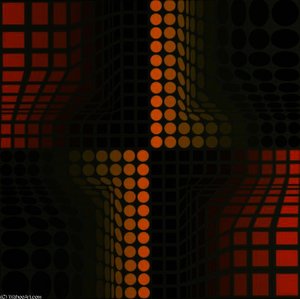
Victor Vasarely’s Yvaral, completed in 1956, is more than just an image; it’s a carefully constructed illusion, a testament to the burgeoning field of Op Art and a profound exploration of how our eyes perceive space and movement. This striking work, measuring 210 x 200 cm, immediately captivates with its stark contrast – a pristine white background punctuated by precisely arranged black circles that seem to vibrate with an almost unsettling energy. Born in Pécs, Croatia (then Austria-Hungary) in 1906, Vasarely’s artistic trajectory began unexpectedly, initially pursuing medical studies before embracing the visual world with unwavering conviction. His journey, shaped by influences from the Bauhaus movement and his time within Bortnyik's Műhely workshop, culminated in a revolutionary approach to art – one that deliberately manipulated perception through geometric abstraction.
The deliberate restriction of the color palette – solely black and white – is crucial to Yvaral’s impact. This stark dichotomy dramatically enhances the optical illusion, making the circles appear to pulsate and shift with every glance. Vasarely wasn't simply depicting shapes; he was engineering a visual experience, exploiting the way our brains process information. The dominant form, of course, is the circle – repeated countless times – but it’s not merely repetition for its own sake. Vasarely meticulously arranged these circles to create larger geometric forms—squares and quadrants—that contribute to the overall structure while simultaneously disrupting any sense of static stability.
The artwork’s execution suggests a serigraph or screen print, a technique favored by Vasarely for its ability to achieve incredibly precise color application and uniform tonal values. The smooth texture, characteristic of printed media, speaks to this meticulous process. It is likely that the original work was created using this method, ensuring the consistent distribution of ink across the canvas. While a photograph of an original work could also account for the image’s appearance, the level of detail and precision strongly points towards a serigraphic reproduction.
Beyond its purely visual impact, Yvaral evokes deeper symbolic resonances. The dynamic arrangement of circles can be interpreted as representing movement, energy, and perhaps even disorientation – mirroring the very experience of engaging with Op Art. The repetitive patterns might also suggest themes of order and chaos, a fundamental duality that Vasarely consistently explored in his work. This piece isn’t just about seeing; it's about *experiencing* perception itself.
Historisch gezien is "Yvaral" een Op Art werk uit het bredere Modern tijdperk.
De auteursrechtelijke status van "Yvaral" door Victor Vasarely: het werk is nog steeds auteursrechtelijk beschermd. Dit bepaalt of reproducties van de afbeelding vrijelijk mogen worden gemaakt.
Black (#100d06) is de dominante kleur van "Yvaral" door Victor Vasarely.

1906 - 1997 , Kroatië

Master the nuances of Giclée printing with our expert guide. Discover how pigment-based inks and museum-grade substrates create fade-resistant, high-fidelity art reproductions designed for discerning collectors seeking unparalleled quality and longevity.

Embark on a visual journey through the mesmerizing world of Op Art. Discover the masters of optical illusion, explore geometric abstraction, and learn how to curate high-impact kinetic works for your private collection with expert guidance from art professionals.

Explore the profound artistry of black and white photography. From historical mastery to the interplay of light and shadow, discover how monochrome captures timeless emotion and form through a sophisticated lens of art history.
Explore the mesmerizing world of Victor Vasarely. Discover how his Bauhaus-inspired Op Art masters the science of perception through geometric abstraction and vibrant color. A sophisticated guide for discerning art collectors seeking to understand the legacy of optical illusion.
 Verstuur
 Delen
Delen
 Details bekijken
 Gids
Gids

 Download
 Vergelijkbare items
 Diavoorstelling
 Vraag & antwoord
 Statistieken

 Lees meer






































 De optie voor glas is alleen beschikbaar bij een formaat kleiner dan 110 cm.