De kunstwerken die op deze pagina worden weergegeven, zijn beschermd door de auteursrechtwetgeving, wat betekent dat het ons wettelijk niet is toegestaan om identieke reproducties te maken of te verkopen. Deze bescherming wordt gehandhaafd onder internationale overeenkomsten zoals de Conventie van Bern en door nationale wetgeving, waaronder de bepalingen van de Amerikaanse auteurswet - Titel 17. Alle rechten voorbehouden. Reproduceren of distribueren van afbeeldingen is niet toegestaan zonder uitdrukkelijke schriftelijke toestemming van WahooArt.com en de rechthebbenden.
Deze methode voldoet volledig aan de auteursrechtwetgeving, omdat het niet gaat om het kopiëren of dupliceren van het beschermde kunstwerk. In plaats daarvan is er sprake van een creatieve herinterpretatie — een nieuw schilderij dat door het origineel wordt geïnspireerd, maar er niet identiek aan is.
Giclée- of canvasafdruk van museumkwaliteit met een snelle productie en flexibele afwerkingsmogelijkheden. ( Bestel handgeschilderde reproductie Schakel over naar digitale afbeeldingen)





























Kies uit onze vooraf ingestelde maten die overeenkomen met de originele verhoudingen van het kunstwerk.

Voer de gewenste breedte en hoogte in, passend bij uw lijst of muur. Een afdruk kan alleen worden ingekort en nooit groter worden gemaakt dan het origineel; een formaat met andere verhoudingen zal daarom een deel van de afbeelding verliezen. Wij sturen u een digitaal mockup ter goedkeuring voordat we tot drukwerk overgaan. De afbeelding op deze pagina toont niet de werkelijke uitsnede — dit is alleen te zien op het mockup.
Wereldwijde levering () binnen 2 weken in plaats van de standaard 4/5 weken. (9 november)
Syry
Afmetingen reproductie
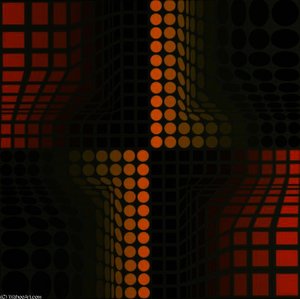
Victor Vasarely's "Syry" is not merely a painting; it’s an invitation – an invitation to question the very nature of visual perception. This vibrant artwork, dominated by a colossal sphere encircled by a constellation of smaller circles, embodies the core tenets of Op Art and represents a pivotal moment in 20th-century art history. Created by a man initially destined for a medical career, Vasarely’s journey reflects a profound fascination with geometry and its ability to manipulate our senses. Born Károly Vaszary in 1906 in Pécs, Croatia – then part of Austria-Hungary – his early life foreshadowed little of the groundbreaking artistic path he would ultimately forge. His initial studies in medicine were abruptly abandoned in favor of a pursuit far more captivating: the exploration of visual form and its impact on human perception.
Vasarely’s artistic evolution was inextricably linked to the intellectual currents of his time. His enrollment at Sándor Bortnyik’s “Műhely” workshop, profoundly influenced by the Bauhaus movement, proved instrumental. This environment fostered a deep understanding of functional design and geometric abstraction – principles that would become the bedrock of his signature style. The Bauhaus emphasis on reducing form to its essential elements—primarily lines, shapes, and colors—directly informed Vasarely’s approach. He wasn't interested in depicting recognizable objects; instead, he sought to create visual experiences that directly stimulated the viewer’s eye and challenged their assumptions about space and depth. “Syry,” with its meticulously arranged circles, is a quintessential example of this pursuit.
The creation of "Syry" exemplifies Vasarely's mastery of Op Art techniques. The large sphere, rendered in bold, contrasting colors – likely utilizing layering and glazing—appears to float within a dynamic field of smaller circles. These circles aren’t simply decorative elements; they are carefully calibrated to create an optical illusion. Through precise placement and color variations, Vasarely generates a sense of movement and depth that seems to defy the two-dimensional surface of the canvas. The technique relies heavily on the viewer's eye actively processing the visual information, creating a dynamic and shifting perception. Vasarely’s meticulous attention to detail ensures that the artwork is not static but rather an active participant in the viewing experience.
"Syry" transcends mere optical illusion; it carries symbolic weight. The sphere itself can be interpreted as representing wholeness, unity, or even the cosmos – a fundamental building block of existence. The surrounding circles evoke a sense of infinite expansion, mirroring the boundless possibilities of perception. Vasarely’s work isn't about creating beautiful images in the traditional sense; it’s about provoking thought and stimulating emotional responses through the manipulation of visual elements. The artwork’s vibrant colors and dynamic composition generate a feeling of excitement, energy, and perhaps even a slight disorientation – a deliberate effect designed to engage the viewer on a visceral level. It's a testament to Vasarely's belief that art could be both intellectually stimulating and emotionally resonant.
"Syry" behoort tot de Op Art in de carrière van Victor Vasarely. Deze classificatie plaatst het werk in de context van de ontwikkeling van de kunstenaar.
Binnen de Op Art-stroming heeft "Syry" een Iconic populariteitsniveau.
In "Syry" versterken Dark kleuren een Calm gevoel.

1906 - 1997 , Kroatië

Explore the profound spiritual depth of geometric abstraction. From Malevich's Suprematism to modern masters, our expert guide reveals how pure form and color command presence in fine art collections.

Explore the profound evolution of Neo-Abstract art. Discover how bold geometric forms, vibrant chromatic depth, and tactile textures redefine modern expression for the discerning collector seeking sophisticated, high-impact masterpieces for contemporary interiors.

Discover the profound beauty of abstract art. Our expert guide explores geometric abstraction, Op Art, and Expressionism, offering connoisseurs deep insights into collecting and curating powerful, non-representational masterpieces for sophisticated interiors.
 Voorvertoning
 Verstuur
 Delen
Delen
 Details bekijken
 Gids
Gids

 Download
 Vergelijkbare items
 Röntgenonderzoek
 Diavoorstelling
 Vraag & antwoord
 Statistieken

 Lees meer









 De optie voor glas is alleen beschikbaar bij een formaat kleiner dan 110 cm.