De kunstwerken die op deze pagina worden weergegeven, zijn beschermd door de auteursrechtwetgeving, wat betekent dat het ons wettelijk niet is toegestaan om identieke reproducties te maken of te verkopen. Deze bescherming wordt gehandhaafd onder internationale overeenkomsten zoals de Conventie van Bern en door nationale wetgeving, waaronder de bepalingen van de Amerikaanse auteurswet - Titel 17. Alle rechten voorbehouden. Reproduceren of distribueren van afbeeldingen is niet toegestaan zonder uitdrukkelijke schriftelijke toestemming van WahooArt.com en de rechthebbenden.
Deze methode voldoet volledig aan de auteursrechtwetgeving, omdat het niet gaat om het kopiëren of dupliceren van het beschermde kunstwerk. In plaats daarvan is er sprake van een creatieve herinterpretatie — een nieuw schilderij dat door het origineel wordt geïnspireerd, maar er niet identiek aan is.
Giclée- of canvasafdruk van museumkwaliteit met een snelle productie en flexibele afwerkingsmogelijkheden. ( Bestel handgeschilderde reproductie Schakel over naar digitale afbeeldingen)





























Kies uit onze vooraf ingestelde maten die overeenkomen met de originele verhoudingen van het kunstwerk.

Voer de gewenste breedte en hoogte in, passend bij uw lijst of muur. Een afdruk kan alleen worden ingekort en nooit groter worden gemaakt dan het origineel; een formaat met andere verhoudingen zal daarom een deel van de afbeelding verliezen. Wij sturen u een digitaal mockup ter goedkeuring voordat we tot drukwerk overgaan. De afbeelding op deze pagina toont niet de werkelijke uitsnede — dit is alleen te zien op het mockup.
Wereldwijde levering () binnen 2 weken in plaats van de standaard 4/5 weken. (12 november)
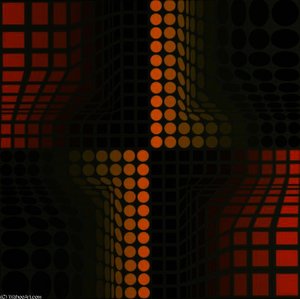
ORION-MC
Afmetingen reproductie
Victor Vasarely's ORION-MC is not merely a painting; it’s an invitation to experience the world through a radically altered lens. This captivating work, rendered in a vibrant palette of red, yellow, green, blue, purple, orange, and black, exemplifies the core tenets of Op Art – Optical Art – pioneered by Vasarely himself. Born Károly Vaszary in 1906 in Pécs, Croatia, his artistic trajectory began with an unexpected detour into medicine before he decisively embraced the power of visual perception. This decision, fueled by his studies at the Podolini-Volkmann Academy and profoundly shaped by Sándor Bortnyik’s “Műhely” workshop – a breeding ground for Bauhaus principles – established him as a key figure in challenging our fundamental understanding of how we see.
The composition of *ORION-MC* is deceptively simple yet profoundly complex. The numerous circles, varying in size and position, create a dynamic visual field that seems to shift and shimmer before your eyes. This effect isn’t accidental; Vasarely meticulously controlled every element to manipulate the viewer's perception. The artist’s skillful use of color intensifies this optical illusion, creating a sense of movement and depth that draws the eye across the canvas. The black elements provide grounding and contrast, further emphasizing the vibrancy of the other colors. It is a carefully constructed visual puzzle designed to challenge our assumptions about reality.
Vasarely’s work emerged during a period of significant artistic and technological change. The rise of industrialization, coupled with advancements in photography and printing, led to a questioning of traditional modes of representation. The Bauhaus movement's emphasis on functional design and geometric abstraction provided a crucial intellectual framework for Vasarely’s explorations. His work can be seen as a direct response to these influences, translating abstract principles into a visually arresting aesthetic. The influence of kinetic art, with its focus on creating illusions of movement, is also evident in *ORION-MC*.
While ostensibly an abstract composition, *ORION-MC* evokes a sense of the cosmos – fittingly named “Orion,” one of the most recognizable constellations. The circles can be interpreted as representing stars or planets, suggesting a connection to the vastness of space and the underlying order of the universe. Beyond this symbolic layer, the painting’s impact lies in its ability to evoke a sense of wonder and contemplation. It invites viewers to slow down, observe carefully, and appreciate the beauty of geometric forms – a timeless invitation to explore the fascinating relationship between art and perception.
De vastgestelde waarden voor "ORION-MC" door Victor Vasarely zijn: deep_shadow helderheid en Dark luminantie.
Een reproductie van "ORION-MC" door Victor Vasarely wordt aanbevolen voor Accent. Dit advies is gebaseerd op het onderwerp, de sfeer en de kleuren van het werk.
De afbeelding van "ORION-MC" door Victor Vasarely is te downloaden op de Downloaden-pagina van het kunstwerk: een digitale afbeelding in hoge resolutie om te downloaden.
Geboren als Károly Vaszary op 9 april 1906 in Pécs, Hongarije, begon de man die later wereldberoemd zou worden als Victor Vasarely zijn pad in een totaal ander vakgebied. In 1925 betrad hij de aula van de Eötvös Loránd Universiteit in Boedapest om medicijnen te studeren. De logica van het menselijk lichaam en de wetenschap bezighielden hem gedurende twee jaar, maar de onweerstaanbare drang naar visuele expressie kreeg uiteindelijk de overhand. Tegen 1927 had hij zijn medische studies definitief achter zich gelaten om zich te wijden aan de klassieke academische schilderkunst aan de Podolini-Volkmann Academie.
Zijn artistieke vorming zette voort toen hij zich richtte op het műhely van Sándor Bortnyik. Deze werkplaats was een broedplaats waar de principes van de Bauhaus-beweging wortel schoten, met een scherpe focus op het snijvlak tussen functioneel ontwerp en geometrische abstractie. Hier verschoof de aandacht naar het structurele en het systematische. De lessen die hij in deze ateliers leerde, vormden het fundament voor zijn latere, diepgaande onderzoek naar de manier waarop vormen en kleuren interageren met het menselijk oog.
Tussen 1929 en 1944 lag de focus van Vasarely op grafisch werk. Hij bracht deze jaren door met experimenteren naar de manier waarop licht en schaduw interageren met eenvoudige vormen. Zijn vroege grafische periode bracht werken voort zoals Chess Board (1935) en Girl-power (1934). In 1937 werkte hij bovendien aan Zebras. Deze werken getuigen van een groeiende fascinatie voor de manier waarop een toeschouwer een plat oppervlak waarneemt. Hij bewoog zich weg van de traditionele schilderkunst naar een meer gestructureerde, grafische benadering.
In de periode van 1944 tot 1947 verschoof zijn koers. Hij verkende diverse stijlen, waaronder kubistische, futuristische, expressionistische, symbolistische en surrealistische benaderingen. Uiteindelijk liet hij deze experimenten achter zich om te zoeken naar een preciezere manier om de ruimte te organiseren. Deze zoektocht naar een nieuwe logica leidde tot de publicatie van zijn Gele Manifest. Zijn werk ging steeds minder over individuele expressie en steeds meer over de mechanica van het zien. Deze systematische methode zou hem uiteindelijk vestigen als een absolute leider van de Op Art-beweging.
De benadering van Victor Vasarely rust op een systematisch gebruik van geometrie om een fysieke reactie bij de toeschouwer uit te lokken. Hij vertrouwde niet op traditionele lichtbronnen of klassiek chiaroscuro om vorm te creëren. In plaats daarvan maakte hij gebruik van een geraffineerd samenspel van hoog-contrast pigmenten om diepte en beweging te simuleren. Door de kleurintensiteit te manipuleren, wist hij het oog te misleiden, waardoor er een perceptie van terugwijking en uitstulping ontstond op een volkomen vlak oppervlak. Deze methode transformeert een statisch vlak in een ruimte die lijkt aan te zwellen of juist weg te wijken.
Zijn methode, die hij zelf visuele kinetiek of plastique cinétique noemde, omvat een uiterst precieze ordening van vormen. Hij maakte gebruik van texturele effecten, perspectief, schaduw en licht om deze illusies op te bouwen. Het werk leunt vaak op de manier waarop het oog ritmische, interne straling interpreteert, in plaats van afhankelijk te zijn van externe verlichting. Door het gebruik van rasters en wiskundige principes creëerde hij sensaties van visuele vibratie en kolkende effecten. Het resultaat is een gevoel van beweging dat volledig binnen de perceptie van de kijker bestaat.
De precisie van zijn techniek is overduidelijk in de wijze waarop hij kleur en lijn hanteert om architecturale diepte te creëren. In werken zoals Torony-Nagy zorgt de kruising van scherpe witte lijnen met diepblauw en smaragdgroen voor een ritmische optische vibratie. Deze elementen werken samen om een sensatie van pulserend licht voort te brengen. Hij gebruikte deze instrumenten om voorbij de eenvoudige representatie te gaan, met een focus op de mechanica van hoe wij daadwerkelijk zien.
In 1937 markeerde de creatie van Zebra een cruciale verschuiving naar wat velen beschouwen als de vroegste voorbeelden van Op Art. Dit werk brak met de traditionele representatie en richtte zich in plaats daarvan op de manier waarop het oog eenvoudige vormen interpreteert. Tegen de jaren '60 hadden zijn experimenten met ritme en licht een hoogtepunt bereikt in het werk Torony-Nagy uit 1969. Dit meesterwerk maakt gebruik van vier gestileerde torens en een contrastrijk palet van blauwen, groenen en oranje om een gevoel van innerlijke gloed te creëren. De compositie leunt op de intersectie van witte lijnen en kleurintensiteit, waardoor het platte vlak lijkt te pulseren en te wijken.
Zijn fascinatie voor beweging reikte veel verder dan het platte vlak; het strekte zich uit naar de driedimensionale ruimte en alledaagse objecten. Zo ontwierp hij Georges Pompidou, een groot kinetisch object dat zijn visuele theorieën integreerde in een fysieke, bewegende vorm. Deze interesse in de praktische toepassing van zijn geometrie leidde ook tot een samenwerking met Rosenthal Studio Linie. Deze partnerschap resulteerde in de Suomi serviescollectie, een oplage van 500 stukken die zijn geometrische patronen introduceerde in de intieme sfeer van het dagelijks leven.
In 1966 begon Victor Vasarely aan het proces voor de oprichting van de Fondation Vasarely. Dit ambitieuze project was geworteld in zijn diepgewortelde overtuigingen over het concept van "kunst voor iedereen" en zijn visionaire blik op de "stad van morgen". Hij streefde naar de creatie van een ruimte die de grenzen van de traditionele galerie-ervaring oversteeg, een plek die zijn filosofische principes werkelijk tot leven kon wekken. De fysieke bouw van dit monumentale gebouw ging in 1973 van start.
De stichting werd officieel ingewijd op 14 februari 1976 in Aix-en-Provence, Frankrijk. De locatie werd met zorg ontworpen om zijn werken te huisvesten en zijn theorieën over de interactie tussen kunst en stedelijk ontwerp te promoten. De architectuur van de ruimte zelf was een integraal onderdeel van deze visie; de indeling van het gebouw was er specifiek op gericht de manier waarop het publiek zijn geometrische vormen ervaart, te versterken en te ondersteunen.
De reikwijdte van zijn visuele taal reikte veel verder dan de muren van een galerie. Zijn patronen en geometrische structuren vonden hun weg naar de texturen van het dagelijks leven, waarbij ze de lijnen van de mode, de lay-outs van het interieurontwerp en de logica van het grafisch ontwerp beïnvloedden. Zelfs de vroege ontwikkeling van de computergraphics draagt het stempel van zijn systematische benadering van vorm en perceptie. Zijn ideeën bleven niet beperkt tot het canvas; ze bewogen mee naar de functionele wereld van objecten en de digitale structuren die daarop volgden.
In 1982 reisde zijn werk zelfs de ruimte in, toen serigrafieën werden meegevoerd aan boord van het Frans-Sovjet-ruimtevaartuig Salyut 7. Dit moment onderstreepte de verbinding tussen zijn wiskundige precisie en de bredere menselijke drang naar exploratie. Hij bleef een centrale figuur in de moderne kunstgeschiedenis tot aan zijn dood in Parijs, Frankrijk, op 15 maart 1997.
Het volgen van de fysieke aanwezigheid van zijn werk vereist een reis langs verschillende locaties in Frankrijk en Hongarije. In Aix-en-Provence, Frankrijk, herbergt de Fondation Vasarely een aanzienlijk deel van zijn oeuvre. Dit museum werd door de kunstenaar zelf opgericht om zijn ideeën over "kunst voor iedereen" te promoten. De ruimte is georganiseerd in zeven zeshoekige cellen, elk 14 meter breed en 11 meter hoog, speciaal ontworpen om vierenzestig monumentale werken van 6 bij 8 meter te huisvesten.
Zijn aanwezigheid in Hongarije is eveneens voelbaar via speciale locaties. Het Vasarely Museum bevindt zich in Pécs, de stad waar hij werd geboren. Daarnaast is er een Vasarely Museum gevestigd in het Zichy-paleis in Óbuda, Boedapest. Deze locaties bieden een directe ontmoeting met de geometrische vormen en optische effecten die zijn artistieke praktijk definieerden. In Frankrijk is een andere plek voor zijn werk het Vasarely Museum in het Saint-Firmin-paleis in Gordes.
Naast deze specifieke musea is zijn invloed terug te vinden in diverse institutionele collecties. Sommige van zijn werken maken deel uit van de collectie van het Bilbao Fine Arts Museum, terwijl andere deel uitmaken van de collecties van de Inter-American Development Bank in Washington, D.C., en het Bechtler Museum of Modern Art in Charlotte. Deze verspreide locaties zorgen ervoor dat zijn visuele experimenten toegankelijk blijven voor een divers publiek.

1906 - 1997 , Kroatië

Explore the profound spiritual depth of geometric abstraction. From Malevich's Suprematism to modern masters, our expert guide reveals how pure form and color command presence in fine art collections.
Explore the mesmerizing world of Victor Vasarely. Discover how his Bauhaus-inspired Op Art masters the science of perception through geometric abstraction and vibrant color. A sophisticated guide for discerning art collectors seeking to understand the legacy of optical illusion.
 Voorvertoning
 Verstuur
 Delen
Delen
 Details bekijken
 Gids
Gids

 Download
 Vergelijkbare items
 Röntgenonderzoek
 Diavoorstelling
 Vraag & antwoord
 Statistieken

 Lees meer









 De optie voor glas is alleen beschikbaar bij een formaat kleiner dan 110 cm.