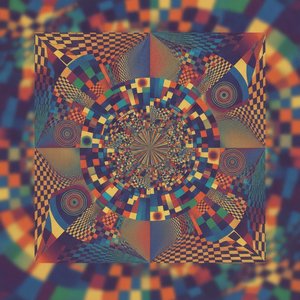
Victor Vasarely's "Olla": A Geometric Dance of Light and Perception
Victor Vasarely’s “Olla,” created in 1988, isn't merely a painting; it’s an experience—a visual vibration that challenges our perception of space and form. This striking work exemplifies the artist’s pioneering role in Op Art (Optical Art), a movement he essentially founded, aiming to create illusions of movement and depth through carefully orchestrated geometric patterns. "Olla," meaning “pot” or “vessel” in Spanish, hints at a contained energy, a vibrant core radiating outward. The title itself is intriguing, suggesting an organic form rendered entirely through the language of pure abstraction.
The Language of Geometric Abstraction
At first glance, "Olla" presents a deceptively simple composition: three overlapping circles, each varying slightly in size and hue, set against a shimmering gold background. However, this simplicity belies a sophisticated understanding of color theory and spatial relationships. Vasarely wasn't interested in representing the external world; instead, he sought to explore the fundamental principles that govern how we perceive it. The circles aren’t solid forms but rather fields of color interacting with one another, creating an illusion of depth and movement. The gold background isn't merely a backdrop but an active participant, reflecting and amplifying the vibrancy of the overlapping shapes. Vasarely employed screenprinting techniques, allowing for precise control over color placement and layering—a crucial element in achieving the desired optical effect. This method also speaks to his desire to democratize art, making it accessible beyond traditional painting mediums.
A Pioneer of Op Art: Historical Context
To fully appreciate "Olla," one must understand its place within the broader context of 20th-century art. Emerging in the 1960s, Op Art was a reaction against the perceived subjectivity and emotionalism of Abstract Expressionism. Vasarely, along with artists like Bridget Riley, sought to create art based on objective principles—mathematical precision and optical phenomena. His work drew inspiration from various sources, including tribal art, scientific diagrams, and even advertising design. "Olla" reflects this eclectic influence, combining geometric rigor with a playful sense of visual dynamism. It’s a testament to Vasarely's belief that art could be both intellectually stimulating and visually engaging—a bridge between science and aesthetics.
Symbolism and Emotional Resonance
While "Olla" is rooted in mathematical principles, it also evokes a range of emotional responses. The vibrant colors – yellows and golds – convey a sense of energy, optimism, and warmth. The overlapping circles suggest interconnectedness and harmony, while the subtle variations in shape create a feeling of visual tension. The work doesn't depict any recognizable objects or figures, yet it resonates with a primal human fascination for patterns and rhythms. It’s an art that engages not just our intellect but also our senses—a mesmerizing dance of light and color that invites us to question the nature of perception itself. The golden background adds a layer of richness and sophistication, elevating the work beyond mere optical illusion into something truly captivating.



 Voorvertoning
 Bestel handgeschilderde reproductie
 Verstuur
 Delen
Delen
 Details bekijken

 Download
 Vergelijkbare items
 Röntgenonderzoek
 Diavoorstelling
 Stats
Stats
 Lees meer






































 De optie voor glas is alleen beschikbaar bij een formaat kleiner dan 110 cm.