Victor Vasarely’s “MEH2”: A Geometric Symphony of Perception
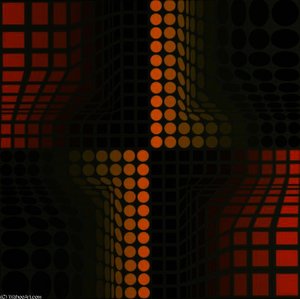
“MEH2,” a captivating work by Hungarian artist Victor Vasarely, is more than just a painting; it's an invitation to explore the very nature of visual perception. Executed in a vibrant palette of blue and yellow against a stark black backdrop, this piece exemplifies Vasarely’s pioneering role as one of the foremost figures in Op Art – Optical Art. Born Károly Vaszary in 1906 in Pécs, Croatia, his artistic trajectory began unexpectedly, initially driven by an interest in medicine before he was drawn to the expressive possibilities of color and form. This shift culminated in a lifelong dedication to dissecting and manipulating how our eyes interpret visual information, a pursuit deeply rooted in the principles of geometric abstraction.
The Genesis of Op Art: Bauhaus Influence and Kinetic Ideas
Vasarely’s artistic journey was profoundly shaped by his time within Sándor Bortnyik’s “Műhely” workshop, a space deeply influenced by the revolutionary ideas emanating from the Bauhaus school. This environment fostered an intense focus on functional design, precise geometric forms, and the exploration of kinetic principles – the idea that perception is not static but actively constructed by the eye. “MEH2” directly reflects this influence; the meticulously arranged squares, seemingly independent yet harmoniously integrated, are designed to create a dynamic visual experience, shifting subtly with the viewer’s perspective. The artist wasn't simply depicting shapes; he was engineering an illusion, challenging our assumptions about how we see and understand the world around us.
Technique and Composition: A Calculated Illusion
The painting’s technique is characterized by a remarkable precision and control. Vasarely employed a layering method, meticulously applying thin washes of paint to create the illusion of depth and movement. The black background serves not merely as a void but actively contributes to the optical effect, intensifying the vibrancy of the blue and yellow squares and further emphasizing their geometric relationships. The scattered smaller black squares are strategically placed to disrupt the overall pattern, adding another layer of complexity and reinforcing the artwork’s engagement with visual perception. This careful orchestration of color and form is a hallmark of Vasarely's work – a testament to his rigorous approach to artmaking.
Symbolism and Emotional Impact: Beyond Representation
While “MEH2” resists straightforward interpretation, it’s clear that Vasarely was less concerned with depicting a recognizable subject than with exploring the fundamental properties of visual experience. The geometric patterns evoke a sense of order and control, yet simultaneously create an unsettling dynamism – a feeling of constant movement and shifting perspective. This tension between stability and flux speaks to the inherent ambiguity of perception itself. The artwork’s bold colors and intricate design are undeniably captivating, inviting viewers to lose themselves in its mesmerizing patterns and contemplate the fascinating relationship between art, science, and the human eye. It's a piece that demands attention, prompting introspection and offering a unique visual reward.



 Bekijk op ware grootte
 Schakel over naar print
 Verstuur
 Delen
Delen
 Details bekijken
 Gids
Gids

 Download
 Vergelijkbare items
 Röntgenonderzoek
 Diavoorstelling
 Statistieken

 Lees meer






































 De optie voor glas is alleen beschikbaar bij een formaat kleiner dan 110 cm.