VoorvertoningVoorvertoning Bekijk in ARBekijk in AR Schakel over naar print Schakel over naar printBestel handgeschilderde reproductie Bestel handgeschilderde reproductie VerstuurVerstuur
Details bekijkenDetails bekijken Toevoegen aan favorieten Toevoegen aan favorieten DownloadDownload Vergelijkbare itemsVergelijkbare items RöntgenonderzoekRöntgenonderzoek DiavoorstellingDiavoorstelling StatistiekenStatistieken

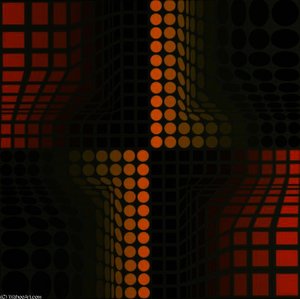
Axo-33

Explore Victor Vasarely’s ‘Axo-33,’ a mesmerizing Op Art masterpiece! This geometric abstraction uses optical illusions & bold colors for a dynamic, 3D effect. Discover its unique style.

Ontdek Victor Vasarely (1906-1997), de pionier van Op Art! Bewonder zijn geometrische abstracties, optische illusies & een blijvende invloed op moderne kunst en design.

Koop een digitale afbeelding in hoge resolutie met verbeterde kwaliteit, die veel superieur is aan de online voorvertoning.

Elk bestand wordt met uiterste precisie voorbereid door onze interne specialisten, met behulp van geavanceerde tools en deskundige handmatige retouche. Wij garanderen dat elke afbeelding een uitzonderlijke helderheid, nauwkeurige kleurweergave en verfijnde details bezit.

Het uiteindelijke bestand wordt binnen 72 uur per e-mail geleverd, geoptimaliseerd voor direct gebruik in professionele, redactionele en printomgevingen. Dit is dezelfde kwaliteit waarop vooraanstaande designstudio's, uitgevers en galerieën vertrouwen.

Digitale afbeeldingen

Download een bestand met hoge resolutie voor persoonlijke weergave, afdrukken en creatieve projecten. (Schakel over naar print Schakel over naar printBestel handgeschilderde reproductie Bestel handgeschilderde reproductie)

Totaalprijs

$ 24,90

Inbegrepen bij elke bestelling van een digitale afbeelding

Professionele digitale levering, gegarandeerd

Wanneer u kiest voor WahooArt.com, ontvangt u niet alleen een afbeelding – u krijgt een professioneel verbeterd digitaal kunstwerk, met precisie vervaardigd en voorzien van een tevredenheidsgarantie. Dit is alles wat automatisch bij uw bestelling is inbegrepen:

shipping_icon
Snelle levering per e-mail

Uw hoogwaardige digitale afbeeldingsbestand wordt binnen 72 uur na bestelling naar u gemaild – klaar voor direct gebruik.

canvas_icon
AI-verbeterd digitaal bestand

Uw kunstwerk wordt professioneel geoptimaliseerd met behulp van geavanceerde AI-tools en handmatige bewerkingen, waardoor maximale details, helderheid en kleurnauwkeurigheid worden gegarandeerd.

insurance_icon
Gratis levenslange herlevering van digitale afbeeldingen

Je bestand per ongeluk verwijderd of kwijtgeraakt? Geen zorgen – we sturen het u op elk gewenst moment gratis opnieuw toe.

tax_icon
Geen invoerkosten – nooit

Geniet direct van uw kunstwerk zonder invoerrechten, belastingen of verzendkosten – digitale downloads zijn altijd belastingvrij.

color_icon
Garantie op kleurgetrouwheid

Met behulp van professionele hulpmiddelen en kleurbeheer zorgen wij ervoor dat uw digitale afbeelding de originele kleuren zo nauwkeurig mogelijk weergeeft.

return_icon
100 dagen tevredenheidsgarantie

Als u niet tevreden bent met uw digitale afbeelding, passen wij deze aan of storten wij 100% terug binnen 100 dagen - zonder vragen te stellen.

guarantee_icon
100% Geld-terug-garantie

Niet tevreden? Ontvang een volledige terugbetaling binnen 100 dagen na ontvangst van uw digitale bestand - zonder vragen te stellen.

discount_icon
Korting bij grote bestellingen

Koop 3 afbeeldingen, bespaar 10% - Koop 5, bespaar 15% - Koop 10+, bespaar 20%. Ideaal voor creatieve projecten, galerieën en bureaus.

Snelle feiten

  • title: Axo-33
  • style: Geometric abstraction, Optical illusion
  • artist: Victor Vasarely
  • subject: Abstract
  • notable elements:
    • Geometric shapes
    • Bold colors
    • Checkered pattern
    • Optical illusions
    • Isometric cube

Kunstquiz

Er is slechts één goed antwoord op elke vraag.

Vraag 1:
Victor Vasarely is most closely associated with which art movement?
Vraag 2:
What is a defining characteristic of Op Art, as exemplified in 'Axo-33'?
Vraag 3:
The composition of 'Axo-33' primarily utilizes what type of shapes?
Vraag 4:
How does Vasarely create a sense of depth in 'Axo-33'?
Vraag 5:
'Axo-33' relies heavily on the viewer’s perception. What effect does this have?

A Symphony of Illusion: Exploring Victor Vasarely’s Axo-33

Victor Vasarely's *Axo-33* is more than just a painting; it’s an invitation to question perception itself. A cornerstone of the Op Art movement, this work exemplifies Vasarely’s pioneering exploration of optical illusions and geometric abstraction. Created during a period fascinated by science, technology, and the power of visual experience, *Axo-33* continues to captivate viewers with its dynamic energy and seemingly impossible spatial effects.

Deconstructing the Composition

At first glance, *Axo-33* presents as a deceptively simple composition: a red square outlined in black, populated by a meticulously arranged checkered pattern. However, this initial impression quickly dissolves upon closer inspection. The arrangement of squares isn’t flat; instead, Vasarely masterfully employs perspective and color variation to create the *illusion* of three-dimensionality. The eye is drawn into a vortex of receding planes, as if peering into an isometric projection of a cube that simultaneously exists and doesn't exist. This deliberate manipulation of visual cues is central to Op Art’s aesthetic.

Vasarely & The Rise of Op Art

Victor Vasarely (1906-1997), born in Pécs, Croatia, was a true innovator who moved beyond traditional painting techniques. His early work explored various styles before he fully embraced geometric abstraction in the 1950s. He believed art should be accessible and democratic, moving away from subjective expression towards objective visual systems. The Op Art Movement, flourishing in the 1960s, built upon this foundation, utilizing bold colors, precise patterns, and optical phenomena to create dynamic and often disorienting effects. Vasarely is widely considered a founding father of this influential style, alongside artists like Bridget Riley.

Technique & Materials

While the original dimensions of *Axo-33* are unknown, its impact stems from the precision of its execution. Vasarely’s technique relies on meticulous planning and a masterful understanding of visual perception. The digital rendering reveals a pixelated construction, highlighting the underlying grid structure that forms the basis of the illusion. This suggests a deliberate choice to emphasize the constructed nature of reality itself. Though originally executed with paint, high-quality reproductions faithfully capture the vibrancy of the colors and the sharpness of the geometric forms.

Symbolism & Emotional Impact

*Axo-33* isn’t about representing something *real*; it's about exploring the mechanics of seeing. The work challenges our assumptions about space, depth, and form. The red color evokes energy and passion, while the black outline provides definition and structure. Beyond its visual impact, the painting invites contemplation on themes of perception, reality, and the power of illusion. It’s a stimulating piece that can add a modern, intellectual edge to any interior space.

Key Features

  • Geometric Abstraction: The artwork is entirely composed of geometric shapes, specifically squares, creating a non-representational image.
  • Optical Illusion: The arrangement of the checkered pattern generates a convincing illusion of three-dimensional space and movement.
  • Bold Color Palette: The striking contrast between red and black enhances the visual impact and contributes to the dynamic energy of the piece.
  • Isometric Projection: The use of isometric perspective creates a sense of depth without traditional vanishing points, adding to the illusionary effect.
*Axo-33* is not merely a decorative element; it’s a conversation starter, an intellectual puzzle, and a testament to the power of art to challenge our perceptions. It's a piece that will continue to fascinate and inspire for generations to come.

Kunstenaarsbiografie

A Life Forged in Geometry: The World of Victor Vasarely

Victor Vasarely’s journey to becoming a pioneer of Op Art and kinetic art was anything but predetermined. Born Károly Vaszary in 1906 in Pécs, a city then nestled within Austria-Hungary (now Croatia), his early life hinted at a path far removed from the canvas. Initially pursuing medical studies at Eötvös Loránd University in Budapest, he abruptly abandoned this ambition for the world of painting in 1927, enrolling at the Podolini-Volkmann Academy. This decision wasn’t merely a career shift; it represented a lifelong dedication to exploring the fundamental principles governing perception and form – a quest rooted in logic and precision. A pivotal moment arrived with his enrollment in Sándor Bortnyik’s workshop – Műhely – a school deeply influenced by the Bauhaus movement. Here, Vasarely absorbed the tenets of functional design and geometric abstraction, seeds that would blossom into his signature style. These formative years weren't simply about acquiring technique; they were about dismantling traditional artistic conventions and embracing a new visual language, one designed to actively engage the viewer’s perception.

From Early Abstraction to the Dawn of Op Art

The late 1920s and early 1930s witnessed Vasarely's gradual departure from representational art, as he delved deeper into the realm of geometric abstraction. Works like “Blue Study” and “Green Study,” created in 1929, exemplify this transition – a deliberate shedding of narrative content in favor of pure form and color relationships. He was profoundly influenced by masters such as Piet Mondrian and Kazimir Malevich, yet he wasn’t content to simply emulate their styles. Vasarely sought to transcend the static compositions of his predecessors, aiming for a dynamism that would actively engage the viewer's perception. This quest led him to Paris in 1930, where he established himself as a graphic designer and advertising artist, honing his skills while continuing to develop his unique artistic vision. It was during this period that he began experimenting with techniques that would later become hallmarks of Op Art – manipulating shapes and colors to create illusions of movement and depth. The seeds were sown for a revolution in visual experience.

The Systematic Illusion: Defining a Movement

By the 1960s, Victor Vasarely had fully emerged as a leading figure in the burgeoning Op Art movement. Unlike many artists who relied on intuition and spontaneous expression, Vasarely approached his work with a distinctly systematic methodology. He employed grids and mathematical principles to generate patterns that created powerful optical illusions – visual vibrations, swirling effects, and sensations of depth where none physically existed. This wasn’t about trickery; it was about revealing the inherent dynamism within perception itself. He believed in reproducibility and mass appeal, aiming to democratize art by making it accessible beyond the confines of galleries and museums. His work challenged viewers to question their own visual experience, forcing them to actively participate in the creation of meaning. This deliberate engagement with perception set Op Art apart and cemented Vasarely’s place at its forefront. He wasn't merely painting pictures; he was constructing experiences.

Historical Significance

Vasarely’s contribution to art history is multifaceted. He moved beyond traditional painting techniques to create works that actively engage the viewer’s perception. His systematic approach challenged conventional notions of artistic creativity and paved the way for computer-generated art and digital design. By embracing reproducibility and commercial applications, Vasarely blurred the boundaries between fine art and popular culture, leaving an enduring mark on both. He wasn't simply creating aesthetically pleasing objects; he was conducting visual experiments that revealed fundamental truths about how we see the world. His work continues to resonate today, reminding us of the power of abstraction, the beauty of geometry, and the endless possibilities of human creativity.

Beyond the Canvas: Kinetic Exploration and a Lasting Legacy

Vasarely’s artistic exploration didn't stop at static illusions. He increasingly ventured into kinetic art, creating works that incorporated actual movement or appeared to move through carefully orchestrated visual effects. “Georges Pompidou” (1976), a large kinematic object installed at the Centre Pompidou in Paris, stands as a testament to this ambition – an integration of art with architecture and urban design on a grand scale. He also demonstrated remarkable innovation by applying his designs to commercial products, most notably through his collaboration with Rosenthal porcelain, resulting in the iconic “Suomi” tableware series. This willingness to blur the boundaries between fine art and functional objects further underscored his belief in art’s potential to permeate everyday life. The establishment of the Fondation Vasarely in Aix-en-Provence ensured the preservation and promotion of his extensive body of work, while a remarkable event – the inclusion of serigraphs aboard the French-Soviet spacecraft Salyut 7 in 1982 – symbolized the global recognition of his art and its connection to the broader human endeavor of exploration. Victor Vasarely’s legacy extends far beyond the realm of painting; he profoundly influenced graphic design, fashion, interior design, and even early computer graphics, inspiring generations with his innovative vision and unwavering commitment to exploring the possibilities of perception. He remains a pivotal figure in modern art history, a true visionary who dared to challenge our understanding of what art could be.
Victor Vasarely

Victor Vasarely

1906 - 1997 , Kroatië

Belangrijkste feiten

  • Artistic Movement Or Style: Op Art, Kinetic Art
  • Artists Or Movements Influenced By This Artist:
    • Graphic design
    • Interieurdesign
  • Artists Who Influenced This Artist:
    • Piet Mondrian
    • Kazimir Malevich
  • Date Of Birth: 9 april 1906
  • Date Of Death: 15 maart 1997
  • Full Name: Victor Vasarely
  • Nationality: Hongaars-Frans
  • Notable Artworks:
    • Blue Study
    • Green Study
    • Zebra
  • Place Of Birth: Pécs, Kroatië