Biografie van de kunstenaar
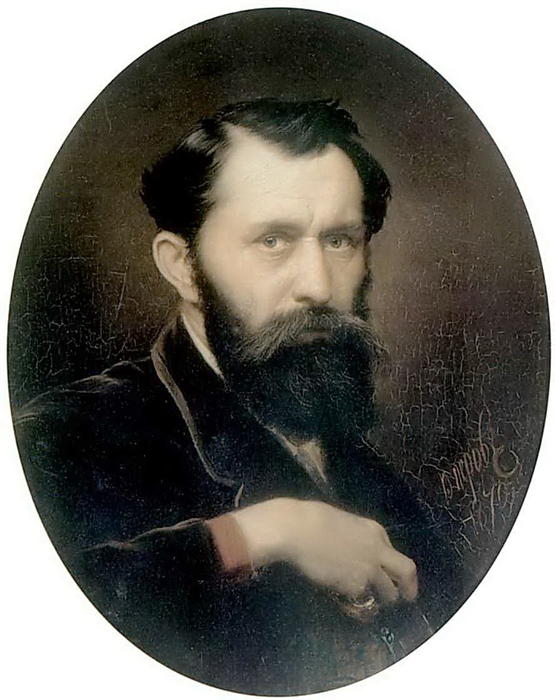
Vasily Grigorevich Perov: A Voice of the Voiceless in Russian Realism
Vasily Grigoryevich Perov, born Vasily Vasiliev on January 21st, 1834, in the remote Siberian town of Tobolsk, stands as a monumental figure in Russian art – a painter whose work transcended mere representation to become a searing indictment of social injustice and a profound exploration of the human condition. His life story is inextricably linked to his artistic vision; born out of wedlock to Baron Grigory Kridener and Akulina Ivanova, Perov’s early years were marked by an unconventional upbringing that instilled within him a deep sensitivity to the inequalities prevalent in 19th-century Russia – a sensitivity he would translate onto canvas with unflinching honesty. The adoption of the surname “Perov,” derived from the Russian word for ‘feather,’ a subtle nod to his early aptitude for calligraphy, foreshadowed his meticulous attention to detail and his dedication to capturing the nuances of everyday life—a world often deliberately obscured by societal norms and political agendas. His formal artistic training began at the Alexander Stupin Art School in Arzamas, where he honed fundamental skills before enrolling at the Moscow School of Painting, Sculpture and Architecture in 1853 – a period crucial for shaping his technical abilities and exposing him to the diverse influences that would inform his distinctive style. Early recognition arrived swiftly, with silver and gold medals awarded by the Imperial Academy of Arts for works such as “Commissary of Rural Police Investigating” and, most notably, "Sermon in a Village" (1861) – a painting that catapulted him into national prominence and secured his place within the prestigious ranks of Russian art.
The Soul of Russia: Themes and Techniques
Perov’s artistic philosophy was rooted in a profound commitment to portraying Russian society with an uncompromising gaze. He deliberately rejected the idealized depictions favored by many of his contemporaries, choosing instead to focus on the lives of ordinary Russians – peasants, laborers, the marginalized, and those often overlooked by official narratives. His paintings weren't simply visual records; they were potent social commentaries, exposing the hardships, injustices, and spiritual emptiness that characterized 19th-century Russia. “Sermon in a Village,” for example, subtly critiques religious hypocrisy by depicting a congregation largely detached from the sermon itself, while "The Queue at the Fountain" starkly illustrates the daily struggles of rural life – the long waits, the meager resources, and the pervasive sense of resignation. His technique was characterized by an extraordinary level of detail—he meticulously rendered every wrinkle, every thread, every expression on his subjects’ faces. This wasn't mere observation; it was a deliberate act of empathy, inviting viewers to confront uncomfortable truths about their own society. Perov’s color palettes were often somber and muted, reflecting the bleak realities he depicted, yet he masterfully employed light and shadow to create dramatic effect and draw attention to key elements within his compositions. He wasn't interested in romanticizing poverty or suffering; rather, he sought to present it with dignity and a quiet sense of sorrow—a refusal to shy away from the difficult aspects of human existence. Works like “The Last Journey,” depicting a peasant funeral procession, and "Troika: Apprentice Workmen Carrying Water" are poignant examples of his ability to evoke profound emotional responses through realistic portrayals of everyday life, imbued with a subtle yet powerful sense of melancholy. His skill extended beyond oil painting; he was also a gifted etcher, as evidenced by the emotionally charged monochromatic work “Naushnitsa. Before the storm,” which showcases his mastery of chiaroscuro and intricate detail.
The Wanderers: A Movement Forged in Realism
Perov’s artistic vision aligned perfectly with the burgeoning spirit of artistic rebellion that led to the formation of the Peredvizhniki (Wanderers) in 1870. This collective of Russian realist painters, disillusioned with the constraints and elitism of the Imperial Academy of Arts, established an independent society dedicated to exhibiting art throughout Russia—reaching audiences beyond the confines of St. Petersburg and Moscow. The Peredvizhniki aimed to bring art directly to the people, fostering a deeper understanding of social issues and promoting a uniquely Russian artistic identity. Perov wasn’t merely a member; he was a driving force behind the movement's formation, instrumental in shaping its ideals and advocating for its principles. His commitment to portraying the lives of ordinary Russians resonated deeply with the Peredvizhniki's mission, solidifying his position as a leading figure within the group. The Wanderers’ exhibitions became immensely popular, attracting large crowds and sparking important conversations about art, society, and national identity—a testament to the power of Perov’s vision.
Major Achievements and Artistic Legacy
Perov’s career was marked by a remarkable string of achievements that cemented his place in Russian art history. He received numerous awards throughout his artistic journey, including a silver medal in 1857 and a grand gold medal in 1861 – the latter securing him the opportunity to study abroad. His painting "Sermon in a Village" (1861) remains arguably his most celebrated work, capturing the essence of Perov’s artistic philosophy with its subtle critique of societal hypocrisy. Beyond this iconic piece, he produced a vast and diverse body of work that explored a wide range of themes – from rural life and poverty to social injustice and religious hypocrisy. Notable works include “The Queue at the Fountain” (1865), depicting the arduous wait for water in a Russian village; "The Last Journey" (1865), portraying a somber peasant funeral procession; “Troika: Apprentice Workmen Carrying Water” (1866), capturing the backbreaking labor of rural workers; and “Drowned Girl” (1867), a haunting depiction of a policeman discovering a drowned body, raising profound questions about life and death. His artistic legacy extends beyond individual masterpieces; he profoundly influenced subsequent generations of Russian realist painters, including Ilya Repin and Vasily Surikov, who built upon his foundation to create their own powerful works of social commentary. Perov’s paintings continue to resonate with audiences today, serving as a poignant reminder of the hardships faced by ordinary people throughout history and prompting reflection on the complexities of human existence.
A Lasting Impact
Vasily Grigorevich Perov tragically died from tuberculosis in 1882 at the age of 48, cutting short a brilliant career but leaving behind an enduring legacy. His works are now housed in prominent collections across Russia, including the Tropinin Gallery and the Moscow Museum of Contemporary Art, ensuring that his vision continues to be appreciated and studied by art lovers worldwide. Perov’s contribution extends beyond mere artistic skill; he was a social conscience etched onto canvas, a voice for the voiceless, and a pioneer of Russian realism—a testament to the power of art to challenge, provoke, and ultimately, illuminate the human experience.


 Bekijk op ware grootte
 Koop handgeschilderd kunstwerk
 Verstuur
 Delen
Delen
 Details bekijken
 Gids
Gids

 Download
 Vergelijkbare items
 Röntgenonderzoek
 Diavoorstelling
 Statistieken


 Lees meer






































 De optie voor glas is alleen beschikbaar bij een formaat kleiner dan 110 cm.


