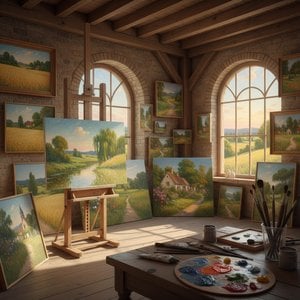
The Quiet Resonance of Ursula Tyrwhitt
In the soft, atmospheric light of the early twentieth century, few artists captured the delicate intersection of domestic intimacy and rugged natural beauty as poignantly as Ursula Tyrwhitt. Born in Nazeing, Essex, to the vicar Henry Mervyn Tyrwhitt, her life was woven into the fabric of English tradition, yet her artistic vision reached far beyond the boundaries of her provincial beginnings. Her journey through the prestigious halls of the Slade School of Fine Art in the 1890s provided the technical foundation upon which she would build a career defined by emotional depth and a masterful command of texture. Through her studies in Paris at the Académie Colarossi and in Rome, Tyrwhitt absorbed the broader currents of European modernism, blending classical discipline with an Impressionistic sensitivity to light and shadow.
Tyrwhitt’s oeuvre is characterized by a profound ability to translate the fleeting sensations of the natural world into enduring visual poetry. Whether she was exploring the sun-drenched landscapes of the Mediterranean or the mist-shrouded coastlines of Cornwall, her work resonates with a quiet, contemplative energy. In masterpieces such as “Haystacks, Mediterranean,” one can observe her skilled use of earthy tones and textured brushstrokes to evoke the warmth and stillness of rural life. Her landscapes were never merely topographical; they were psychological spaces where the interplay of color and impasto served to convey the very essence of the atmosphere, capturing a sense of peace that feels both timeless and deeply personal.
A Tapestry of Connections and Creative Spirit
The narrative of Tyrwhitt’s life is inseparable from her vibrant circle of artistic contemporaries, a group of creators who shared her devotion to capturing the nuances of human emotion. Her close friendship with the Welsh artist Gwen John was particularly transformative, fostering a shared aesthetic centered on the beauty of the mundane and the dignity of the individual. This connection is palpable in their collaborative spirit, seen in works like “Head of a Woman,” where the lines are expressive and the palette muted, reflecting a commitment to portraying subjects with profound empathy. Furthermore, her relationship with the celebrated Augustus Edwin John brought a different dimension to her life; he captured her likeness in a striking portrait now held by the National Portrait Gallery, cementing her place within the influential artistic dialogues of her era.
Beyond her portraits and landscapes, Tyrwhitt’s versatility as an artist allowed her to experiment with diverse mediums, from the fluid grace of watercolor to the sculptural weight of oil paint. Her life was also marked by significant personal milestones, such as her marriage to the artist Walter Spencer Stanhope Tyrwhitt, a union that further embedded her within the creative landscape of Oxford and beyond. As a member of the New English Art Club since 1913, she stood at the forefront of a movement that sought to refine British painting through a modern lens, balancing tradition with an innovative approach to form.
Legacy and Enduring Significance
Though her name may not always command the same immediate recognition as some of her more boisterous contemporaries, the historical significance of Ursula Tyrwhitt lies in her ability to find the extraordinary within the ordinary. Her work serves as a vital record of an era of transition, capturing the shifting light of a world moving toward modernity while clinging to the soulful textures of the past. Today, her contributions are preserved in some of the world's most esteemed institutions, ensuring that her quiet observations continue to inspire:
- The Tate Gallery, where her landscapes and portraits contribute to the narrative of British art history.
- The National Portrait Gallery, London, housing significant depictions of her and by her peers.
- The National Library of Wales, showcasing her connection to the broader British landscape.
- The Ashmolean Museum, which honored her legacy with a retrospective exhibition in 1973.
Ultimately, Tyrwhitt remains an artist of profound grace, a painter who mastered the art of the understated. Her ability to imbue a simple reclining figure or a distant haystack with a sense of spiritual weight ensures that her work remains a captivating study in the power of quiet observation.



 Bekijk op ware grootte
 Schakel over naar print
 Verstuur
 Delen
Delen
 Details bekijken
 Gids
Gids

 Download
 Vergelijkbare items
 Röntgenonderzoek
 Diavoorstelling
 Statistieken


 Lees meer






































 De optie voor glas is alleen beschikbaar bij een formaat kleiner dan 110 cm.