Voorvertoning Bekijk in AR Schakel over naar print Schakel over naar digitale afbeeldingen Verstuur
Details bekijken Gids Toevoegen aan favorieten Download Vergelijkbare items Röntgenonderzoek Diavoorstelling Statistieken

The Annunciation

Discover Titian’s "The Annunciation" (1557), a Baroque masterpiece! Explore its dramatic lighting, dynamic composition & rich colors of this Venetian painting.

Titian Ramsay Peale II's "De dood van Actaeon" is een dramatische renaissance schilderkunst die het verhaal vertelt van Actaeon, waarbij hij wordt achtervolgd door honden en gedood door Artemis en Diana. Een meesterwerk van kleurgebruik en compositie!

Handgemaakte olieverfreproductie

Met de hand geschilderd in olieverf op canvas in uw gewenste maat en lijst, op bestelling gemaakt door onze kunstenaars. ( Schakel over naar print Schakel over naar digitale afbeeldingen)

Corner sample of the P118B picture frame: gegoten polystyreen, 5 cm wide and 3 cm thick
P118B €10
Corner sample of the P118H picture frame: gegoten polystyreen, 5 cm wide and 3 cm thick
P118H €10
Corner sample of the P118W picture frame: gegoten polystyreen, 5 cm wide and 3 cm thick
P118W €10
Corner sample of the P438Z picture frame: gegoten polystyreen, 5.5 cm wide and 3.5 cm thick
P438Z €10
Corner sample of the P508JH picture frame: gegoten polystyreen, 7 cm wide and 3.5 cm thick
P508JH €12
Corner sample of the P508YH picture frame: gegoten polystyreen, 7 cm wide and 3.5 cm thick
P508YH €12
Corner sample of the P805H picture frame: gegoten polystyreen, 5 cm wide and 3.5 cm thick
P805H €10
Corner sample of the P805Z picture frame: gegoten polystyreen, 5 cm wide and 3.5 cm thick
P805Z €10
Corner sample of the P919BZ picture frame: gegoten polystyreen, 7 cm wide and 3.5 cm thick
P919BZ €10
Corner sample of the P919G picture frame: gegoten polystyreen, 7 cm wide and 3.5 cm thick
P919G €10
Corner sample of the P919XJ picture frame: gegoten polystyreen, 7 cm wide and 3.5 cm thick
P919XJ €10
Corner sample of the P959ZH picture frame: gegoten polystyreen, 5 cm wide and 3 cm thick
P959ZH €10
Corner sample of the P968JZ picture frame: gegoten polystyreen, 6 cm wide and 4 cm thick
P968JZ €12
Corner sample of the W106C picture frame: massief hout, 5 cm wide and 3 cm thick
W106C €8
Corner sample of the W218G picture frame: massief hout, 5 cm wide and 3 cm thick
W218G €10
Corner sample of the W218JH picture frame: massief hout, 5 cm wide and 3 cm thick
W218JH €8
Corner sample of the W218Y picture frame: massief hout, 5 cm wide and 3 cm thick
W218Y €10
Corner sample of the W307PJ picture frame: massief hout, 6 cm wide and 3 cm thick
W307PJ €10
Corner sample of the W316G picture frame: massief hout, 6 cm wide and 3 cm thick
W316G €10
Corner sample of the W316PJ picture frame: massief hout, 6 cm wide and 3 cm thick
W316PJ €8
Corner sample of the W316Y picture frame: massief hout, 6 cm wide and 3 cm thick
W316Y €10
Corner sample of the W398PJ picture frame: massief hout, 5 cm wide and 3 cm thick
W398PJ €8
Corner sample of the W4111J picture frame: massief hout, 6.5 cm wide and 3.5 cm thick
W4111J €10
Corner sample of the W500HY picture frame: massief hout, 7 cm wide and 5 cm thick
W500HY €15
Corner sample of the W500JH picture frame: massief hout, 7 cm wide and 5 cm thick
W500JH €15
Corner sample of the W692G picture frame: massief hout, 8 cm wide and 4 cm thick
W692G €12
Corner sample of the W849H picture frame: massief hout, 5 cm wide and 3 cm thick
W849H €8
Corner sample of the W940BG picture frame: massief hout, 7.5 cm wide and 4.5 cm thick
W940BG €15
Corner sample of the W953PJ picture frame: massief hout, 6 cm wide and 3.5 cm thick
W953PJ €8

Standaardformaat
op maat gemaakt
CM
INCH

Kies uit onze vooraf ingestelde maten die overeenkomen met de originele verhoudingen van het kunstwerk.

breedte
hoogte

Voer de breedte en hoogte in die u nodig heeft, passend bij uw lijst of uw muur. Omdat dit handgeschilderd is, kan de kunstenaar bij een afmeting met een andere beeldverhouding iets meer rondom het schilderij schilderen of juist iets meer weglaten — u kiest zelf. Wij sturen u een digitaal mockup ter goedkeuring voordat het schilderwerk begint. De afbeelding die op deze pagina wordt getoond, is niet het uiteindelijke resultaat — alleen de mockup geeft dit weer.

Voorbeelden van aanpassingen: Vervang het gezicht met een eigen foto; Voeg een huisdier toe (bijv. vervang de kat door een hond); Verwerk een verborgen boodschap in de achtergrond; Wijzig het landschap of andere elementen in de achtergrond.
Na de bestelling zal het team van WahooArt.com per e-mail contact opnemen met de klant voor instructies en een mockup-voorbeeld sturen.

Wereldwijde levering () binnen 3 tot 4 weken in plaats van de standaard 5 weken. (26 oktober). Zonder concessies aan de kwaliteit.

Gratis wereldwijde expressverzending
Hoogwaardig linnen canvas
Volledige verzendverzekering
Garantie op terugbetaling van invoerrechten
Garantie op exacte kleurweergave
Retourbeleid van 100 dagen (alleen bij defecten)
100% Geld-terug-garantie
Korting bij meerdere afnames

Totaalprijs

€ 261

The Annunciation

Druktechniek

Afmetingen reproductie

-

Eindtotaal

€ 261

Snelle feiten

  • Dimensions: 280 x 21 cm
  • Notable elements: Pyramidal comp.
  • Medium: Oil on Canvas
  • Location: Palace of Capodimonte
  • Influences: Renaissance
  • Year: 1557

Kunstquiz

Er is slechts één goed antwoord op elke vraag.

Vraag 1:
What artistic movement is most closely associated with ‘The Annunciation’?
Vraag 2:
The composition of 'The Annunciation' primarily utilizes which structural element?
Vraag 3:
What is the dominant color palette used in ‘The Annunciation’?
Vraag 4:
Which of the following best describes the lighting technique employed in ‘The Annunciation’?
Vraag 5:
Considering Titian Ramsay Peale II’s background and artistic influences, what is a key characteristic of his work evident in ‘The Annunciation’?

The Annunciation: A Baroque Dialogue of Grace and Revelation

Titian Ramsay Peale II’s “The Annunciation,” painted in 1557, is more than just a depiction of a pivotal biblical moment; it's a carefully constructed tableau brimming with the emotional intensity and dramatic lighting characteristic of late Renaissance – specifically, Baroque – art. This masterful work transports us to a space both sacred and subtly unsettling, inviting contemplation on themes of divine grace, human humility, and the profound mystery at the heart of faith. Peale’s interpretation diverges from purely literal representation, opting instead for a heightened emotionalism that resonates powerfully with viewers centuries later.

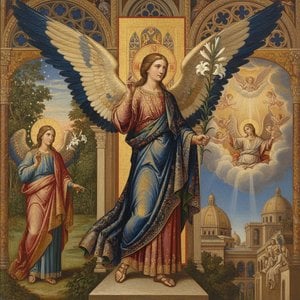
The scene unfolds within an undefined, almost dreamlike space – a dark void punctuated by subtle architectural elements suggesting a modest dwelling. The focus immediately draws the eye to the kneeling woman, Mary, rendered in exquisite detail. Her posture conveys both vulnerability and profound absorption; her hands clasped together, her gaze fixed upward with an expression of awe and gentle surprise. This isn’t merely a passive recipient of divine news but a figure actively engaged in a momentous encounter. The artist skillfully uses light to sculpt her form, highlighting the delicate contours of her face and emphasizing the weight of this revelation.

A Symphony of Color and Movement

Peale's palette is dominated by rich browns, deep golds, and muted reds – colors that evoke a sense of solemnity and reverence. These warm tones are juxtaposed with cooler blues and purples in the swirling clouds above, creating a dynamic interplay between earthly humility and celestial splendor. The drapery, particularly the voluminous robes of the angel, is rendered with meticulous attention to detail, utilizing layered impasto – thick applications of paint that create a tactile, almost sculptural effect. This technique not only adds depth and texture but also contributes to the overall sense of drama and movement within the composition.

The use of curved lines—particularly in the flowing drapery and the wings of the angel—is paramount to the painting’s dynamic feel. These lines guide the viewer's eye through the scene, creating a sense of continuous motion and upward aspiration. The positioning of the ascending cherubs further reinforces this feeling of ascension, symbolizing the divine presence reaching down to earth. The pyramidal composition, anchored by Mary’s kneeling form and culminating in the angel and celestial elements, provides stability while simultaneously directing the eye upwards towards the heavens.

Symbolism and Artistic Echoes

“The Annunciation” is rich in symbolic meaning. The angel, rendered with powerful wings and a commanding presence, represents divine grace and the messenger of God’s will. Mary's posture embodies humility and receptivity – she is not demanding answers but humbly accepting the extraordinary news. The architectural details, though subtly suggested, hint at the familiar setting of Nazareth, grounding the miraculous event in a tangible reality. The painting draws heavily on the artistic traditions of the High Renaissance, particularly the works of Raphael and Leonardo da Vinci, yet Peale imbues it with a distinctly Baroque sensibility – a heightened emotionalism, dramatic lighting, and an emphasis on movement and dynamism.

Furthermore, it’s important to consider Peale's lineage. As the son of Charles Willson Peale, a pivotal figure in early American art and founder of the first museum, Titian Ramsay Peale II inherited a legacy of scientific observation and artistic exploration. This influence is evident in his meticulous detail and his commitment to capturing both the beauty and the complexity of the natural world – as seen in his extensive wildlife paintings. “The Annunciation” thus represents a fascinating synthesis of High Renaissance ideals with New World sensibilities, creating an artwork that is both timelessly beautiful and deeply rooted in its historical context. It’s a powerful testament to the enduring appeal of religious iconography and the artist's ability to translate profound spiritual themes into visually arresting form.

Veelgestelde vragen

Hoe komen stroming en tijdperk samen in "The Annunciation" door Titian Ramsay Peale II?

"The Annunciation" behoort tot de Baroque-stroming en de maker ervan was werkzaam in het 19e eeuw-tijdperk.

Zijn de kleuren van "The Annunciation" door Titian Ramsay Peale II levendig of gedempt?

"The Annunciation" door Titian Ramsay Peale II is vastgelegd met een Subtle Color verzadiging en een Monochromatic intensiteit.

Is "The Annunciation" typerend voor het werk van Titian Ramsay Peale II?

Binnen de bekende thema's van Titian Ramsay Peale II - titian's venetian mastery, divine grace and humility, counter-reformation piety, symbolic celestial vision, iconic annunciation depiction, key work in artist's output, emphasis on color & emotion - legt "The Annunciation" een eigen focus op annunciation, angel, virgin mary, divine revelation, religious art, baroque painting, spiritual encounter, celestial.


Biografie kunstenaar

Een Renaissance Echo in de Nieuwe Wereld

Titian Ramsay Peale II (1799-1885) neemt een fascinerende, vaak over het hoofd geziene positie in binnen het landschap van de 19e-eeuwse Amerikaanse kunst. Geboren in Philadelphia, was hij doordrenkt van artistieke afkomst als de jongste zoon van Charles Willson Peale, een sleutelfiguur in de vroege Amerikaanse portretschilderkunst en oprichter van het eerste museum van het land. Hoewel de erfenis van zijn vader groot was, smidde Titian zijn eigen pad, geworteld in de esthetische idealen van de Hoge Renaissance, met name die uit Venetië. Hij repliceerde stijlen niet louter; hij kanaliseerde een diepgaand artistiek gevoel en doordreef zijn doeken met minutieuze details en levendige kleuren die hem onderscheiden van veel tijdgenoten. Zijn leven ontvouwde zich tegen de achtergrond van een opkomende Amerikaanse identiteit, maar zijn artistieke hart bleef verbonden aan de klassieke meesters, waardoor een boeiende spanning ontstond tussen oude-wereld eerbiediging en nieuwe-wereld expressie.

Van Natuuronderzoeker’s Schetsboek tot Schilderscanvas

De vroege jaren van Peale werden gekenmerkt door een dubbele fascinatie voor kunst en natuurlijke historie – een combinatie die werd bevorderd door de veelzijdige bezigheden van zijn vader. Hij vergezelde expedities, met name de reis van Stephen Harriman Long naar de Rocky Mountains in 1819-20, waarbij hij flora en fauna documenteerde met een steeds verfijnder artistieke blik. Deze periode ging niet alleen over het vastleggen van observaties; het ging om *begrip* van vorm, licht en textuur – vaardigheden die onmisbaar zouden blijken te zijn toen hij zich volledig op de schilderkunst toelegde. Zijn werk als natuuronderzoeker informeerde zijn kunst, gaf een wetenschappelijke precisie aan zijn afbeeldingen van de natuurlijke wereld, maar doordreef ze ook met een emotionele resonantie die verder ging dan louter documentatie. Hij liet ons niet alleen zien hoe dingen eruitzagen; hij onthulde hun inherente schoonheid en spirituele betekenis. Deze toewijding aan beide disciplines komt tot uiting in stukken als “The Tribute Money”, een dramatische weergave die meesterlijk licht en schaduw laat zien, doet denken aan Rubens, en "Nymph and Shepherd", dat natuur, mythologie en zintuiglijke schoonheid combineert.

Venetiaanse Invloeden en Heilige Visies

De invloed van Venetiaans colorisme – de nadruk op rijke, lichtgevende kleuren en atmosferische effecten gepromoot door kunstenaars als Titiaan (naar wie hij zijn voornaam ontleende) – is onmiskenbaar in het oeuvre van Peale. Hij kopieerde deze meesters niet louter; hij internaliseerde hun principes en paste ze aan op zijn eigen artistieke visie. Dit komt met name tot uiting in zijn religieuze werken, zoals “Altar Shrine with Four Saints” en "Adoration of the Shepherds". Deze schilderijen zijn niet slechts afbeeldingen van Bijbelse scènes; het zijn meeslepende ervaringen die de kijker door zorgvuldig georkestreerde composities en een meesterlijke inzet van kleur om emotie op te wekken, in een wereld van spirituele contemplatie trekken. De minutieuze aandacht voor detail in deze werken getuigt niet alleen van zijn technische vaardigheid, maar ook van diepe eerbiediging voor zijn onderwerp. “The Beauty”, een opvallend portret, demonstreert verder zijn vermogen om menselijke vorm en karakter met elegantie en verfijning vast te leggen.

Herontdekking en Blijvende Betekenis

Gedurende het grootste deel van de 20e eeuw bleef Titian Ramsay Peale II grotendeels verborgen in kunsthistorische overzichten. Zijn werk paste niet netjes in de heersende trends, en zijn toewijding aan een klassieke stijl voelde anachronistisch aan in een snel veranderend artistiek landschap. De laatste jaren is er echter een groeiende herwaardering van zijn bijdragen gekomen. Kunsthistorici en verzamelaars erkennen de unieke combinatie van Amerikaanse gevoeligheden en Europese tradities die zijn schilderijen kenmerkt. De herontdekking van zijn werk gaat niet alleen over het opvullen van lacunes in de kunstgeschiedenis; het gaat om een ​​dieper begrip van de complexe culturele krachten die de 19e-eeuwse Amerika hebben gevormd. Peale vertegenwoordigt een brug tussen werelden, een getuigenis van de blijvende kracht van klassieke idealen en een herinnering dat artistische innovatie vaak voortkomt uit onverwachte combinaties van invloeden. Zijn schilderijen, nu te vinden in collecties zoals die van WahooArt, de Uffizi Gallery en Palazzo Pitti, bieden een boeiende blik op een vergeten hoek van de Amerikaanse kunstgeschiedenis – een hoek verlicht door de stralende gloed van de Renaissance.

Een Complex Palet: Peale’s Uitdagingen en Legacy

Ondanks zijn talent en vroege succes, kende Peale's carrière periodes van onzekerheid en teleurstelling. De concurrentie met gevestigde kunstenaars zoals Audubon was hevig, en de veranderende smaak in Amerika gaf de voorkeur aan meer realistische of romantische stijlen dan zijn klassieke benadering. Het falen van het familie museum en persoonlijke tragedies droegen bij aan een periode van financiële en artistieke stagnatie. Hij vond werk als examinator op het Patent Office in Washington D.C., waar hij zich wijdde aan fotografie, maar kon nooit meer de status bereiken die hij ooit had genoten als naturalist-schilder. Toch is zijn nalatenschap aanzienlijk. Zijn gedetailleerde botanische en ornithologische illustraties blijven een waardevolle bron voor wetenschappers en kunstliefhebbers. Zijn religieuze werken getuigen van een diepe spirituele gevoeligheid, en zijn portretten vangen de essentie van zijn tijdgenoten met opmerkelijke elegantie. De recente herontdekking van zijn werk heeft geleid tot een groeiend aantal tentoonstellingen en publicaties, waardoor zijn bijdrage aan de Amerikaanse kunst eindelijk wordt erkend. Titian Ramsay Peale II was meer dan alleen de zoon van een beroemde schilder; hij was een getalenteerd kunstenaar, een toegewijde naturalist en een visionair die probeerde de schoonheid en harmonie van de natuurlijke wereld te vangen in zijn doeken. Zijn verhaal is een herinnering dat artistieke waarde niet altijd onmiddellijk wordt herkend, maar dat ware genialiteit uiteindelijk de tand des tijds kan doorstaan.

Titian Ramsay Peale II

Titian Ramsay Peale II

1799 - 1885 , Verenigde Staten

Belangrijkste feiten

  • Artistic Movement Or Style: Hoge Renaissance
  • Artists Who Influenced This Artist:
    • Titian
    • Rubens
  • Date Of Birth: 1799
  • Date Of Death: 1885
  • Full Name: Titian Ramsay Peale II
  • Nationality: Amerikaans
  • Notable Artworks:
    • The Tribute Money
    • Nymph and Shepherd
Ontdek kunstwerken georganiseerd op thema, stijl en kenmerk.