Biografie van de kunstenaar
A Visionary of Cookham: The Life and Art of Sir Stanley Spencer
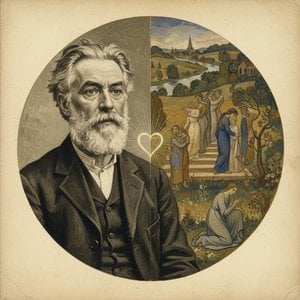
Sir Stanley Spencer was, without a doubt, one of the most distinctive and profoundly personal artists to emerge from Britain in the 20th century. His entire life and artistic output were inextricably linked to his birthplace – the small village of Cookham, Berkshire – transforming it into a living, breathing spiritual realm where biblical narratives unfolded with startling intimacy and modern sensibility. Born on June 30th, 1891, into a large family deeply rooted in religion and literature, Spencer’s early education was shaped by his sisters, Annie and Florence, who provided him with an unconventional yet stimulating home environment before he enrolled at the Slade School of Fine Art in London from 1908 to 1912. This formal training offered a foundation, but it was Cookham itself – which he famously described as “a village in heaven” – that truly became the bedrock of his artistic vision, informing every brushstroke and shaping his unique perspective.
Early Influences and the Pre-Raphaelite Spirit
Spencer’s distinctive style wasn't born in a vacuum; it was forged through a careful synthesis of diverse influences. The meticulous detail and reverence for nature characteristic of the Pre-Raphaelites resonated deeply within his work, mirroring the romanticism and symbolic richness found in artists like Millais and Rossetti. However, Spencer wasn’t merely replicating past masters. He absorbed elements of French Post-Impressionism, particularly the expressive use of color championed by Paul Gauguin – a bold departure from the muted tones often associated with British art at the time. Furthermore, he drew inspiration from early Italian painting, notably Giotto's masterful compositions, which demonstrated a remarkable ability to convey emotion and narrative through simple forms and vibrant colors. Yet, despite these influences, Spencer ultimately forged his own path, creating a style that was both deeply personal and profoundly original. His paintings weren’t simply illustrations of biblical stories; they were intensely subjective interpretations, populated by villagers he knew intimately – farmers, shopkeepers, churchgoers – cast as biblical figures in a familiar setting. This deliberate blurring of the sacred and secular was revolutionary, elevating everyday life to a level of spiritual significance.
The Resurrection, Cookham: A Groundbreaking Masterpiece
Perhaps the most iconic example of Spencer’s unique approach is *The Resurrection, Cookham* (1924-1926), now housed in the Tate Gallery in London. This monumental painting isn't a grand, ethereal depiction of resurrection; instead, it’s a vibrant, earthy scene unfolding in the fields surrounding Cookham, with local residents – including his sisters and neighbors – rising from their graves. The painting is filled with an almost palpable sense of joy and wonder, yet it retains a remarkable grounding in reality. Spencer masterfully captured the textures of the earth, the light filtering through the trees, and the expressions on the faces of the villagers, creating a scene that feels both utterly fantastical and deeply familiar. *The Resurrection, Cookham* demonstrated Spencer’s ability to transform the ordinary into the extraordinary, revealing the sacred within the mundane. It was hailed by critics as “the most important picture painted by any English artist in the present century,” solidifying his reputation as a visionary of unparalleled originality.
Wartime Reflections and Public Service
Spencer's artistic journey wasn’t confined to idyllic landscapes and biblical scenes; he also responded profoundly to the horrors of World War I and the challenges of the interwar period. Serving first at the Beaufort War Hospital in Bristol, where he cared for wounded soldiers, and later in Macedonia, witnessing firsthand the devastation of conflict, Spencer channeled his experiences into a series of powerful paintings. His most significant wartime commission was the creation of murals for the Sandham Memorial Chapel at Burghclere in Hampshire (1927-1932), built to commemorate a soldier who had died from an illness contracted in Macedonia. These monumental paintings weren’t glorifications of war; they were honest, unflinching depictions of the lives of ordinary soldiers – their routines, anxieties, and quiet moments of contemplation. The arrangement consciously echoed Giotto's Arena Chapel, but Spencer infused it with a uniquely British sensibility and a deeply humanistic perspective. Later, during World War II, he again served as an Official War Artist, documenting the vital work being done in the shipyards on the Clyde. These paintings, like his earlier wartime works, focused not on heroic battles but on the collective effort and resilience of those contributing to the war effort.
A Complex Legacy: Controversy and Enduring Influence
Despite his artistic brilliance, Spencer’s career wasn't without its challenges. His intensely personal vision and unconventional depictions of religious themes often provoked controversy. The frankness with which he explored sexuality in works like *Love Among the Nations* (1935) and his nude portraits of his second wife, Patricia Preece, scandalized some critics and led to rejection from the Royal Academy for a period. His personal life was equally complex, marked by passionate relationships and emotional turmoil. He married Hilda Carline in 1918, but their relationship was fraught with difficulties, eventually leading to divorce in 1937. His subsequent marriage to Patricia Preece proved equally turbulent, yet it inspired some of his most daring and innovative work. Despite these controversies, Spencer’s influence on later generations of artists is undeniable. He foreshadowed aspects of Lucian Freud's unflinching realism and paved the way for a more honest and emotionally charged approach to religious art. Sir Stanley Spencer was knighted in 1959, shortly before his death on December 14th, 1959, leaving behind a body of work that continues to captivate and challenge viewers with its unique blend of spirituality, humanity, and artistic innovation. His paintings remain powerful testaments to the enduring search for meaning within the ordinary moments of life, forever anchored in the landscape he so deeply loved – Cookham, his village in heaven.



 Voorvertoning
 Bestel handgeschilderde reproductie
 Verstuur
 Delen
Delen
 Details bekijken

 Download
 Vergelijkbare items
 Röntgenonderzoek
 Diavoorstelling
 Statistieken
 Lees meer






































 De optie voor glas is alleen beschikbaar bij een formaat kleiner dan 110 cm.