Ontvang een bestand dat klaar is voor drukwerk en de kwaliteit van het online voorbeeld ver overstijgt. Elke digitale afbeelding die wij verkopen, is afkomstig van een high-resolution master uit onze database — meestal tussen de 5.000 en 15.000 pixels breed — zodat u met vertrouwen groot kunt afdrukken, nauwkeurig kunt bijsnijden of fijne details kunt reproduceren.
Geen enkel bestand verlaat ons atelier onbewerkt. Een digitaal expert controleert de kleuren aan de hand van het originele schilderij en corrigeert deze indien nodig, om vervolgens de helderheid en details te verbeteren met professionele retoucheertechnieken — waarbij de penseelstreek en stijl van de kunstenaar altijd strikt worden gerespecteerd. Het resultaat is een afbeelding die oogt als het schilderij zelf, en niet als een gescande foto met een filter.
U keurt de afbeelding goed voordat de bestelling wordt afgerond: onze expert stuurt u binnen 72 uur een e-mail ter beoordeling. Niet tevreden? Vraag om aanpassingen of correcties, of vraag een terugbetaling aan als de kwaliteit niet aan de verwachtingen voldoet.
Dit is de kwaliteit waarop uitgevers, designstudio's, galeries en drukkerijen vertrouwen.
Download een bestand met hoge resolutie voor persoonlijke weergave, afdrukken en creatieve projecten. ( Schakel over naar print Bestel handgeschilderde reproductie)
Wanneer u kiest voor WahooArt.com, ontvangt u niet alleen een afbeelding – u krijgt een professioneel verbeterd digitaal kunstwerk, met precisie vervaardigd en voorzien van een tevredenheidsgarantie. Dit is alles wat automatisch bij uw bestelling is inbegrepen:
Uw hoogwaardige digitale afbeeldingsbestand wordt binnen 72 uur na bestelling naar u gemaild – klaar voor direct gebruik.
Uw kunstwerk wordt professioneel geoptimaliseerd met behulp van geavanceerde AI-tools en handmatige bewerkingen, waardoor maximale details, helderheid en kleurnauwkeurigheid worden gegarandeerd.
Je bestand per ongeluk verwijderd of kwijtgeraakt? Geen zorgen – we sturen het u op elk gewenst moment gratis opnieuw toe.
Geniet direct van uw kunstwerk zonder invoerrechten, belastingen of verzendkosten – digitale downloads zijn altijd belastingvrij.
Met behulp van professionele hulpmiddelen en kleurbeheer zorgen wij ervoor dat uw digitale afbeelding de originele kleuren zo nauwkeurig mogelijk weergeeft.
Mocht u niet tevreden zijn met uw digitale afbeelding, dan passen wij deze aan of storten wij 100% terug binnen 100 dagen – zonder vragen te stellen.
Niet tevreden? Ontvang een volledige terugbetaling binnen 100 dagen na ontvangst van uw digitale bestand – zonder vragen te stellen.
Koop 3 afbeeldingen, bespaar 10% - Koop 5, bespaar 15% - Koop 10+, bespaar 20%. Ideaal voor creatieve projecten, galerieën en bureaus.
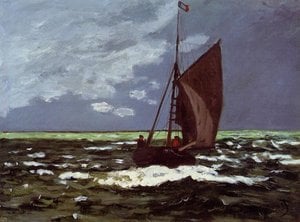
A heavy, dark indigo water rises in diagonal lines across the canvas. Large, cresting waves move with a raw, turbulent energy, pushing toward the viewer from a low vantage point within the sea itself. Deep charcoal grays and blacks dominate the depths of the ocean, while muted whites mark the churning foam at the peaks. The ships appear as dark silhouettes, their sharp, angular masts providing a structural contrast to the organic, undulating shapes of the waves. Light breaks through thick, overcast clouds in a chiaroscuro effect, catching only the highest points of the spray and the edges of the vessels.
The year 1627 marks this moment of maritime peril. The painting utilizes oil on canvas to achieve atmospheric depth and realistic light effects characteristic of Baroque maritime painting. Through delicate brushwork, a sense of mist and salt spray settles over the scene. The composition captures multiple sailing vessels struggling against massive swells, creating a feeling of isolation and the immense power of nature. A pale ochre tint touches the heavy clouds above the dark water.
The sea remains restless.
"Seascape" door Claes Claesz. Wou toont: waves, ships, sea, clouds, dark blue, white foam, ocean.
Wat betreft het auteursrecht valt "Seascape" onder bevindt zich in het publiek domein - de auteursrechten zijn verlopen.
"Seascape" kan laag voor laag worden onderzocht op de Röntgenanalyse pagina van het kunstwerk, een interactieve viewer geïnspireerd op de lichttafel van een restaurator met elf optische lagen van de afbeelding.

In the narrow streets of Amsterdam, where the water meets the stone, Claes Claesz. Wou lived a life tied to the movement of the tides. Born in 1592, he was a man of the city, moving from the quiet outskirts of Buitenveldert to the bustling Prinsengracht near the Laurierstraat. He was more than a painter; he held the position of a waard in 't Groene Woudt, a role that suggests a life deeply embedded in the local community. There was a certain social weight to his presence, though perhaps not a financial one. At the time of his death in 1665, he left behind many debts owed by his fellow artists, a detail that hints at a man who lived closely among his peers, perhaps spending as much time in their company as he did at his easel.
His hands were accustomed to the brush, but his eyes were fixed on the horizon. He did not seek the bright, clear skies of the Mediterranean. Instead, he found his subject in the heavy, churning waters of the North Sea. His work focused on the struggle of ships against the elements, capturing the weight of a storm and the spray of salt against wood.
Wou’s technique was one of restraint and atmosphere. He did not rely on a wide palette to tell his story. Instead, he worked within a restricted range, often using a monochrome grey to build the depth of a storm. He understood how light breaks through a heavy sky to hit the crest of a wave. His compositions were defined by a low horizon, a choice that forces the viewer to look up at the vastness of the sky and the chaos of the water, making the ships appear small and vulnerable against the immense scale of the ocean.
His approach to the sea was shaped by specific technical choices:
The influence of Wou can be seen in the way he translated the movement of water onto a flat surface. He was not a solitary figure in the art world, but one who sat at the center of a circle of makers. It is believed that he may have been the teacher of Jan Abrahamsz. van Beerstraten, another painter who dedicated his life to the same maritime subjects. This connection suggests a continuity of style and a passing down of the specific way to capture a storm. He remained active in his craft from 1612 until his death in 1665, a long life spent observing the way the light changes over the water.

1592 - 1665 , Netherlands
 Voorvertoning

 Verstuur
 Delen
 Details bekijken
 Gids


 Download
 Vergelijkbare items
 Röntgenonderzoek
 Diavoorstelling
 Vraag & antwoord

 Statistieken


 Lees meer