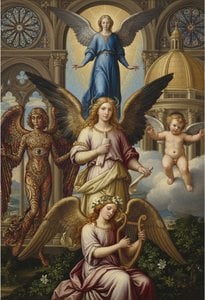
A Vision of Grace: Botticelli’s Angel and the Renaissance Ideal
In the quietude of the Florentine Renaissance, few images capture the ethereal intersection of the divine and the human as poignantly as Sandro Botticelli’s “Angel.” Painted during the height of the Quattrocento, approximately between 1475 and 1485, this masterpiece serves as a profound window into an era defined by spiritual longing and classical rebirth. The painting presents us with a celestial figure—an angel manifested in the delicate form of a woman—whose presence commands the canvas with a serene yet powerful grace. As her gaze drifts upward toward the heavens, she invites the viewer to share in her moment of profound contemplation, bridging the gap between our earthly realm and the infinite.
The composition is a masterclass in pyramidal stability, a hallmark of Renaissance technique that provides the artwork with an enduring sense of balance and permanence. While the angelic figure dominates the left side of the frame, her reaching arm suggests a dynamic movement, a silent dialogue with the unseen. Beside her, the secondary presence of a male figure adds a layer of narrative depth, grounding the celestial event within a human context. This careful arrangement ensures that while the subject matter is supernatural, the emotional resonance remains deeply relatable to the human experience.
Mastery of Line and the Luminous Tempera Technique
To behold this work is to witness Botticelli’s unparalleled command over line and luminosity. Eschewing the heavy, dramatic realism that would later define the Baroque period, Botticelli utilizes a style characterized by flowing, rhythmic curves and soft, pastel hues. His use of tempera on panel—a medium requiring meticulous, layer-by-layer application—allows for a translucent quality that makes the angel’s skin appear to glow from within. Every fold of her drapery and every strand of her cascading hair is rendered with a precision that celebrates the beauty of detail.
This delicate approach to technique does more than just showcase skill; it reinforces the painting's thematic essence. The soft edges and fluid contours mirror the humanist ideals of the time, which sought to find harmony and proportion in all things. For the discerning collector or interior designer, this piece offers a sophisticated aesthetic that brings a sense of calm, classical elegance to any space. The subtle tonal variations and the gentle interplay of light and shadow create an atmosphere of quiet luxury, making it a timeless addition to a curated collection.
Historical Resonance and Emotional Depth
The historical backdrop of this painting is as rich as its visual textures. Created during the illustrious reign of Lorenzo de' Medici, the "Magnificent," the work is steeped in the intellectual ferment of Florence. This was a period when the rediscovery of classical antiquity fueled an artistic revolution, encouraging painters to explore the divine through the lens of idealized human beauty. The angel’s upward gaze is not merely a gesture; it is a symbol of aspiration and spiritual transcendence, reflecting the Renaissance belief in the potential of the soul to reach toward the divine.
Ultimately, Botticelli’s “Angel” transcends its historical era to offer a universal emotional impact. It evokes a sense of wonder, peace, and reverence that remains undiminished by the passage of centuries. Whether viewed as a historical artifact of the Florentine school or as a breathtaking piece of decorative art, the painting continues to inspire awe. For those seeking to surround themselves with art that speaks to the soul, this reproduction offers an opportunity to possess a fragment of the Renaissance spirit—a permanent reminder of grace, beauty, and the eternal search for meaning.
Veelgestelde vragen
Tot welke periode in de carrière van Sandro Botticelli behoort "Angel"?
"Angel" vertegenwoordigt de Mature Period van Sandro Botticelli.
Maakt "Angel" door Sandro Botticelli gebruik van sterke contrasten of zachte harmonieën?
De kleurcompositie van "Angel" door Sandro Botticelli combineert een Gentle contrast met een Unified Palette harmonie.
Uit welke historische periode stamt "Angel" door Sandro Botticelli?
"Angel" door Sandro Botticelli dateert uit de Renaissance-periode. Deze classificatie plaatst het werk binnen de kunstgeschiedenis.



 Voorvertoning
 Bestel handgeschilderde reproductie
 Verstuur
 Delen
Delen
 Details bekijken
 Gids
Gids

 Download
 Vergelijkbare items
 Röntgenonderzoek
 Diavoorstelling
 Statistieken

 Lees meer






































 De optie voor glas is alleen beschikbaar bij een formaat kleiner dan 110 cm.