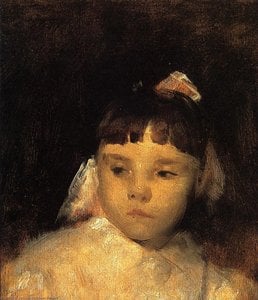
Nelson: A Glimpse into American Realism
Robert Henri’s "Nelson," painted in 1914, stands as a poignant example of
American Realism, capturing the essence of
everyday life with striking honesty and
emotional depth. This
oil on canvas portrait depicts a young boy, his gaze direct and seemingly introspective, inviting viewers to contemplate his inner world. The painting's power lies not just in its skillful execution but also in
Henri’s ability to convey a sense of quiet dignity and perhaps even a touch of melancholy through the subject's posture and expression. The deep
blue background serves to isolate Nelson, focusing attention on his face and upper body, enhancing the intimacy of the portrait.
The Artist and His Vision: Robert Henri and the Ashcan School
Robert Henri (1865-1929) was a pivotal figure in
American art, renowned for his bold style and commitment to portraying
urban life with unflinching
realism. As a leading member of the
Ashcan School,
Henri rejected the idealized subjects favored by traditional
academic painting, instead choosing to depict scenes from everyday existence – bustling city streets,
working-class neighborhoods, and ordinary people. His approach was revolutionary, challenging artistic conventions and paving the way for future generations of American artists.
Henri’s influence extended beyond his own paintings; he was a dedicated teacher who encouraged his students to find beauty and significance in the commonplace, fostering a spirit of independent expression and social awareness within the art world. He was also an organizer of "The Eight," a group of artists who protested against the restrictive exhibition practices of the
National Academy of Design, further solidifying his reputation as a champion of artistic freedom.
Composition and Technique: Capturing Emotion Through Brushwork
Henri’s technique in “Nelson” is characterized by loose, expressive brushstrokes that imbue the painting with a sense of energy and spontaneity. The visible texture of the paint adds depth and dimension to the portrait, creating a dynamic interplay between
light and shadow. The artist's use of color is equally impactful; the
warm tones of Nelson’s skin contrast beautifully with the cool
blue background, drawing the viewer's eye directly to the subject. The composition itself is deliberately simple, allowing the focus to remain squarely on Nelson’s face and expression. This deliberate restraint amplifies the emotional impact of the portrait, inviting viewers to project their own interpretations onto the young boy’s contemplative gaze. The absence of distracting details further emphasizes the intimacy between the viewer and the subject, creating a powerful sense of connection.
Symbolism and Emotional Resonance
While seemingly straightforward in its depiction, "Nelson" carries layers of symbolic meaning. The boy's posture—arms crossed, head slightly bowed—suggests introspection or perhaps a quiet defiance. His direct gaze challenges the viewer, inviting them to engage with his emotions and experiences.
Henri’s choice to portray Nelson not as an idealized figure but as a real boy, complete with subtle imperfections, speaks to his commitment to portraying humanity in all its complexity. The painting evokes a sense of nostalgia and reflection, prompting viewers to consider the lives and stories of those often overlooked by mainstream society. "Nelson" is more than just a portrait; it's a window into a specific moment in time, capturing the spirit of
American Realism and offering a glimpse into the heart of an individual.
Veelgestelde vragen
Welk kleurenpalet wordt gebruikt in "Nelson" door Robert Henri?
Het kleurenpalet van "Nelson" door Robert Henri wordt beschreven als Dark. Het is een beknopte beschrijving van de kleuren in het werk.
Hoe oud was Robert Henri bij het creëren van "Nelson" in 1914?
Robert Henri maakte "Nelson" op 49-jarige leeftijd. De kunstenaar werd geboren in 1865 en het werk dateert uit 1914.
Toont "Nelson" sterke licht-donkercontrasten?
"Nelson" door Robert Henri vertoont een Statement contrast tussen de lichte en donkere partijen.