The Enigmatic Allure of René Magritte’s “The Beautiful Realities”
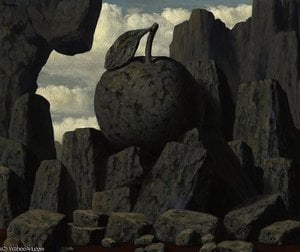
René Magritte's "The Beautiful Realities," a deceptively simple painting featuring an apple suspended in mid-air above a white tablecloth, is far more than a visual trick. It’s a profound meditation on perception, representation, and the very nature of reality itself – a cornerstone of Surrealist thought that continues to resonate with viewers today. Painted around 1928-1929, during Magritte's intensely productive period in Paris, this work exemplifies his signature style: an unsettling juxtaposition of familiar objects placed within illogical or dreamlike contexts. The painting immediately challenges our assumptions about how we see the world; it’s a deliberate disruption designed to provoke questions rather than offer easy answers.
Magritte's artistic journey leading up to this iconic piece was marked by a fascinating evolution. Initially drawn to Impressionism, he later embraced Cubism and Futurism, absorbing their innovative techniques while simultaneously developing his own distinct visual language. The influence of Giorgio de Chirico, with his enigmatic cityscapes and unsettling figures, is particularly evident in the painting’s mood – a sense of melancholy and mystery that permeates the scene. The subtle details, like the slightly blurred edges of the apple and tablecloth, contribute to this feeling of unreality, suggesting that what we perceive isn't necessarily what *is*.
Deconstructing Reality: Symbolism and Technique
At its core, “The Beautiful Realities” operates as a visual paradox. The apple, a symbol of temptation, knowledge, and even mortality throughout art history, is rendered weightless, defying gravity and existing in a space that shouldn’t allow it to float. This deliberate suspension isn't merely a technical exercise; it represents the breakdown of logical expectations. The white tablecloth, typically associated with domesticity and order, becomes an ambiguous surface – a barrier between the viewer and the apple, or perhaps a representation of the limitations of our understanding.
Magritte’s technique is meticulously controlled yet subtly unsettling. He employed a precise, almost photographic realism in his rendering of the objects, creating a startling contrast with their illogical arrangement. The smooth brushstrokes and careful attention to detail heighten the sense of artificiality, reinforcing the painting's central theme: that representation can be deceptive. He utilized a limited palette – primarily muted greens, whites, and browns – further contributing to the painting’s dreamlike quality. This restrained approach allows the symbolic weight of the objects to take center stage.
A Legacy of Questioning
“The Beautiful Realities” is not simply a charming visual puzzle; it's a key work in understanding Magritte’s broader artistic project. He wasn’t interested in creating beautiful images for their own sake, but rather in exposing the mechanisms by which we construct our perception of reality. His paintings consistently challenge viewers to question what they see and to consider alternative ways of interpreting the world around them.
The painting's influence extends far beyond the Surrealist movement. It has resonated with artists across various disciplines, including Pop Art (particularly Andy Warhol’s use of familiar imagery) and Conceptual Art, where the idea behind the artwork is often more important than its aesthetic qualities. Reproductions of “The Beautiful Realities” continue to be popular choices for interior design, bringing a touch of intellectual intrigue and surreal beauty to any space. Its enduring appeal lies in its ability to spark conversation and invite viewers to contemplate the mysteries of existence – a testament to Magritte’s genius as one of the 20th century's most profound artists.
Bringing “The Beautiful Realities” Home
WahooArt offers meticulously crafted, hand-painted reproductions of René Magritte’s "The Beautiful Realities," ensuring that you experience the full impact of this iconic artwork. Our skilled artisans replicate Magritte's precise technique and subtle nuances with exceptional care, capturing the painting's dreamlike atmosphere and symbolic depth. Whether you are an art collector, a design enthusiast, or simply someone seeking to add a touch of intellectual stimulation to your surroundings, our reproduction provides a beautiful and authentic representation of this seminal work.
Explore our high-resolution digital reproductions and hand-painted versions – each meticulously crafted to preserve the original’s captivating mystery. Discover how “The Beautiful Realities” can transform your space into a realm of contemplation and artistic appreciation.



 Voorvertoning
 Schakel over naar print
 Verstuur
 Delen
Delen
 Details bekijken

 Download
 Vergelijkbare items
 Röntgenonderzoek
 Diavoorstelling
 Statistieken
 Lees meer






































 De optie voor glas is alleen beschikbaar bij een formaat kleiner dan 110 cm.