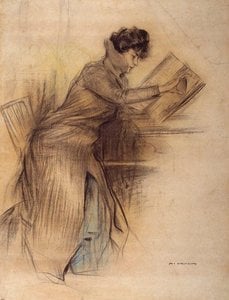
A Vision of Spanish Spirit: The Captivating Presence of Julia
In the storied annals of Catalan Modernisme, few portraits possess the magnetic vitality found in Ramon Casas i Carbó’s Julia. This masterpiece is far more than a mere likeness; it is a profound encounter with a woman who embodied both personal passion and cultural archetype. The subject, Julia Peraire, was not just a frequent model for Casas but his lifelong companion, a woman whose beauty and spirited nature left an indelible mark on the artist's soul. In this particular work, Casas captures her in a pose that is simultaneously defiant and alluring, seated with hands resting upon her hips in a manner that commands the viewer's immediate attention. The painting breathes with the energy of a bygone era, inviting us into a moment where personal intimacy meets the grand theatricality of Spanish tradition.
The brilliance of the composition lies in its masterful use of color and the striking espagnolade aesthetic. Casas dresses Julia in the iconic attire of a matador, featuring a vibrant red jacket intricately embroidered with black thread and silver accents. This choice of costume is not accidental; it serves to connect the sitter to the broader cultural identity of Spain, blending the sensual allure of the female form with the rugged, heroic symbols of Spanish folk tradition. The rich, saturated reds of her jacket harmonize exquisitely with the floral elements in her hair and the delicate comb, creating a visual rhythm that guides the eye across the canvas. Against a muted, atmospheric background that recedes into soft shadows, the subject emerges with a luminous clarity, making the painting an ideal focal point for any sophisticated interior.
Technique and the Mastery of Light
To behold Julia is to witness the technical prowess of a painter who could seamlessly bridge the gap between the precision of Realism and the emotive fluidity of Impressionism. Casas employs a layered oil technique, utilizing subtle glazes to achieve a breathtaking luminosity within the skin tones and the metallic sheen of the embroidery. The brushwork is deliberate yet expressive; while the contours of Julia’s face and the structural details of her jacket are rendered with academic rigor, there is an underlying softness in the textures of her hair and the surrounding atmosphere that prevents the work from feeling static. This interplay between sharp detail and soft, diffused light creates a sense of three-dimensional depth, pulling the viewer into the very space Julia occupies.
For the discerning collector or interior designer, this reproduction offers an unparalleled opportunity to introduce a sense of historical grandeur and emotional warmth into a living space. The painting’s ability to evoke both strength and vulnerability makes it a versatile piece of art, capable of anchoring a room with its bold color palette while providing a sophisticated narrative element. It is a work that does not merely decorate a wall but tells a story of love, identity, and the enduring beauty of the human spirit, making it a timeless investment for those who appreciate the profound legacy of the Modernisme movement.



 Voorvertoning
 Schakel over naar print
 Verstuur
 Delen
Delen
 Details bekijken

 Download
 Vergelijkbare items
 Röntgenonderzoek
 Diavoorstelling
 Statistieken


 Lees meer






































 De optie voor glas is alleen beschikbaar bij een formaat kleiner dan 110 cm.