


x


 Print kopen Koop afbeelding in hoge resolutie
 Verstuur
 Details
 Toevoegen aan favorieten
 Download
 Vergelijkbare werken
 X-Ray
X-Ray
 Diavoorstelling
Met de hand geschilderd in olieverf op canvas in uw gewenste maat en lijst, op bestelling gemaakt door onze kunstenaars.





























Kies uit onze vooraf ingestelde maten die overeenkomen met de originele verhoudingen van het kunstwerk.

U kunt uw eigen afmetingen invoeren om in een specifieke lijst of ruimte te passen. Als de door u gekozen maat niet overeenkomt met de verhoudingen van het originele beeld, zullen we het kunstwerk bijsnijden of het schilderij uitbreiden met extra handgeschilderde elementen. Een digitale mockup wordt ter goedkeuring naar u verzonden voordat de productie begint.
Houd er rekening mee dat de preview op het scherm niet de werkelijke uitsnede of uitbreiding weergeeft. Alleen de mockup toont de uiteindelijke compositie nauwkeurig.
Hoewel aangepaste afmetingen mogelijk zijn, raden we aan een maat uit de vooraf gedefinieerde lijst te selecteren om de originele verhoudingen te behouden.
Wereldwijde levering () binnen 3/4 weken in plaats van de standaard 5 weken. (1 juli). Geen concessies aan de kwaliteit.


St Sebastian
Afmetingen reproductie
Raffaello Sanzio da Urbino, known to the world as Raphael (Raffaello Sanzio da Urbino), was born in 1483 within the small but highly cultured city-state of Urbino in the Marches region, where his father Giovanni Santi was court painter to the Duke. The reputation of the court had been established by Federico da Montefeltro, a highly successful condottiere who had been created Duke of Urbino by Pope Sixtus IV – Urbino formed part of the Papal States – and who died the year before Raphael was born. The emphasis of Federico’s court was more literary than artistic, but Giovanni Santi was a poet of sorts as well as a painter, and had written a rhymed chronicle of the life of Federico, and both wrote the texts and produced the decor for masque-like court entertainments. His poem to Federico shows him as keen to demonstrate awareness of the most advanced North Italian painters, and Early Netherlandish artists as well. This immersion in a courtly environment, one that valued refinement and intellectual discourse, profoundly shaped the young Raphael's sensibilities. The loss of his father at age eleven thrust responsibility upon him, but also provided an opportunity to hone his skills within the family workshop, absorbin


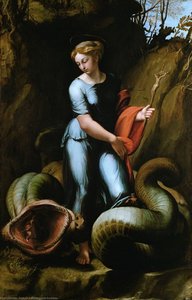

Raffaello Sanzio da Urbino, wereldberoemd als Rafaël, ontsproot aan een uitzonderlijk vruchtbare culturele omgeving. Geboren in 1483 binnen de muren van Urbino, een kleine maar intellectueel levendige stadstaat in het centrale Italië, bracht hij zijn eerste jaren door in een sfeer die zowel artistieke vaardigheid als humanistische geleerdheid hoog in het vaandel droeg. Zijn vader, Giovanni Santi, was niet slechts een schilder in dienst van hertog Federico da Montefeltro – hij was een man diep betrokken bij de stromingen van de Renaissance, een dichter die het leven van de hertog beschreef en actief op zoek ging naar vernieuwende artistieke ideeën uit heel Italië en daarbuiten. Deze onderdompeling in een hofelijke omgeving, die verfijning en intellectuele discussie waardeerde, vormde de jonge Rafaëls gevoeligheid diepgaand. Het verlies van zijn vader op elfjarige leeftijd legde verantwoordelijkheid op hem, maar bood ook de gelegenheid om zijn vaardigheden te perfectioneren in de familie werkplaats, technieken en tradities absorberend onder leiding van lokale kunstenaars. Zelfs in deze vroege werken begon een zachte gratie en minutieuze aandacht voor detail – kenmerken van zijn volwassen stijl – zich af te tekenen.
Rafaëls artistieke reis was er één van voortdurende evolutie, gekenmerkt door periodes van intense studie en assimilatie. Zijn eerste opleiding bij Pietro Perugino in Perugia legde een solide basis in de Umbrische stijl – gekenmerkt door zachte modellering, harmonieuze composities en serene religieuze scènes. Rafaël bezat echter een onstilbare nieuwsgierigheid die hem dreef om nieuwe uitdagingen te zoeken en zijn artistieke horizon te verbreden. In 1504 reisde hij naar Florence, een stad die toen bruiste van artistieke innovatie. Hier ontmoette hij de meesterwerken van Leonardo da Vinci en Michelangelo, kunstenaars die de grenzen van de schilderkunst op ongekende wijze verlegden. Hij bestudeerde hun technieken nauwkeurig – Leonardo’s sfumato, zijn subtiele gradaties van licht en schaduw, en Michelangelo’s krachtige anatomische precisie en dramatische composities. Deze Florentijnse periode was een smeltkroes voor Rafaël, die hem dwong om nieuwe artistieke mogelijkheden onder ogen te zien en deze te synthetiseren tot zijn eigen unieke visie. De invloed is zichtbaar in de toegenomen dynamiek en psychologische diepte van zijn werken uit deze tijd, met name in zijn serie Madonna’s.
In 1508 ontving Rafaël een oproep die het verloop van zijn carrière zou veranderen – een uitnodiging van paus Julius II om naar Rome te komen. Dit markeerde het begin van zijn meest productieve en gevierde periode. De Eeuwige Stad bood hem een ongeëvenaarde kans om zijn talenten op grote schaal te tonen, door de pauskamer in het Vaticaan te sieren met adembenemende fresco’s. De School van Athene, misschien wel zijn beroemdste werk, getuigt van zijn beheersing van compositie, perspectief en filosofische allegorie. Binnen deze majestueuze ruimte bracht Rafaël figuren uit de klassieke oudheid samen – Plato, Aristoteles, Pythagoras, Euclid – en creëerde hij een levendig tableau dat menselijke rede en het streven naar kennis vierde. Hij bleef werken voor latere pausen, waaronder Leo X, en ondernam monumentale projecten zoals de decoratie van de Stanze della Segnatura en de Stanza d'Eliodoro. Zijn fresco’s in deze kamers zijn niet slechts decoratief; het zijn diepgaande verklaringen over pauselijke macht, religieus geloof en de idealen van de Renaissance.
Rafaëls artistieke stijl wordt vaak omschreven als een harmonieuze mix van gratie, helderheid en geïdealiseerde schoonheid. Hij bezat een buitengewoon vermogen om uiteenlopende invloeden – de Umbrische traditie, Florentijnse innovaties, klassieke oudheid – te synthetiseren tot een uniek evenwichtige esthetiek. Zijn composities zijn minutieus gepland en vertonen een gevoel van orde en proportie dat zijn diepgaande begrip van Renaissance-principes weerspiegelt. Zijn figuren stralen serene waardigheid en emotionele expressiviteit uit, belichamend het humanistische ideaal van menselijke perfectie. Hij was ook een meesterkleurist, die rijke, heldere tinten gebruikte om werken te creëren die zowel visueel aantrekkelijk als intellectueel stimulerend zijn. In tegenstelling tot Michelangelo’s vaak dramatische en turbulente stijl straalt Rafaëls werk een gevoel van kalmte en harmonie uit – een kwaliteit die hem eeuwenlang dierbaar is gebleven bij het publiek.
Rafaëls voortijdige dood in 1520 op de leeftijd van zevenendertig maakte abrupt een carrière af die vol potentieel zat. Toch blijft zijn nalatenschap bestaan als één van de belangrijkste figuren in de westerse kunstgeschiedenis. Zijn werk werd een hoeksteen van de High Renaissance-esthetiek en diende als model voor generaties kunstenaars. Hoewel Michelangelo’s invloed later de artistieke discussie zou domineren, beleefde Rafaëls nadruk op helderheid, harmonie en geïdealiseerde schoonheid een heropleving tijdens de neoklassieke periode, geprezen door critici als Johann Joachim Winckelmann. Vandaag de dag blijven zijn schilderijen ontzag en bewondering inspireren, waarbij kijkers worden geboeid door hun technische genialiteit, emotionele diepte en blijvende aantrekkingskracht. Zijn invloed is te zien in talloze kunstwerken die volgden, waardoor zijn plaats als een ware meester van de Renaissance wordt verstevigd – een schilder die niet alleen het fysieke uiterlijk van zijn onderwerpen vastlegde, maar ook de essentie van menselijke gratie en waardigheid.

1483 - 1520 , Italië

Explore the life & art of Pietro Perugino, a pivotal Renaissance master and Raphael’s influential teacher. Discover his serene compositions, Sistine Chapel frescoes, and lasting legacy with WahooArt.

Laat uw dierbare herinneringen tot leven komen met handgeschilderde olie verfschilderijen van WahooArt.com. Authentieke reproducties, custom portretten & museumkwaliteit. Ontdek de magie van artistieke reconstructie!

Ontdek handgeschilderde reproducties & unieke maatwerk kunst bij WahooArt.com. Expertise in traditionele technieken, museumkwaliteit en persoonlijke service. Vraag een gratis consult aan!

Discover the art of museum-quality oil painting reproduction. Explore our expert process, skilled artists & authentic replicas. Elevate your home with timeless beauty – handcrafted and customized to your vision.

Transform your cherished photos into timeless oil paintings with WahooArt's expert artists. Museum-quality reproductions & custom portraits, crafted to last a lifetime. Discover the art of personal legacy.


Blijf op de hoogte van het laatste kunstnieuws, exclusieve aanbiedingen en decoratie-ideeën.
Vertel ons over uw project en onze kunstexperts geven u 3 gepersonaliseerde kunstsuggesties.
Wij stellen 3 opties speciaal voor u samen – Gratis!
 Delen
Delen









 Lees meer over
 De optie voor glas is alleen beschikbaar bij een formaat kleiner dan 110 cm.


