GRATIS KUNSTADVIES

x
Bestel schilderij Bestel schilderijKoop afbeelding in hoge resolutie Koop afbeelding in hoge resolutie VerstuurVerstuur
DetailsDetails Toevoegen aan favorieten Toevoegen aan favorieten DownloadDownload Vergelijkbare werkenVergelijkbare werken RöntgenfotoRöntgenfoto DiavoorstellingDiavoorstelling

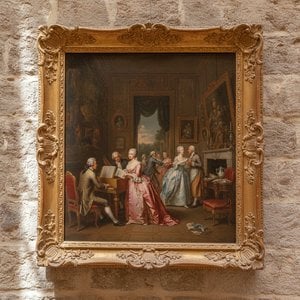
The Tooth Puller

Witness 18th-century Venetian life with Pietro Longhi's genre scene of a tooth puller; capture the intimate drama of daily existence from this exquisite print.

Pietro Longhi (1701-1785) schilderde prachtige genrebeelden van het Venetië van zijn tijd – een stijlvolle combinatie van humor en sociale observatie die hem doet denken aan William Hogarth. Een kunstenaar die de essentie van het rococo vastlegde!

Giclée / Kunstafdruk

Giclée- of canvasafdruk van museumkwaliteit met snelle productie en flexibele afwerkingsopties.

Standard
custom
CM
INCH

Kies uit onze vooraf ingestelde maten die overeenkomen met de originele verhoudingen van het kunstwerk.

breedte
hoogte

U kunt uw eigen afmetingen opgeven om in een specifieke lijst of ruimte te passen. Als de door u gekozen maat niet overeenkomt met de proporties van het originele kunstwerk, zullen wij de afbeelding bijsnijden of uitbreiden met een gespiegelde of effen rand. Een digitaal mockup wordt ter goedkeuring naar u verzonden voordat de productie begint.
Houd er rekening mee dat de preview op het scherm de werkelijke bijsneding of uitbreiding niet weergeeft. Alleen de mockup toont de uiteindelijke compositie nauwkeurig.
Hoewel aangepaste maten beschikbaar zijn, raden wij aan een afmeting uit de vooraf bepaalde lijst te kiezen om de originele proporties te behouden.

Wereldwijde levering () binnen 2 weken in plaats van de standaard 4/5 weken. (5 juli)

why_choose_icon
Gratis wereldwijde expressverzending
why_choose_icon
Hoogwaardig linnen canvas
why_choose_icon
Volledige verzendverzekering
why_choose_icon
Garantie op terugbetaling van invoerrechten
why_choose_icon
Garantie op exacte kleurweergave
why_choose_icon
60 dagen retourbeleid (alleen bij defecten)
why_choose_icon
100% Geld-terug-garantie
why_choose_icon
Korting bij meerdere afnames

Totaalprijs

-

reproduction

The Tooth Puller

Giclée / Kunstafdruk

Afmetingen reproductie

-

Eindtotaal

-

Snelle feiten

  • Subject or theme: Everyday life in Venice
  • Title: The Tooth Puller
  • Artist: Pietro Longhi
  • Artistic style: Genre painting
  • Year: 1746

Kunstquiz

Er is slechts één correct antwoord op elke vraag.

Vraag 1:
What is the primary subject matter depicted in 'The Tooth Puller'?
Vraag 2:
Which city is the artist, Pietro Longhi, most associated with depicting scenes from?
Vraag 3:
Pietro Longhi is best known for painting which genre of subject matter?
Vraag 4:
Approximately what year was 'The Tooth Puller' painted?
Vraag 5:
Based on the description, what kind of setting appears to be in the painting?

Beschrijving verzamelobject

A Glimpse into Venetian Domesticity

To stand before Pietro Longhi’s depiction of The Tooth Puller is not merely to observe an event; it is to slip, quite unexpectedly, into the vibrant, intimate tapestry of 18th-century Venice. This painting transports us beyond the grand pronouncements of mythology or history that often dominated art, offering instead a profoundly human moment—a scene unfolding within what appears to be a richly furnished domestic space. The composition buzzes with life, capturing a gathering around a central dining table. One can almost hear the murmur of conversation mingling with the focused tension surrounding the procedure taking place in the foreground. Longhi masterfully frames this confluence of everyday activity and minor drama, inviting the viewer not as an objective spectator, but as a privileged guest who has stumbled upon a private moment.

The Art of the Everyday Moment

Pietro Longhi is celebrated precisely because he dared to look at the mundane and find it extraordinary. As a chronicler of daily life, his genius lay in elevating genre scenes—the gatherings, the meals, the simple acts of human interaction—to the level of high art. In The Tooth Puller, the sheer number of figures, numbering at least twelve, creates a complex social ecosystem. They are arranged with an almost theatrical naturalism; some stand observing from the periphery, others are seated in close proximity to the action. This density is not chaotic; rather, it suggests the interwoven nature of community life in Venice—a place where public and private spheres constantly overlapped. The black and white quality of this particular rendition lends a timeless, almost photographic quality, allowing us to focus intensely on gesture, expression, and the subtle dynamics between the assembled company.

Technique and Historical Resonance

The technical brilliance evident in Longhi’s hand is palpable. While the original medium would have allowed for rich color, this reproduction captures the delicate brushwork that defined his style—a lightness of touch paired with an acute understanding of human anatomy and costume. The setting itself, suggested by the dining table and surrounding furniture, speaks volumes about the social strata and domestic elegance of the era. Longhi’s ability to render texture, from the folds of clothing to the polished wood of the room, anchors the viewer firmly in the year 1746. It is a masterclass in observational painting, where the artist acts as both chronicler and skilled illusionist.

Symbolism of Community and Vulnerability

At its heart, the scene carries a subtle undercurrent of vulnerability juxtaposed against communal support. The tooth extraction itself is an act of necessary discomfort, a moment of focused pain managed by expertise. Yet, this singular medical event becomes the focal point for an entire social circle. It symbolizes how human experience—even moments of minor distress—are always shared, witnessed, and absorbed by the surrounding community. For the collector or decorator, owning such a piece is acquiring more than just decoration; it is acquiring a narrative device—a conversation starter that speaks to the enduring power of human connection against the backdrop of daily routine.

Vergelijkbare kunstwerken


Biografie van de kunstenaar

Pietro Longhi (1701-1785): A Venetian Chronicler of Daily Life

Pietro Longhi, born Pietro Falca in Venice on November 5th, 1701, wasn’t painting grand historical narratives or mythological scenes; he was capturing the quiet dramas unfolding within the city's elegant homes and bustling streets. He became renowned for his witty genre paintings – intimate glimpses into the lives of 18th-century Venetians, a departure from the prevailing artistic trends of his time. The son of Alessandro Falca, a silversmith, Longhi’s early training began under the Veronese painter Antonio Balestra, who recognized and nurtured the young artist's talent. This foundation in traditional technique would later serve as a subtle counterpoint to the innovative spirit he brought to his chosen subject matter. He adopted the surname “Longhi” upon beginning his artistic career, a symbolic shedding of his father’s trade for the pursuit of painting.

Early Life and Artistic Foundations

Pietro Longhi's formative years were marked by a privileged upbringing under the tutelage of Antonio Balestra, one of Venice’s foremost painters. Balestra instilled in Longhi a deep appreciation for Venetian artistic tradition—specifically, the meticulous observation of nature and the mastery of broken brushwork and vibrant color glazes—techniques that would characterize Longhi's entire oeuvre. Unlike many artists of his era who pursued monumental historical commissions, Longhi skillfully avoided grand narratives, focusing instead on capturing the subtleties of everyday life in Venice. His father’s profession as a silversmith undoubtedly influenced his artistic sensibilities, fostering an eye for detail and craftsmanship—qualities that would prove invaluable in his later endeavors. He married Caterina Maria Rizzi in 1732, establishing a family life that provided him with inspiration and grounding amidst the whirlwind of Venetian artistic circles.

From Religious Altarpieces to Genre Scenes: A Transformative Shift

Longhi’s initial artistic output reflected the expectations of his time—primarily altarpieces and religious compositions executed in accordance with established conventions. His 1732 depiction of Saint Pellegrino for San Pellegrino church exemplifies Balestra's influence, demonstrating a masterful command of Venetian painting techniques: precise brushstrokes and luminous color glazes that conveyed depth and emotion. However, it was around 1737 that Longhi embarked on a pivotal artistic journey—a deliberate move away from grand historical canvases toward the small-scale genre scenes that would solidify his legacy as Venice’s “William Hogarth.” This transition wasn't merely stylistic; it represented an engagement with the burgeoning social and cultural currents of the Enlightenment, particularly the growing fascination with bourgeois society and domestic rituals. Longhi’s decision to prioritize observation over allegory—to depict human behavior and interactions with unflinching honesty—was a radical departure from prevailing artistic trends.

The Venetian Hogarth: Capturing Everyday Life with Wit and Insight

Longhi's genius lay in his ability to infuse seemingly mundane subjects with profound social commentary, mirroring the approach of William Hogarth, whom he admired greatly. Unlike Hogarth’s didactic moralizing style, Longhi’s satire possessed a subtle grace—a quiet irony that revealed contradictions within Venetian society without resorting to overt judgment. His paintings are populated by figures engaged in familiar activities—gambling parlors (*Ridotti*) filled with elegantly dressed men and women; masked balls celebrating Carnival; intimate interiors depicting domestic life—each scene meticulously rendered with remarkable detail and psychological insight. Consider *The Concert*, painted circa 1741, where Longhi portrays a gathering of Venetian nobles—a tableau vivant capturing the social dynamics of the era. The painting’s composition—characterized by shallow depth and carefully arranged figures—reflects Longhi's commitment to realism while simultaneously conveying an atmosphere of restrained elegance.

A Legacy Defined by Observation and Technique

Longhi’s artistic technique was as distinctive as his subject matter. He favored small canvases, meticulously crafted with a delicate touch and an unwavering attention to detail. His interiors are bathed in soft light—a deliberate choice that enhanced the sense of intimacy and realism—and he achieved this effect through masterful glazing techniques. Longhi's ability to depict textures—the sheen of silk robes, the roughness of stone walls, the folds of drapery—added depth and authenticity to his scenes, elevating them beyond mere representation into evocative evocations of Venetian life. He skillfully blended traditional Venetian painting methods with innovative approaches to composition and color, anticipating later developments in genre art. Longhi’s influence extended far beyond Venice; he served as Director of the Academy of Drawing and Carving from 1763, shaping the artistic education of a generation of Venetian painters. His son, Alessandro Longhi, continued his father's artistic tradition, furthering Longhi’s legacy as one of Venice’s most astute observers and accomplished artists—a true chronicler of the Enlightenment age. ## Notable Works
  • The Tailor
  • The Baptism
  • Painter in his Studio
  • The Concert
  • The Charlatan
Pietro Longhi

Pietro Longhi

1701 - 1785 , Italië

Belangrijkste feiten

  • Artistic Movement Or Style: Venetiaanse schilderkunst, Rococo
  • Artists Or Movements Influenced By This Artist: ['William Hogarth']
  • Artists Who Influenced This Artist:
    • Antonio Balestra
    • Giuseppe Maria Crespi
  • Date Of Birth: November 5, 1701
  • Date Of Death: May 8, 1785
  • Full Name: Pietro Longhi
  • Nationality: Italiaans
  • Notable Artworks:
    • De Tailleur
    • De Baptisie
    • Schilder in zijn atelier
  • Place Of Birth: Venice, Italy