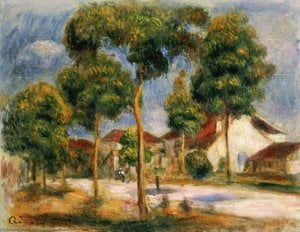
A Glimpse of Provençal Serenity: Pierre-Auguste Renoir’s *Medlar Trees, Cagnes*
Pierre-Auguste Renoir's *Medlar Trees, Cagnes*, painted in 1908, isn’t merely a depiction of a landscape; it’s an immersion into the heart of Impressionism’s golden age. This oil on canvas transports us to the sun-drenched hillsides of Cagnes-sur-Mer, a charming coastal town near Nice, France – a place that profoundly shaped Renoir's artistic vision in his later years. The painting captures a moment of quiet beauty, a fleeting impression of light and color that embodies the very essence of the Impressionist movement. It’s a scene brimming with warmth, inviting the viewer to step into the dappled shade beneath the medlar trees and lose themselves in the gentle rhythm of Provençal life.
Renoir's masterful brushwork is immediately apparent. He doesn’t strive for photographic realism but instead employs loose, visible strokes—a hallmark of Impressionism—to capture the ephemeral qualities of light and atmosphere. Notice how he uses short, broken color to suggest the texture of bark, the shimmer of leaves in the sunlight, and the hazy distance of the buildings beyond. The composition itself is deceptively simple: a cluster of trees dominates the foreground, framing a glimpse of a building with people strolling beneath them. This deliberate arrangement draws our eye into the scene, creating a sense of depth and inviting us to contemplate the interplay between nature and human activity.
The Artistic Style and Technique – A Dance of Light and Color
At its core, *Medlar Trees, Cagnes* is a study in light. Renoir was obsessed with capturing the fleeting effects of sunlight on surfaces—the way it dances through foliage, reflects off stone walls, and casts long shadows across the landscape. He achieves this not through meticulous detail but by layering colors and applying paint in rapid, broken strokes. The warm hues – rich greens, ochres, and hints of red – create a vibrant yet harmonious palette that evokes the feeling of a summer afternoon. The artist’s use of *plein air* painting—working directly from nature—is evident in the immediacy and freshness of the colors. He wasn't aiming for perfect representation but rather to convey his subjective experience of the scene, translating it onto canvas with remarkable sensitivity.
Contextualizing the Painting – Renoir’s Cagnes Years
Cagnes-sur-Mer held a special significance for Renoir. Seeking respite from the bustling Parisian art world and battling chronic arthritis, he moved to the town in 1907, establishing a studio there that would become his home until his death in 1919. This period marked a significant shift in his artistic focus. He began to paint landscapes with greater frequency, capturing the beauty of the surrounding countryside—olive groves, vineyards, and the azure Mediterranean Sea. *Medlar Trees, Cagnes* is part of a series of paintings he created during these years, reflecting his deep connection to the local environment and his desire to capture its unique character.
Interestingly, Renoir’s later work shows influences beyond pure Impressionism. The vibrant colors and painterly quality of *Medlar Trees, Cagnes* hint at elements of Fauvism—a movement that emphasized bold color and expressive brushwork—while still retaining the core principles of Impressionism. This blending of styles demonstrates Renoir's willingness to experiment and evolve throughout his career, constantly pushing the boundaries of artistic expression.
Relevance to Art Movements – A Bridge Between Eras
Renoir’s work stands as a crucial bridge between the Impressionist movement and subsequent developments in modern art. While firmly rooted in the techniques and philosophies of Impressionism—particularly the emphasis on capturing fleeting moments, using broken color, and working *en plein air*—he also incorporated elements from other artistic traditions. His exploration of color, composition, and subject matter paved the way for later artists to further develop these ideas. The painting’s enduring appeal lies in its ability to evoke a sense of nostalgia and tranquility, reminding us of the simple pleasures of life and the beauty of the natural world.
Other Relevant Works by Renoir
Conclusion
*Medlar Trees, Cagnes* is a testament to Renoir’s mastery of Impressionism and his ability to capture the essence of natural beauty. This painting, along with other works by Renoir, continues to inspire art lovers and artists alike. For those interested in exploring more about Impressionism and Fauvism, visit Fauvism Art Movement on WahooArt.



 Voorvertoning
 Schakel over naar print
 Verstuur
 Delen
Delen
 Details bekijken

 Download
 Vergelijkbare items
 Röntgenonderzoek
 Diavoorstelling
 Statistieken

 Lees meer