Voorvertoning Bekijk in AR Bestel handgeschilderde reproductie Schakel over naar digitale afbeeldingen Verstuur
Details bekijken Gids Toevoegen aan favorieten Download Vergelijkbare items Röntgenonderzoek Diavoorstelling Q&A Statistieken

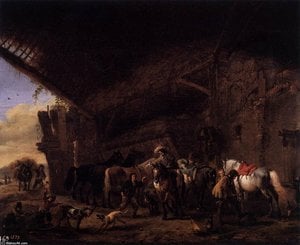
Huntsmen Setting Out

Philips Wouwerman's 'Huntsmen Setting Out' captures a vibrant Dutch Golden Age scene of aristocratic hunters preparing for their pursuit, showcasing masterful detail and dramatic light.

Philips Wouwerman (1619-1668): Een meester van het Nederlandse Gouden Eeuw, bekend om zijn levendige schilderijen van jachtscènes, landschappen en historische taferelen met een bijzondere beheersing van paarden. Ontdek zijn dynamische werken vol humor en detail!

Giclée / Kunstafdrukken

Giclée- of canvasafdruk van museumkwaliteit met een snelle productie en flexibele afwerkingsmogelijkheden. ( Bestel handgeschilderde reproductie Schakel over naar digitale afbeeldingen)

Corner sample of the P118B picture frame: gegoten polystyreen, 5 cm wide and 3 cm thick
P118B €10
Corner sample of the P118H picture frame: gegoten polystyreen, 5 cm wide and 3 cm thick
P118H €10
Corner sample of the P118W picture frame: gegoten polystyreen, 5 cm wide and 3 cm thick
P118W €10
Corner sample of the P438Z picture frame: gegoten polystyreen, 5.5 cm wide and 3.5 cm thick
P438Z €10
Corner sample of the P508JH picture frame: gegoten polystyreen, 7 cm wide and 3.5 cm thick
P508JH €12
Corner sample of the P508YH picture frame: gegoten polystyreen, 7 cm wide and 3.5 cm thick
P508YH €12
Corner sample of the P805H picture frame: gegoten polystyreen, 5 cm wide and 3.5 cm thick
P805H €10
Corner sample of the P805Z picture frame: gegoten polystyreen, 5 cm wide and 3.5 cm thick
P805Z €10
Corner sample of the P919BZ picture frame: gegoten polystyreen, 7 cm wide and 3.5 cm thick
P919BZ €10
Corner sample of the P919G picture frame: gegoten polystyreen, 7 cm wide and 3.5 cm thick
P919G €10
Corner sample of the P919XJ picture frame: gegoten polystyreen, 7 cm wide and 3.5 cm thick
P919XJ €10
Corner sample of the P959ZH picture frame: gegoten polystyreen, 5 cm wide and 3 cm thick
P959ZH €10
Corner sample of the P968JZ picture frame: gegoten polystyreen, 6 cm wide and 4 cm thick
P968JZ €12
Corner sample of the W106C picture frame: massief hout, 5 cm wide and 3 cm thick
W106C €8
Corner sample of the W218G picture frame: massief hout, 5 cm wide and 3 cm thick
W218G €10
Corner sample of the W218JH picture frame: massief hout, 5 cm wide and 3 cm thick
W218JH €8
Corner sample of the W218Y picture frame: massief hout, 5 cm wide and 3 cm thick
W218Y €10
Corner sample of the W307PJ picture frame: massief hout, 6 cm wide and 3 cm thick
W307PJ €10
Corner sample of the W316G picture frame: massief hout, 6 cm wide and 3 cm thick
W316G €10
Corner sample of the W316PJ picture frame: massief hout, 6 cm wide and 3 cm thick
W316PJ €8
Corner sample of the W316Y picture frame: massief hout, 6 cm wide and 3 cm thick
W316Y €10
Corner sample of the W398PJ picture frame: massief hout, 5 cm wide and 3 cm thick
W398PJ €8
Corner sample of the W4111J picture frame: massief hout, 6.5 cm wide and 3.5 cm thick
W4111J €10
Corner sample of the W500HY picture frame: massief hout, 7 cm wide and 5 cm thick
W500HY €15
Corner sample of the W500JH picture frame: massief hout, 7 cm wide and 5 cm thick
W500JH €15
Corner sample of the W692G picture frame: massief hout, 8 cm wide and 4 cm thick
W692G €12
Corner sample of the W849H picture frame: massief hout, 5 cm wide and 3 cm thick
W849H €8
Corner sample of the W940BG picture frame: massief hout, 7.5 cm wide and 4.5 cm thick
W940BG €15
Corner sample of the W953PJ picture frame: massief hout, 6 cm wide and 3.5 cm thick
W953PJ €8

Standaardformaat
op maat gemaakt
CM
INCH

Kies uit onze vooraf ingestelde maten die overeenkomen met de originele verhoudingen van het kunstwerk.

breedte
hoogte

Voer de gewenste breedte en hoogte in, passend bij uw lijst of muur. Een afdruk kan alleen worden ingekort en nooit groter worden gemaakt dan het origineel; een formaat met andere verhoudingen zal daarom een deel van de afbeelding verliezen. Wij sturen u een digitaal mockup ter goedkeuring voordat we tot drukwerk overgaan. De afbeelding op deze pagina toont niet de werkelijke uitsnede — dit is alleen te zien op het mockup.

Wereldwijde levering () binnen 2 weken in plaats van de standaard 4/5 weken. (31 oktober)

Gratis wereldwijde expressverzending
Hoogwaardig linnen canvas
Volledige verzendverzekering
Garantie op terugbetaling van invoerrechten
Garantie op exacte kleurweergave
Retourbeleid van 100 dagen (alleen bij defecten)
100% Geld-terug-garantie
Korting bij meerdere afnames

Totaalprijs

€ 61

Huntsmen Setting Out

Giclée / Kunstafdrukken

Afmetingen reproductie

-

Eindtotaal

€ 61

Snelle feiten

  • Notable elements: Dramatic light, detail
  • Dimensions: 55 x 80 cm
  • Subject or theme: Hunting scene
  • Movement: Dutch Golden Age
  • Location: Hermitage Museum, St. Petersburg

Kunstquiz

Er is slechts één goed antwoord op elke vraag.

Vraag 1:
What is the primary subject matter of Philips Wouwerman’s ‘Huntsmen Setting Out’?
Vraag 2:
The painting ‘Huntsmen Setting Out’ is primarily associated with which artistic movement?
Vraag 3:
Where is ‘Huntsmen Setting Out’ currently housed?
Vraag 4:
What is a key characteristic of Philips Wouwerman’s technique as demonstrated in ‘Huntsmen Setting Out’?
Vraag 5:
Which of the following best describes the historical context of this painting?

Philips Wouwerman’s “Huntsmen Setting Out”: A Dutch Golden Age Masterpiece

“Huntsmen Setting Out,” painted by Philips Wouwerman around 1665, is more than just a hunting scene; it's a meticulously crafted tableau of aristocratic leisure and the vibrant energy of the Dutch Golden Age. This oil on canvas, currently residing in the Hermitage Museum in St. Petersburg, Russia – a testament to its enduring appeal – offers a captivating glimpse into the lives of the wealthy elite and their elaborate pursuits. Wouwerman, a prolific artist known for his dynamic depictions of hunting, landscapes, and battle scenes, masterfully captures a fleeting moment of preparation before the chase, imbuing it with a sense of movement, drama, and subtle social commentary.

A Symphony of Light and Movement

Wouwerman’s technique is immediately striking. The painting pulsates with life through his masterful use of light and shadow – a hallmark of Baroque art that he expertly employs to create depth and drama. Notice how the sunlight, seemingly originating from an unseen source, illuminates the hunters' attire, highlighting the rich textures of their coats and the gleam of their weapons. Conversely, areas in shadow suggest the cool air and impending darkness of the forest. The composition itself is a carefully orchestrated dance of movement; horses gallop forward with powerful strides, hounds strain at their leashes, and riders gesture excitedly, all contributing to an overwhelming sense of kinetic energy. The artist’s attention to detail is remarkable – from the individual strands of hair on the hunters' heads to the intricate patterns on their clothing, every element feels deliberately placed.

Symbolism and Social Commentary

Beyond its technical brilliance, “Huntsmen Setting Out” carries layers of symbolic meaning. The scene depicts a hunt, a pastime deeply intertwined with aristocratic status in 17th-century Holland. The lavish attire of the hunters – their elaborate coats, feathered hats, and finely crafted weapons – clearly signal their wealth and privilege. However, Wouwerman subtly introduces an element of social critique through the inclusion of a beggar at the bottom left corner of the painting. This figure, starkly contrasting with the opulent setting, serves as a poignant reminder of the vast disparity between the wealthy elite and the less fortunate. The hermit on the hillside further emphasizes this contrast, representing a moral counterpoint to the aristocratic pursuit of pleasure.

Historical Context: The Dutch Golden Age

To fully appreciate “Huntsmen Setting Out,” it’s crucial to understand the historical context in which it was created – the Dutch Golden Age. This period, spanning roughly from the mid-16th to the early 18th centuries, witnessed an unprecedented flourishing of art, science, and commerce in the Netherlands. Philips Wouwerman thrived during this era, becoming one of its most celebrated artists. His works reflect the values and sensibilities of the time – a fascination with realism, a celebration of human activity, and a keen awareness of social dynamics. The painting’s presence in the Hermitage Museum underscores its significance as a key example of Dutch Golden Age art, offering a window into the lives and aspirations of a remarkable era.

Bringing Wouwerman Home: High-Quality Reproductions

Experience the timeless beauty of “Huntsmen Setting Out” in stunning detail with our meticulously crafted oil painting reproductions. Each reproduction is hand-painted by skilled artists using archival-quality materials, ensuring that every brushstroke and color nuance faithfully captures the original’s artistry. Available in a range of sizes to suit your space and budget, these reproductions are an exquisite addition to any home or office – a vibrant reminder of the artistic brilliance of Philips Wouwerman and the captivating spirit of the Dutch Golden Age. Explore our collection at WahooArt.com and discover how you can bring this masterpiece into your life.

Veelgestelde vragen

Welke stemming en emotie komen samen in "Huntsmen Setting Out"?

In "Huntsmen Setting Out" gaat een Dramatic sfeer gepaard met een Nostalgic emotie.

Is "Huntsmen Setting Out" in zijn geheel eerder licht of donker?

De helderheid van "Huntsmen Setting Out" door Philips Wouwermans is vastgelegd op balanced, met een luminantie van Soft Shadow.

Welk gevoel roept "Huntsmen Setting Out" bij u op?

"Huntsmen Setting Out" door Philips Wouwermans straalt een Nostalgic emotionele toon uit.


Biografie kunstenaar

Philips Wouwerman: Een Leven in de Gouden Eeuw

  • Geboren: Haarlem, Nederland (1619)
  • Overleden: 1668

Philips Wouwerman (gedoopt op 24 mei 1619 – overleden op 19 mei 1668) was een uiterst productieve en veelzijdige Nederlandse schilder, die wereldwijd bekend staat om zijn meesterlijke weergaven van jachttaferelen, landschappen en slagvelden. Hij vormt een onmiskenbare en significante figuur binnen het rijke artistieke landschap van de Nederlandse Gouden Eeuw.

Vroege Leven en Opleiding

Geboren in het schildersstadje Haarlem, was Philips Wouwerman de zoon van Pouwels Joostsz Wouwerman, eveneens een schilder, hoewel minder beroemd dan zijn zoon. Hoewel de details over zijn vroege artistieke vorming enigszins schaars zijn, wordt algemeen aangenomen dat hij studeerde onder Frans Hals (1581/85–1666), de prominente Haarlemse portretmeester. Hoewel de kenmerkende stijl van Hals zijn latere volwassen werk niet direct domineerde, was deze fundamentele opleiding waarschijnlijk van onschatbare waarde. In de beginfase van zijn carrière liet Wouwerman zich inspireren door de bamboccianti-traditie, in het bijzonder door de werken van Pieter van Laer (1592/99–na 1642), waarbij hij hun focus op het dagelijks leven en genrestukken overnam.

Artistieke Ontwikkeling en Stijl

In zijn vroege jaren begon Wouwerman de bamboccianti-schilders te emuleren, met werken die vooral het eenvoudige dagelijkse leven vastlegden. Rond het midden van de jaren 1640 ontstond er echter een uniek compositorisch element in zijn oeuvre: een diagonale helling in het landschap, vaak vergezeld door een boom die fungeende als een repoussoir om diepte te creëren. Deze scènes werden levendig bevolkt door figuren, waarbij paarden een centrale rol speelden.

Tijdens zijn volwassen periode (ca. 1650-1660) ontwikkelde Wouwerman zijn eigen, individuele stijl en breidde hij zijn onderwerpkeuze aanzienlijk uit. Hij schilderde niet langer alleen het alledaagse, maar ook genrescènes, landschappen met reizigers, cavaleriegevechten, militaire kampementen en feestelijke bijeenkomsten van boeren. Zijn ware meesterschap uitte zich vooral in de weergave van het paard; hij bezat een uitzonderlijk talent om verschillende rassen in dynamische beweging vast te leggen. De kunsthistoricus Frederik J. Duparc noemde hem dan ook treffend "ongetwijfeld de meest bekwame en succesvolle Nederlandse schilder van paarden uit de 17e eeuw". Zijn werk wordt gekenmerkt door ingetogen kleuren, een koele atmosfeer en een minutieuze aandacht voor detail, waardoor hij met humoristische en anekdotische verhalen binnen zijn scènes een bijzondere diepgang bereikte. Vaak combineerde hij hierbij verbeelde zuidelijke landschappen met een uitgesproken Nederlandse ambiance.

Grote Prestaties en Nalatenschap

De werken van Wouwerman waren tijdens zijn leven zeer gewild en bleven ook in de 18e eeuw aan populariteit winnen. Zijn schilderijen vonden hun weg naar de meest vooraanstaande collecties in heel Europa, waaronder die van vorstelijke huizen in Dresden en Sint-Petersburg, wat getuigt van de wijdverbreide bewondering voor zijn kunstenaarschap.

Zijn productiviteit was ongekend; vroege catalogi vermelden rond de 800 werken die aan hem werden toegeschreven, een aantal dat later zelfs de 1200 oversteeg. Een recenter catalogue raisonné (Schumacher, 2006) identificeert ongeveer 570 authentieke werken, waarbij rekening wordt gehouden met de vele volgelingen en imitators die in zijn stijl werkten. Ook binnen zijn eigen familie was de kunst aanwezig; zijn broers Jan (1629–1666) en Pieter (1623–1682) waren eveneidsgenoten als schilders, waarbij hun werk vaak aanvankelijk aan Philips werd toegeschreven. Hoewel het werk van Pieter duidelijk de invloed van Philips weerspiegelde, ontwikkelde hij een eigen stijl, terwijl Jan werd erkend als een meer autonome landschapsschilder.

De invloed van Wouwerman reikte ver buiten zijn eigen tijd en beïnvloedde kunstenaars zoals Jan van Huchtenburgh (1647–1733), de broers Jan Frans en Joseph van Bredael (1ode 1688–1739) en Carel van Falens (1683–1733). Naast zijn artistieke ambities was hij ook diep geworteld in het maatschappelijk leven; als lid van het Haarlemse Sint-Lucasgilde bekleedde hij diverse officiële functies en werkte hij daarnaast als makelaar in Haarlem.

Historische Betekenis

De bijdrage van Philips Wouwerman aan de Gouden Eeuw ligt in zijn unieke vermogen om een breed scala aan scènes vast te leggen – van bruisende markten en jachtpartijen tot dramatische slagvelden en serene landschappen – met een bewonderenswaardig oog voor detail en dynamiek. Zijn beheersing van de paardendarstelling, gecombineerd met zijn scherpzinnigheid in het vertellen van anekdotische verhalen, verzekerde hem een plaats als een van de meest gevierde en invloedrijke schilders van zijn tijd. Een retrospectieve tentoonstelling in Kassel en Den Haag (2009/2010) onderstreepte opnieuw de blijvende kracht van zijn artistieke nalatenschap.

Philips Wouwermans

Philips Wouwermans

1619 - 1668 , Nederland

Belangrijkste feiten

  • Artistic Movement Or Style: Gouden eeuw
  • Artists Or Movements Influenced By This Artist: ['Jan Wijnants']
  • Artists Who Influenced This Artist:
    • Frans Hals
    • Pieter van Laer
  • Date Of Birth: 24 mei 1619
  • Date Of Death: 19 mei 1668
  • Full Name: Philips Wouwerman
  • Nationality: Nederlands
  • Notable Artworks:
    • Paarden
    • Veldschoots
    • Marktscene
  • Place Of Birth: Haarlem, Nederland
Ontdek kunstwerken georganiseerd op thema, stijl en kenmerk.