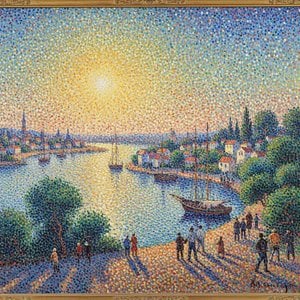
The Harmonious Vision of Paul Signac
Paul Victor Jules Signac, geboren in Parijs in 1863, kwam op als een sleutelfiguur in de evolutie van moderne kunst, onlosmakelijk verbonden met de geboorte en ontwikkeling van Neo-Impressionisme. In eerste instantie aangetrokken tot architectuur, leidde een jeugdige ontmoeting met de tentoonstelling van Claude Monet binnenin hem een blijvende passie voor schilderkunst, die hem op een pad plaatste dat kleurtheorie en artistieke expressie opnieuw zou definiëren. Signac was niet alleen een kunstenaar; hij was een toegewijde verkenner van licht, kleur en het fundamentele wetenschappelijke begrip van visuele waarneming. Zijn vroege werken, hoewel Impressionistische neigingen vertoonden, evolueerden snel onder de diepe invloed van Georges Seurat, waardoor een partnerschap ontstond dat Pointillisme – een techniek gekenmerkt door de nauwkeurige toepassing van minuscule, afzonderlijke punten van zuivere kleur bedoeld om optisch te mengen in het oog van de toeschouwer – tot leven bracht. Dit was niet alleen een kwestie van esthetiek; het was een poging om schilderkunst systematisch aan te pakken, het te verankeren in wetenschappelijke principes en conventionele artistieke normen uit te dagen.
Een Dialoog met Seurat en de Geboorte van Neo-Impressionisme
De ontmoeting tussen Signac en Seurat in 1884 bleek transformatief voor beide kunstenaars. Ze deelden een fascinatie voor de geschriften van Eugène Delacroix over kleurtheorie, met name zijn verkenning van complementaire contrasten en het emotionele effect van tinten. Samen begonnen ze een rigoureuze onderzoeksronde in deze principes, die ze vertaalden naar een revolutionaire schildertechniek. Signac omarmde Seurat’s visie volkomen, liet de vluchtige penseelstreken van het Impressionisme achter en nam de nauwkeurige, berekende toepassing van kleurpunten aan. *Boulevard de Clichy* (1886) staat als een vroeg bewijs van deze nieuwe benadering, die Signac’s nauwkeurige stijl en zijn toewijding om het bruisende leven van de stad te vangen door middel van een wetenschappelijke lens weer te geven. Echter, hun samenwerking was niet alleen technisch; het was ook intellectueel, gevoed door een gedeelde wens om schilderkunst op hetzelfde niveau als een strenge rationaliteit te tillen. Signac werd een toegewijde pleitbezorger voor Seurat’s ideeën, die de Neo-Impressionistische beweging onvermoeibaar promootte en zijn principes verdedigde tegen kritiek. Het tragische vroege overlijden van Seurat in 1891 liet Signac achter als de belangrijkste vertegenwoordiger van hun gedeelde artistieke visie, een rol die hij met onwrikbare toewijding omarmde.
Zeegezichten en Artistieke Onafhankelijkheid
Na het overlijden van Seurat nam Signac’s artistieke reis een nieuwe dimensie aan, sterk beïnvloed door zijn diepe liefde voor zeilen en de aantrekkingskracht van de Middellandse Zee. Hij ontdekte Saint-Tropez in 1892 en vestigde daar een thuis dat een schuilplaats werd voor kunstenaars en een bron van eindeloze inspiratie. De fonkelende wateren, zonnige havens en pittoreske kustlandschappen boden de ideale setting om de interactie tussen licht en kleur te verkennen. *The Red Buoy, Saint-Tropez* (1895) toont dit, waarbij zijn meesterschap van Pointillisme wordt getoond bij het vastleggen van de levendige kleuren en dynamische energie van de zee. Zijn techniek evolueerde, werd vloeiender en expressiever terwijl hij toch vasthield aan de wetenschappelijke basis. Hij begon te experimenteren met grotere penseelstreken en een bredere palet, waarbij hij verder ging dan het strikte naleven van Seurat’s nauwkeurige dottechniek. Signac’s reizen gingen verder dan Frankrijk, omvatten Italië, Nederland en zelfs Constantinopel, elk reisje verrijkte zijn artistieke woordenschat en breidde zijn perspectief uit.
Een Patron van de Avant-Garde en Erfgoed
Naast zijn eigen artistieke inspanningen speelde Signac een cruciale rol bij het bevorderen van de ontwikkeling van moderne kunst door zijn leiderschap binnen de Société des Artistes Indépendants. Als president vanaf 1908 tot aan zijn overlijden in 1935, promootte hij artistieke vrijheid en bood hij een platform voor opkomende talenten, waaronder Henri Matisse, André Derain en andere pioniers van Fauvisme en Kubisme. Hij was een van de eersten die hun baanbrekende werk erkende en steunde, controversiële werken tentoonstelde die conventionele esthetische normen uitdaagden. Signac’s toewijding aan inclusiviteit en zijn bereidheid om innovatie te omarmen hebben de loopbaan van de 20e-eeuwse kunst vormgegeven, een blijvend spoor achterlatend voor generaties kunstenaars. Zijn theoretische geschriften, met name *From Eugène Delacroix to Neo-Impressionism* (1899), versterkten zijn positie als een leidende intellectuele figuur in de kunstwereld.
Belangrijke datums & prestaties
- 1863: Geboren in Parijs, Frankrijk.
- 1884: Co-stichtte de Société des Artistes Indépendants met Georges Seurat.
- 1886: Schilderde *Boulevard de Clichy*, een sleutelvoorbeeld van vroege Pointillisme.
- 1895: Creeerde *The Red Buoy, Saint-Tropez*, die zijn meesterschap van kustlandschappen demonstreert.
- 1899: Publiceerde *From Eugène Delacroix to Neo-Impressionism*, een baanbrekend werk over kleurtheorie.
- 1908 – 1935: Diende als president van de Société des Artistes Indépendants, die avant-garde kunstenaars promootte.
- 1935: Overleden in Parijs op 72-jarige leeftijd, achterlatend een rijke artistieke nalatenschap.



 Bekijk op ware grootte
 Koop handgeschilderd kunstwerk
 Verstuur
 Delen
Delen
 Details bekijken
 Gids
Gids

 Download
 Vergelijkbare items
 Röntgenonderzoek
 Diavoorstelling
 Statistieken


 Lees meer






































 De optie voor glas is alleen beschikbaar bij een formaat kleiner dan 110 cm.