Ontvang een bestand dat klaar is voor drukwerk en de kwaliteit van het online voorbeeld ver overstijgt. Elke digitale afbeelding die wij verkopen, is afkomstig van een high-resolution master uit onze database — meestal tussen de 5.000 en 15.000 pixels breed — zodat u met vertrouwen groot kunt afdrukken, nauwkeurig kunt bijsnijden of fijne details kunt reproduceren.
Geen enkel bestand verlaat ons atelier onbewerkt. Een digitaal expert controleert de kleuren aan de hand van het originele schilderij en corrigeert deze indien nodig, om vervolgens de helderheid en details te verbeteren met professionele retoucheertechnieken — waarbij de penseelstreek en stijl van de kunstenaar altijd strikt worden gerespecteerd. Het resultaat is een afbeelding die oogt als het schilderij zelf, en niet als een gescande foto met een filter.
U keurt de afbeelding goed voordat de bestelling wordt afgerond: onze expert stuurt u binnen 72 uur een e-mail ter beoordeling. Niet tevreden? Vraag om aanpassingen of correcties, of vraag een terugbetaling aan als de kwaliteit niet aan de verwachtingen voldoet.
Dit is de kwaliteit waarop uitgevers, designstudio's, galeries en drukkerijen vertrouwen.
Download een bestand met hoge resolutie voor persoonlijke weergave, afdrukken en creatieve projecten. ( Schakel over naar print Bestel handgeschilderde reproductie)
Wanneer u kiest voor WahooArt.com, ontvangt u niet alleen een afbeelding – u krijgt een professioneel verbeterd digitaal kunstwerk, met precisie vervaardigd en voorzien van een tevredenheidsgarantie. Dit is alles wat automatisch bij uw bestelling is inbegrepen:
Uw hoogwaardige digitale afbeeldingsbestand wordt binnen 72 uur na bestelling naar u gemaild – klaar voor direct gebruik.
Uw kunstwerk wordt professioneel geoptimaliseerd met behulp van geavanceerde AI-tools en handmatige bewerkingen, waardoor maximale details, helderheid en kleurnauwkeurigheid worden gegarandeerd.
Je bestand per ongeluk verwijderd of kwijtgeraakt? Geen zorgen – we sturen het u op elk gewenst moment gratis opnieuw toe.
Geniet direct van uw kunstwerk zonder invoerrechten, belastingen of verzendkosten – digitale downloads zijn altijd belastingvrij.
Met behulp van professionele hulpmiddelen en kleurbeheer zorgen wij ervoor dat uw digitale afbeelding de originele kleuren zo nauwkeurig mogelijk weergeeft.
Mocht u niet tevreden zijn met uw digitale afbeelding, dan passen wij deze aan of storten wij 100% terug binnen 100 dagen – zonder vragen te stellen.
Niet tevreden? Ontvang een volledige terugbetaling binnen 100 dagen na ontvangst van uw digitale bestand – zonder vragen te stellen.
Koop 3 afbeeldingen, bespaar 10% - Koop 5, bespaar 15% - Koop 10+, bespaar 20%. Ideaal voor creatieve projecten, galerieën en bureaus.
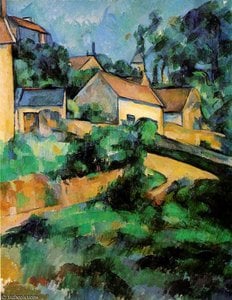
Paul Cézanne's “Study – Landscape at Auvers” isn’t merely a depiction of a Provençal village; it’s a carefully constructed meditation on perception, color, and the very essence of seeing. Painted in 1890 during his sojourn in the small village of Auvers-sur-Oise, just outside Paris, this work embodies the core tenets of Post-Impressionism – a movement Cézanne profoundly shaped – moving beyond the fleeting effects of light to explore underlying forms and structures. It’s a painting that invites prolonged contemplation, revealing layers of meaning with each return visit.
Cézanne's approach was revolutionary for his time. He wasn’t interested in faithfully reproducing what he saw; instead, he sought to capture the *idea* of the landscape – its underlying geometry and the way it interacts with light. Notice how he employs flattened planes of color, reminiscent of Seurat’s pointillism but imbued with a far more expressive intent. These aren't simply decorative hues; they are carefully chosen to define shapes and create a sense of solidity within the composition. The greens and blues of the hills are not blended smoothly, but rather applied in distinct blocks, suggesting volume and depth through color alone. This deliberate manipulation of form anticipates the abstract explorations of Cubism that would follow.
Auvers-sur-Oise itself held a particular significance for Cézanne. He had been invited there by his friend, Vincent van Gogh, who was struggling with mental illness and depression. While the two artists shared a mutual respect, their creative approaches were vastly different. Cézanne’s work in Auvers reflects a quiet intensity, a focused observation of the local environment. The village houses, rendered with simplified forms and bold colors, are not presented as charming rustic dwellings but rather as fundamental building blocks within a larger spatial arrangement. He meticulously observed the way light fell upon these structures, translating that experience onto the canvas with an almost architectural precision.
The inclusion of two figures – a man and a woman – adds a subtle layer of narrative to the scene. They are not actively engaged in any particular activity; instead, they seem to be simply present within the landscape, integrated into its fabric. Their placement is deliberate, drawing the eye across the composition and reinforcing Cézanne’s emphasis on spatial relationships. Some scholars suggest these figures represent Cézanne's wife, Marguérite, and their son, Paul, offering a glimpse into his personal life amidst his artistic endeavors.
Cézanne’s masterful use of color is central to the painting’s impact. He employs a limited palette – primarily blues, greens, browns, and ochres – but manipulates these colors with remarkable skill. The warm yellows and oranges of the sunlight contrast sharply with the cooler tones of the landscape, creating a dynamic interplay of light and shadow. He doesn't shy away from using non-naturalistic color combinations, prioritizing visual harmony over literal representation. This bold approach was revolutionary at the time, challenging traditional notions of how landscapes should be depicted.
Furthermore, Cézanne’s brushstrokes are deliberately visible, adding a tactile quality to the painting. They aren't blended or smoothed out; instead, they retain their individual character, creating a sense of movement and energy. This technique reflects his belief that the artist’s hand is an integral part of the creative process – a testament to the act of seeing itself.
"Study – Landscape at Auvers" stands as a pivotal work in art history, bridging the gap between Impressionism and modernism. It demonstrates Cézanne’s profound understanding of form, color, and spatial relationships, paving the way for subsequent generations of artists to explore new ways of representing reality. Its influence can be seen in the works of Picasso, Matisse, and countless others who followed in his footsteps. Today, reproductions of this iconic painting continue to captivate viewers with its quiet beauty and enduring power.
To experience the full richness of Cézanne’s vision, explore high-quality hand-painted oil reproduction prints available at WahooArt. Discover how these faithful recreations capture the essence of this groundbreaking masterpiece, bringing a touch of Provençal serenity to your home or studio.
Een afdruk van "Study - Landscape at Auvers" wordt aanbevolen voor Accent.
"Study - Landscape at Auvers" door Paul Cézanne heeft een Serene atmosfeer en wordt aanbevolen voor de Living Room. De stemming bepaalt wat het werk toevoegt aan de omringende ruimte.
"Study - Landscape at Auvers" werd gecreëerd door Paul Cézanne in de Post-Impressionism-stijl. De kunstenaar en de stroming bepalen de traditie van het werk.


1839 - 1906 , Frankrijk
 Voorvertoning
 Verstuur
 Delen
Delen
 Details bekijken
 Gids
Gids

 Download
 Vergelijkbare items
 Röntgenonderzoek
 Diavoorstelling
 Vraag & antwoord
 Statistieken

 Lees meer