Biografie van de kunstenaar
Een Revolutionaire Visie: Het Leven en Werk van Paul Cézanne
Paul Cézanne, geboren in Aix-en-Provence in 1839, staat als een monumentale figuur die de kloof overbrugt tussen de vluchtige impressies van het Impressionisme en de gefragmenteerde vormen van het Kubisme. Zijn weg was er geen van onmiddellijke erkenning; eerder was het een langzaam smeulen van artistieke exploratie, gekenmerkt door periodes van zelfvertwijfeling en kritische afwijzing, die uiteindelijk culmineerde in een nalatenschap die de loop van de moderne kunst voorgoed zou veranderen. Geboren in een welvarende familie – zijn vader aanvankelijk hoedenmaker, later bankier – genoot Cézanne een financiële zekerheid die ongebruikelijk was voor beginnende kunstenaars, waardoor hij zich zonder de directe druk van commercieel succes aan zijn passie kon wijden. Hoewel aanvankelijk gestuurd in de richting van een juridische carrière door de ambities van zijn vader, bleek de aantrekkingskracht van artistieke expressie te sterk en verliet hij uiteindelijk het recht om zich toe te leggen op schilderen, een beslissing die zijn leven zou definiëren. Vroege invloeden waren onder meer het Romantisme dat in zijn jeugd heerste en de toewijding van de Barbizonschool aan het landschap, maar juist door ontmoetingen met kunstenaars als Paul Gauguin en Georges Seurat, en hun innovatieve benaderingen van kleur en vorm, begon Cézanne zijn eigen unieke pad te smeden.
Van Duisternis tot Structuur: De Evolutie van een Stijl
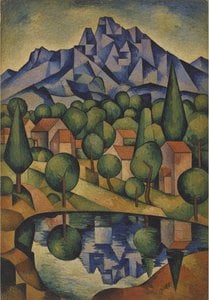
Cézannes vroege werk weerspiegelde vaak de dramatische, emotioneel geladen thema's die kenmerkend waren voor het Romantische schilderij – donkere paletten en expressieve penseelstreken domineerden zijn doeken. Deze eerste fase was echter slechts een opstapje naar een veel analytischere en baanbrekende benadering. Ontevreden met het eenvoudig vastleggen van vluchtige impressies van licht, zoals de Impressionisten dat graag deden, begon Cézanne aan een zoektocht om de onderliggende structuur van objecten zelf te begrijpen en weer te geven. Hij zocht niet alleen *wat* hij zag, maar *hoe* hij de fundamentele vormen die de werkelijkheid vormden waarnam. Dit leidde hem ertoe natuurlijke vormen af te breken tot hun geometrische equivalenten – kegels, cilinders, sferen – en zo decennia voor het materialiseren van de Kubistische revolutie een voorsprong te nemen. Zijn techniek kenmerkte zich door kleine, repetitieve penseelstreken, minutieus gelaagd om complexe velden van kleur en textuur op te bouwen, waardoor een gevoel van soliditeit en diepte ontstond dat voorheen onbekend was in de schilderkunst. Hij was niet geïnteresseerd in illusionistische ruimte; in plaats daarvan presenteerde hij vaak objecten vanuit meerdere standpunten tegelijkertijd, waarmee hij traditionele opvattingen over perspectief uitdaagde en de kijker dwong om actief betrokken te raken bij de geconstrueerde aard van zijn composities. Deze bewuste vervorming was niet willekeurig, maar eerder een poging om een completer begrip van vorm over te brengen, waarbij niet slechts één moment in de tijd werd weergegeven, maar een synthese van waarneming.
Landschappen, Stille levens en de Menselijke Vorm: Sleutelwerken en Terugkerende Motieven
Cézannes oeuvre is opmerkelijk divers, omvattende landschappen, stille levens, portretten en afbeeldingen van baders, maar ze zijn allemaal verenigd door zijn unieke benadering van vorm en kleur. De Vijver bij Jas de Bouffan, geschilderd in 1880, is een voorbeeld van zijn landschapswerk, waarin hij zijn vermogen laat zien om de essentie van de natuur vast te leggen door middel van een zorgvuldige ordening van vormen en tonen. Portret van Émile Zola, gemaakt in 1866, onthult zijn ontwikkelende stijl en biedt een overtuigende blik op de intellectuele intensiteit van zijn nauwe vriend en medeschrijver. Zijn stille levens, zoals die met appels en ander fruit, zijn niet slechts representaties van objecten, maar eerder exploraties van volume, licht en ruimtelijke relaties. De Mont Sainte-Victoire serie werd een obsessie voor Cézanne, een terugkerend motief dat hem decennialang in staat stelde om vorm en perspectief meedogenloos te onderzoeken. Deze schilderijen zijn niet simpelweg afbeeldingen van een berg; het zijn studies naar hoe we diepte, volume en het samenspel van licht en schaduw waarnemen. Ten slotte vertegenwoordigen zijn serie Baders, met naakte figuren in idyllische landschappen, een diepgaande verkenning van de menselijke vorm en haar verbinding met de natuur, vaak doordrenkt van een gevoel van tijdloosheid en stille contemplatie.
Een Nalatenschap Gesmeed in Innovatie: Cézannes Invloed op de Moderne Kunst
De impact van Paul Cézanne op latere generaties kunstenaars is onmeetbaar. Hij wordt algemeen beschouwd als de “vader van de moderne kunst” vanwege zijn baanbrekende bijdragen aan de picturale taal, die de weg vrijmaakte voor veel van de belangrijkste artistieke bewegingen van de 20e eeuw. Pablo Picasso en Georges Braque waren diep in het schuld aan Cézannes nadruk op geometrische vormen en meervoudige perspectieven, die centrale pijlers werden van het Kubisme. Zijn gedurfde gebruik van kleur inspireerde ook de Fauvisten, onder leiding van kunstenaars als Henri Matisse, die levendige, on-naturalistische tinten omarmden. Zelfs surrealistische kunstenaars vonden weerklank in Cézannes verkenning van subjectieve waarneming en psychologische diepte. Voorbij specifieke bewegingen bevrijdde Cézannes nadruk op de persoonlijke visie van de kunstenaar en zijn afwijzing van traditionele academische beperkingen generaties schilders om nieuwe vormen van expressie te verkennen. Hij daagde de definitie van representatie uit, waarbij hij de focus verlegde van het nabootsen van de werkelijkheid naar het construeren van een visuele ervaring op basis van onderliggende structuur en subjectieve waarneming. Zijn dood in 1906 markeerde niet een einde, maar een begin – de dageraad van een nieuw tijdperk in de kunstgeschiedenis, diepgaand gevormd door zijn revolutionaire visie.



 Bekijk op ware grootte
 Koop handgeschilderd kunstwerk
 Verstuur
 Delen
Delen
 Details bekijken
 Gids
Gids

 Download
 Vergelijkbare items
 Röntgenonderzoek
 Diavoorstelling
 Statistieken


 Lees meer






































 De optie voor glas is alleen beschikbaar bij een formaat kleiner dan 110 cm.