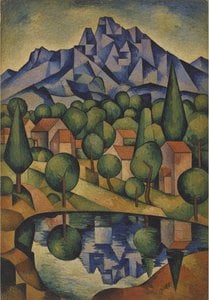
Bathers at Rest: A Revolutionary Vision of Space and Form
Paul Cézanne’s “Bathers at Rest,” painted in 1877, stands as a cornerstone of Post-Impressionism – a movement that irrevocably shifted the course of modern art. More than simply a depiction of figures enjoying leisure, this painting is a profound exploration of space, form, and the relationship between an object and its surrounding environment. It’s a work brimming with tension, emotion, and a nascent desire to break free from the constraints of traditional representation, paving the way for movements like Cubism and Abstract Expressionism. Cézanne wasn't interested in merely *showing* us a scene; he aimed to capture its essence – the very feeling of being within that space. The painting’s genesis lies in Cézanne’s fascination with Japanese prints, particularly their flattened perspective and emphasis on geometric shapes, which profoundly influenced his approach to composition. He meticulously studied the effects of light and shadow, striving to render not just what he saw but how it *felt* to be there.
- The Influence of Japonisme: Cézanne’s encounter with Japanese woodblock prints—known as Japonisme—was transformative. These prints championed a radically different visual language compared to Western painting, prioritizing simplified forms and flattened planes of color. Artists like Cézanne eagerly absorbed these principles, seeking ways to emulate their distinctive aesthetic qualities.
- Compositional Innovation: Cézanne’s masterful arrangement of figures within the landscape is central to understanding his artistic vision. He deliberately disrupts conventional perspective, creating a sense of depth that defies traditional conventions. The placement of the bathers—grouped together and subtly angled—suggests an intentional effort to impose order on what might otherwise appear chaotic.
- Color Palette & Light: Cézanne’s use of color is equally noteworthy. He employs complementary hues—such as blue and orange—to heighten visual tension and create a vibrant atmosphere. The dappled sunlight filtering through the trees contributes to this dynamic interplay of light and shadow, capturing not merely optical reality but also the subjective experience of perceiving it.
- Technique: Cézanne’s distinctive brushstrokes are characterized by their thick impasto—a technique where paint is applied in layers that stand out from the surface of the canvas. These visible brushstrokes convey a sense of immediacy and energy, reflecting Cézanne's desire to express his emotional response to the subject matter.
Post-Impressionism: Beyond Impression’s Fleeting Light
To truly appreciate “Bathers at Rest,” one must understand its place within the broader context of Post-Impressionism. Following in the footsteps of Impressionists like Monet and Renoir, who focused on capturing fleeting moments of light and color, artists such as Cézanne, Vincent van Gogh, and Georges Seurat sought to move beyond mere optical representation. They rejected the Impressionist emphasis on capturing a momentary impression and instead explored subjective expression, distorted forms, and bold colors – techniques that would fundamentally alter the landscape of art. Cézanne’s work, in particular, is characterized by its deliberate simplification of natural forms into geometric shapes—a crucial step towards Cubism. He wasn't aiming for photographic realism; rather, he was constructing a new visual language based on his own perception and understanding of the world. The thick, visible brushstrokes, often applied with a sense of urgency and dynamism, contribute to this feeling of constructed reality.
- A Reaction Against Impressionism: Post-Impressionists reacted against Impressionism’s preoccupation with capturing transient visual sensations. They believed that art should convey deeper emotional and intellectual ideas beyond mere optical observation.
- Emphasis on Form & Structure: Unlike Impressionists who prioritized color and light, Post-Impressionists focused on defining the underlying structure of objects—often represented through simplified geometric forms.
- Emotional Expression: Artists like Cézanne sought to express their inner feelings and psychological states through their paintings, prioritizing emotional resonance over accurate depiction.
Analyzing Cézanne’s Unique Style: Geometry and Distortion
“Bathers at Rest” showcases Cézanne's distinctive style in remarkable clarity. The figures themselves are rendered with a degree of distortion – their bodies aren’t perfectly proportioned, and their poses are subtly unsettling. This isn’t done for mere aesthetic effect; it’s a deliberate attempt to represent the underlying structure of the scene rather than its superficial appearance. Notice how Cézanne breaks down the forms into basic geometric shapes—rectangles, triangles, and circles—and then reassembles them in a new, more dynamic arrangement. The landscape is similarly fragmented, with trees depicted as simplified masses of color and form. The use of complementary colors – such as the juxtaposition of blue and orange – intensifies the sense of tension and creates a vibrant, almost unsettling atmosphere. Cézanne’s approach to perspective—often abandoning traditional linear perspective—further contributes to this feeling of constructed reality.
- Geometric Reduction: Cézanne's simplification of forms into geometric shapes—particularly cubes and cylinders—was revolutionary for its time.
- Spatial Illusion: Cézanne challenged conventional notions of space by depicting objects as overlapping planes rather than receding into the distance.
- Emotional Resonance: The distortions in Cézanne’s figures convey a sense of psychological depth, reflecting his belief that art should communicate emotion and intellect beyond mere visual representation.
Influence and Legacy: A Father of Modern Art
Cézanne's radical innovations had a profound and lasting impact on the development of modern art. His emphasis on form, color, and spatial relationships directly influenced artists like Pablo Picasso and Georges Braque, who would later pioneer Cubism. Picasso famously declared Cézanne “the father of us all,” recognizing his pivotal role in dismantling traditional artistic conventions. Cézanne’s work continues to inspire artists and captivate audiences with its innovative spirit and timeless beauty. He paved the way for subsequent movements—such as Cubism, Surrealism, and Abstract Expressionism—demonstrating that art could transcend mere imitation of reality and explore new realms of visual expression.
WahooArt.com offers exquisite handmade oil painting reproductions and prints on canvas of “Bathers at Rest,” allowing you to experience this masterpiece in your own home or office. These meticulously crafted reproductions capture the essence of Cézanne’s vision, bringing his revolutionary style into a contemporary setting.



 Voorvertoning
 Bestel print
 Verstuur
 Delen
Delen
 Details bekijken

 Download
 Vergelijkbare items
 Röntgenonderzoek
 Diavoorstelling

 Lees meer






































 De optie voor glas is alleen beschikbaar bij een formaat kleiner dan 110 cm.