Parnasus
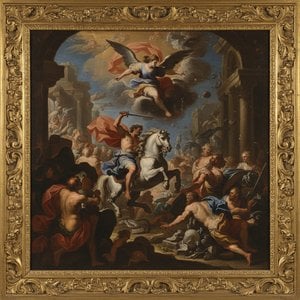
In the realm of art, few paintings capture the essence of a mythological scene as vividly as Parnasus, created by the renowned French artist Nicolas Poussin in 1626. This large oil on canvas painting is housed at the prestigious Museo del Prado in Spain, a testament to its significance and beauty.
The Scene Unfolds
The painting depicts a lively gathering of figures in a forest setting, reminiscent of ancient Greek mythology. The scene is set amidst lush trees and bushes, with at least 14 individuals engaged in various activities such as conversing, eating, or simply enjoying their time together. This social and lively atmosphere is characteristic of Poussin’s style, blending elements of nature and human interaction.
Artistic Significance
Parnasus showcases Poussin's mastery in creating depth and perspective within the image. The arrangement of figures from the foreground to the background adds a sense of dimensionality, drawing the viewer into the scene. This technique was innovative for its time and reflects Poussin’s influence on the development of European art.
Contextualizing the Painting
To fully appreciate Parnasus, it is essential to understand the broader context of Poussin's work and the era in which he painted. The 17th century was a time of great artistic innovation, with artists like Poussin contributing significantly to the evolution of painting techniques and styles.
Relevance Today
Today, Parnasus remains an important piece in the art world, not only for its historical significance but also for its enduring beauty. The Museo del Prado, where it is housed, is a must-visit destination for art enthusiasts, offering a comprehensive collection of European paintings and sculptures from the 14th to the 20th century.
Conclusion
Parnasus by Nicolas Poussin is a masterpiece that continues to captivate audiences with its vivid depiction of mythological figures in a natural setting. Its artistic significance, historical context, and enduring beauty make it a standout piece in the world of art.
- Artist: Nicolas Poussin
- Born Year: 1594
- Death Year: 1665
- Birth City: Le Havre
- Birth Country: France
Biography:
Nicolas Poussin (born June 1594 – died 1665) stands as a pivotal figure in French Baroque painting. Though he spent the majority of his career in Rome, his artistic vision remained profoundly connected to French artistic traditions, establishing him as a cornerstone of classical French art.
Early Life and Training:
Poussin’s early life remains somewhat shrouded in mystery. Born in Le Havre, France, details about his initial training are scarce. By 1612, he had begun formal studies in Paris, absorbing influences from various lesser-known artists of the time. This period laid the groundwork for his later artistic development before his pivotal move to Rome in 1624.
Artistic Development and Influences:
Poussin’s aesthetic is celebrated for its coherent composition and emphasis on linearity, a deliberate departure from the more flamboyant styles prevalent at the time. His work reflects
Parnasus and St. Cecilia are available for viewing on WahooArt.com, along with other notable works such as La tentación de Santo Tomás de Aquino by Diego Velázquez.
The Museum Museo Thyssen-Bornemisza (Spain) - A Comprehensive Guide on WahooArt.com.
Vragen & Antwoorden
Met welk gevoel wordt "Parnasus" geassocieerd?
"Parnasus" roept een Sereniteit gevoel op. De emotionele toon beschrijft de indruk die het werk achterlaat.
Hoeveel mensen bekijken "Parnasus"?
De Statistieken-pagina van "Parnasus" door Nicolas Poussin presenteert statistieken over publieksbezoeken: de maandelijkse bezoeken aan dit kunstwerk, een vergelijking met de meest bekeken werken van de kunstenaar en de herkomst van de bezoekers.
Waar zou een reproductie van "Parnasus" door Nicolas Poussin opgehangen moeten worden?
Het Landschap-formaat van "Parnasus" door Nicolas Poussin wordt aanbevolen voor een Woonkamer. Formaat en ruimte samen bepalen de ideale plaatsing van een reproductie.



 Bekijk op ware grootte
 Schakel over naar print
 Verstuur
 Delen
Delen
 Details bekijken
 Gids voor studentenkunstwerken

 Download
 Vergelijkbare items
 Röntgenonderzoek
 Diavoorstelling
 Statistieken

 Lees meer






































 De optie voor glas is alleen beschikbaar bij een formaat kleiner dan 110 cm.