Voorvertoning Bekijk in AR Bestel handgeschilderde reproductie Schakel over naar digitale afbeeldingen Verstuur
Details bekijken Gids Toevoegen aan favorieten Download Vergelijkbare items Röntgenonderzoek Diavoorstelling Statistieken

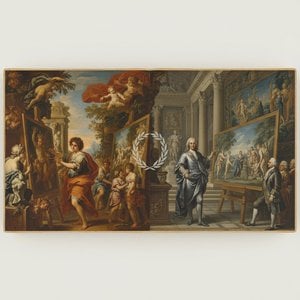
Self-Portrait

Explore Nicolas de Largillière’s ‘Self-Portrait’ (1725). A masterful Baroque portrait showcasing his skill & Parisian elegance. Discover this iconic artwork's details.

Nicolas de Largillière (1656-1746): Een meester van het Franse Barokschilderkunst, bekend om zijn elegante portretten die rijkdom en status vastleggen. Zijn werken blijven een prachtige terugblik op het lichtende Gouden Eeuw.

Giclée / Kunstafdrukken

Giclée- of canvasafdruk van museumkwaliteit met een snelle productie en flexibele afwerkingsmogelijkheden. ( Bestel handgeschilderde reproductie Schakel over naar digitale afbeeldingen)

Corner sample of the P118B picture frame: gegoten polystyreen, 5 cm wide and 3 cm thick
P118B €10
Corner sample of the P118H picture frame: gegoten polystyreen, 5 cm wide and 3 cm thick
P118H €10
Corner sample of the P118W picture frame: gegoten polystyreen, 5 cm wide and 3 cm thick
P118W €10
Corner sample of the P438Z picture frame: gegoten polystyreen, 5.5 cm wide and 3.5 cm thick
P438Z €10
Corner sample of the P508JH picture frame: gegoten polystyreen, 7 cm wide and 3.5 cm thick
P508JH €12
Corner sample of the P508YH picture frame: gegoten polystyreen, 7 cm wide and 3.5 cm thick
P508YH €12
Corner sample of the P805H picture frame: gegoten polystyreen, 5 cm wide and 3.5 cm thick
P805H €10
Corner sample of the P805Z picture frame: gegoten polystyreen, 5 cm wide and 3.5 cm thick
P805Z €10
Corner sample of the P919BZ picture frame: gegoten polystyreen, 7 cm wide and 3.5 cm thick
P919BZ €10
Corner sample of the P919G picture frame: gegoten polystyreen, 7 cm wide and 3.5 cm thick
P919G €10
Corner sample of the P919XJ picture frame: gegoten polystyreen, 7 cm wide and 3.5 cm thick
P919XJ €10
Corner sample of the P959ZH picture frame: gegoten polystyreen, 5 cm wide and 3 cm thick
P959ZH €10
Corner sample of the P968JZ picture frame: gegoten polystyreen, 6 cm wide and 4 cm thick
P968JZ €12
Corner sample of the W106C picture frame: massief hout, 5 cm wide and 3 cm thick
W106C €8
Corner sample of the W218G picture frame: massief hout, 5 cm wide and 3 cm thick
W218G €10
Corner sample of the W218JH picture frame: massief hout, 5 cm wide and 3 cm thick
W218JH €8
Corner sample of the W218Y picture frame: massief hout, 5 cm wide and 3 cm thick
W218Y €10
Corner sample of the W307PJ picture frame: massief hout, 6 cm wide and 3 cm thick
W307PJ €10
Corner sample of the W316G picture frame: massief hout, 6 cm wide and 3 cm thick
W316G €10
Corner sample of the W316PJ picture frame: massief hout, 6 cm wide and 3 cm thick
W316PJ €8
Corner sample of the W316Y picture frame: massief hout, 6 cm wide and 3 cm thick
W316Y €10
Corner sample of the W398PJ picture frame: massief hout, 5 cm wide and 3 cm thick
W398PJ €8
Corner sample of the W4111J picture frame: massief hout, 6.5 cm wide and 3.5 cm thick
W4111J €10
Corner sample of the W500HY picture frame: massief hout, 7 cm wide and 5 cm thick
W500HY €15
Corner sample of the W500JH picture frame: massief hout, 7 cm wide and 5 cm thick
W500JH €15
Corner sample of the W692G picture frame: massief hout, 8 cm wide and 4 cm thick
W692G €12
Corner sample of the W849H picture frame: massief hout, 5 cm wide and 3 cm thick
W849H €8
Corner sample of the W940BG picture frame: massief hout, 7.5 cm wide and 4.5 cm thick
W940BG €15
Corner sample of the W953PJ picture frame: massief hout, 6 cm wide and 3.5 cm thick
W953PJ €8

Standaardformaat
op maat gemaakt
CM
INCH

Kies uit onze vooraf ingestelde maten die overeenkomen met de originele verhoudingen van het kunstwerk.

breedte
hoogte

Voer de gewenste breedte en hoogte in, passend bij uw lijst of muur. Een afdruk kan alleen worden ingekort en nooit groter worden gemaakt dan het origineel; een formaat met andere verhoudingen zal daarom een deel van de afbeelding verliezen. Wij sturen u een digitaal mockup ter goedkeuring voordat we tot drukwerk overgaan. De afbeelding op deze pagina toont niet de werkelijke uitsnede — dit is alleen te zien op het mockup.

Wereldwijde levering () binnen 2 weken in plaats van de standaard 4/5 weken. (26 oktober)

Gratis wereldwijde expressverzending
Hoogwaardig linnen canvas
Volledige verzendverzekering
Garantie op terugbetaling van invoerrechten
Garantie op exacte kleurweergave
Retourbeleid van 100 dagen (alleen bij defecten)
100% Geld-terug-garantie
Korting bij meerdere afnames

Totaalprijs

€ 61

Self-Portrait

Giclée / Kunstafdrukken

Afmetingen reproductie

-

Eindtotaal

€ 61

Snelle feiten

  • Movement: Baroque
  • Year: 1725
  • Subject or theme: Self-portraiture
  • Artist: Nicolas de Largillière
  • Influences: Anton Goubau

Kunstquiz

Er is slechts één goed antwoord op elke vraag.

Vraag 1:
What is the primary subject matter depicted in this artwork?
Vraag 2:
Which artistic period's portraiture style is the artwork reminiscent of?
Vraag 3:
What medium was primarily used to create this painting, as suggested by the description?
Vraag 4:
The background elements, such as the easel and canvas, serve what artistic function in the composition?
Vraag 5:
Nicolas de Largillière was known for his association with which style of portraiture?

The Intimate Gaze of Self-Reflection

To stand before this self-portrait is to encounter not merely a likeness, but a profound meditation on the act of seeing and being seen. The subject, an elderly gentleman whose white hair and gray beard speak volumes of a life richly lived, confronts the viewer with an unwavering, serious gaze. Draped in a dark, voluminous robe that seems to absorb the surrounding light, his presence is both commanding and deeply introspective. This painting captures a moment suspended in time—a quiet confrontation between the artist and posterity. The overall impression is one of intellectual gravity, inviting us to peer into the depths of a seasoned mind.

Mastery of Light and Shadow: Technique and Form

The technical brilliance evident in this work speaks to an advanced command of oil painting. The dramatic lighting scheme is perhaps the most arresting element; strong chiaroscuro effects carve out the contours of his face and the deep folds of his garments, lending an almost sculptural quality to the flesh and fabric alike. One can almost feel the texture achieved by the artist’s meticulous brushwork—the subtle sheen on the skin contrasted with the matte depth of the velvet-like robe. The composition is masterfully balanced, utilizing linear perspective that draws the eye inexorably toward the central figure. While the subject matter is intensely personal, the execution demonstrates a formal rigor reminiscent of 18th-century portraiture, where every stroke contributes to an illusion of tangible reality.

The Artist at Work: Symbolism and Setting

What elevates this piece beyond a simple portrait is the subtle narrative woven into its background. The inclusion of the wooden easel and the partially visible canvas transforms the setting from mere backdrop into a crucial element of symbolism. These tools are not incidental; they are declarations. They anchor the subject within his profession, reminding us that he is an artisan, a creator whose very identity is intertwined with pigment and brushstroke. This self-referential quality—the artist painting himself amidst his materials—lends the work an intellectual resonance, suggesting that the act of creation mirrors the act of self-discovery.

Historical Echoes and Emotional Resonance

Dating to 1725, this portrait situates itself within a period where portraiture served not only as commemoration but also as a statement of status and intellect. The style echoes the refined elegance associated with masters like Nicolas de Largillière, whose Parisian flair for capturing sophisticated likenesses is palpable here. For the collector or designer, owning such a piece offers more than mere decoration; it offers a conversation starter—a tangible link to the golden age of European portraiture. It evokes a sense of timeless dignity and quiet authority, making it a powerful focal point for any discerning interior space.

Veelgestelde vragen

Welk kleurenpalet wordt gebruikt in "Self-Portrait" door Nicolas de Largillière?

"Self-Portrait" door Nicolas de Largillière maakt gebruik van een Earthy kleurenpalet. Dit palet vat het algemene kleurkarakter van het werk samen.

Waarvoor wordt een reproductie van "Self-Portrait" door Nicolas de Largillière aanbevolen?

De aanbevolen toepassing voor "Self-Portrait" door Nicolas de Largillière is Focal. Het kan echter ook voor andere doeleinden worden gebruikt.

Zijn de kleuren van "Self-Portrait" krachtig of juist zacht?

"Self-Portrait" door Nicolas de Largillière heeft een Monochromatic kleurintensiteit.


Biografie kunstenaar

A Parisian Life in Portraiture

Nicolas de Largillière, a name inextricably linked to the elegance and refinement of French Baroque portraiture, was born into a bustling commercial world in Paris in 1656. His father, a hatmaker, moved the family to Antwerp when Nicolas was just three years old, a pivotal relocation that would profoundly shape his artistic trajectory. This early immersion in the vibrant art scene of Antwerp—a center for Flemish painting—laid the groundwork for his future endeavors, exposing him to the rich traditions and techniques that would later inform his own distinctive style. Though initially destined for commerce, Largillière’s innate artistic inclination led him away from the family trade and toward a life dedicated to capturing the likenesses of those around him. A brief sojourn in London followed, where he absorbed the nuances of portraiture under prominent artists before returning to Antwerp and briefly studying with Anton Goubau. It was his four-year apprenticeship under Sir Peter Lely at Windsor, however, that truly solidified his artistic foundation, instilling a meticulous attention to detail and a skillful rendering of textures that would become hallmarks of his work. The political turmoil surrounding the Rye House Plot ultimately prompted Largillière’s return to Paris, a move that would define his career and establish him as one of the leading portraitists of his era.

Early Life and Artistic Formation

Largillière was born into a family deeply rooted in Antwerp's mercantile landscape—a city renowned for its textile trade and artistic patronage. His father’s profession provided valuable insight into the economic realities of the time, fostering an understanding of social dynamics that would later permeate Largillière’s artistic vision. At just three years old, his family relocated to Antwerp, a decision driven by practical considerations but also fueled by a desire for exposure to the burgeoning Flemish art world. This formative experience instilled in him a fascination with painting and sculpture—influences that would prove decisive in shaping his artistic style. Recognizing his talent early on, Largillière pursued formal training under Anton Goubau, a respected Antwerp artist known for his landscapes and portraits. Goubau’s guidance honed Largillière's technical skills and introduced him to the stylistic conventions of Flemish Baroque painting—a tradition characterized by dramatic lighting, rich color palettes, and an emphasis on idealized beauty. This initial artistic grounding would prove invaluable as he embarked upon his subsequent studies in London.

London Years and Artistic Influences

A brief journey to London during the reign of James II offered Largillière a crucial opportunity to broaden his artistic horizons. He immersed himself in the vibrant art scene of the capital, studying under Sir Peter Lely—a celebrated portraitist who championed classical ideals and employed meticulous techniques. Lely’s influence was particularly significant in shaping Largillière's understanding of composition and perspective—elements that would become integral to his distinctive style. Furthermore, Largillière engaged with the artistic currents circulating within London’s intellectual circles, absorbing inspiration from artists like Rubens and Van Dyck—masters who had established themselves as icons of Baroque portraiture. These encounters fostered a critical appreciation for artistic excellence and encouraged Largillière to strive for unparalleled realism and elegance in his own work. The encounter with these masters solidified his belief that art should aspire to capture not merely physical likeness but also the essence of human character and status—a principle that would guide his artistic endeavors throughout his career.

Parisian Career and Artistic Achievements

Upon returning to Paris, Largillière swiftly ascended within the city’s artistic hierarchy, attracting the patronage of influential nobles and merchants alike. His ability to convey both physical resemblance and psychological depth captivated clients eager to commemorate their achievements and solidify their reputations for posterity. Largillière quickly gained recognition as a leading portraitist—a distinction that cemented his position among the most respected artists of his era. He was appointed director of the Académie Royale de peinture et de sculpture in 1736, marking a pivotal moment in his career and symbolizing acknowledgment from the artistic establishment. This role afforded him considerable influence over artistic training and scholarship—further bolstering his legacy as a champion of Baroque ideals. Among his most celebrated works are *The Royal Family Portrait* (1709)—a monumental depiction of Louis XIV and his family—and *Portrait of Jacques-Antoine Arlaud*, which exemplifies Largillière’s masterful command of technique and composition. These paintings stand as enduring symbols of French grandeur and artistic achievement, demonstrating Largillière's unwavering commitment to capturing the splendor of aristocratic life.

Legacy and Enduring Influence

Nicolas de Largillière left behind a substantial body of work that continues to inspire artists and captivate audiences today. His portraits are not merely aesthetically pleasing; they serve as invaluable historical documents—providing insights into the social customs, fashions, and intellectual debates of 18th-century France. Largillière’s influence extends beyond his immediate pupils—who carried on his artistic legacy and contributed to the flourishing Rococo movement—and he remains a testament to the transformative power of art. His meticulous attention to detail—particularly in capturing textures and expressions—established him as one of the foremost practitioners of Baroque painting, securing his place among the most revered artists of his time. Today’s scholars recognize Largillière's contribution to the artistic canon—a legacy that transcends temporal boundaries and continues to resonate with viewers worldwide. His paintings are housed in prominent museums across Europe—including the Louvre and the National Gallery of Art—ensuring that his artistry remains accessible to future generations. Largillière’s enduring impact on portraiture is undeniable, cementing his place as a cornerstone of Baroque art history
Nicolas de Largillière

Nicolas de Largillière

1656 - 1746 , Frankrijk

Belangrijkste feiten

  • Artistic Movement Or Style: Barok, Rococo
  • Artists Or Movements Influenced By This Artist: ['Jean-Baptiste Oudry']
  • Artists Who Influenced This Artist:
    • Peter Lely
    • Anton Goubau
  • Date Of Birth: 1656
  • Date Of Death: 1746
  • Full Name: Nicolas de Largillière
  • Nationality: Frans
  • Notable Artworks:
    • Zelfportret (1707)
    • Royal Family Portrait
    • Montausier portrait
  • Place Of Birth: Parijs, Frankrijk