Met de hand geschilderd in olieverf op canvas in uw gewenste maat en lijst, op bestelling gemaakt door onze kunstenaars. ( Bestel print Koop afbeelding)





























Kies uit onze vooraf ingestelde maten die overeenkomen met de originele verhoudingen van het kunstwerk.

U kunt uw eigen afmetingen invoeren om in een specifieke lijst of ruimte te passen. Als de door u gekozen maat niet overeenkomt met de verhoudingen van het originele beeld, zullen we het kunstwerk bijsnijden of het schilderij uitbreiden met extra handgeschilderde elementen. Een digitale mockup wordt ter goedkeuring naar u verzonden voordat de productie begint.
Houd er rekening mee dat de preview op het scherm niet de werkelijke uitsnede of uitbreiding weergeeft. Alleen de mockup toont de uiteindelijke compositie nauwkeurig.
Hoewel aangepaste afmetingen mogelijk zijn, raden we aan een maat uit de vooraf gedefinieerde lijst te selecteren om de originele verhoudingen te behouden.
Wereldwijde levering () binnen 3 tot 4 weken in plaats van de standaard 5 weken. (6 september). Zonder concessies aan de kwaliteit.


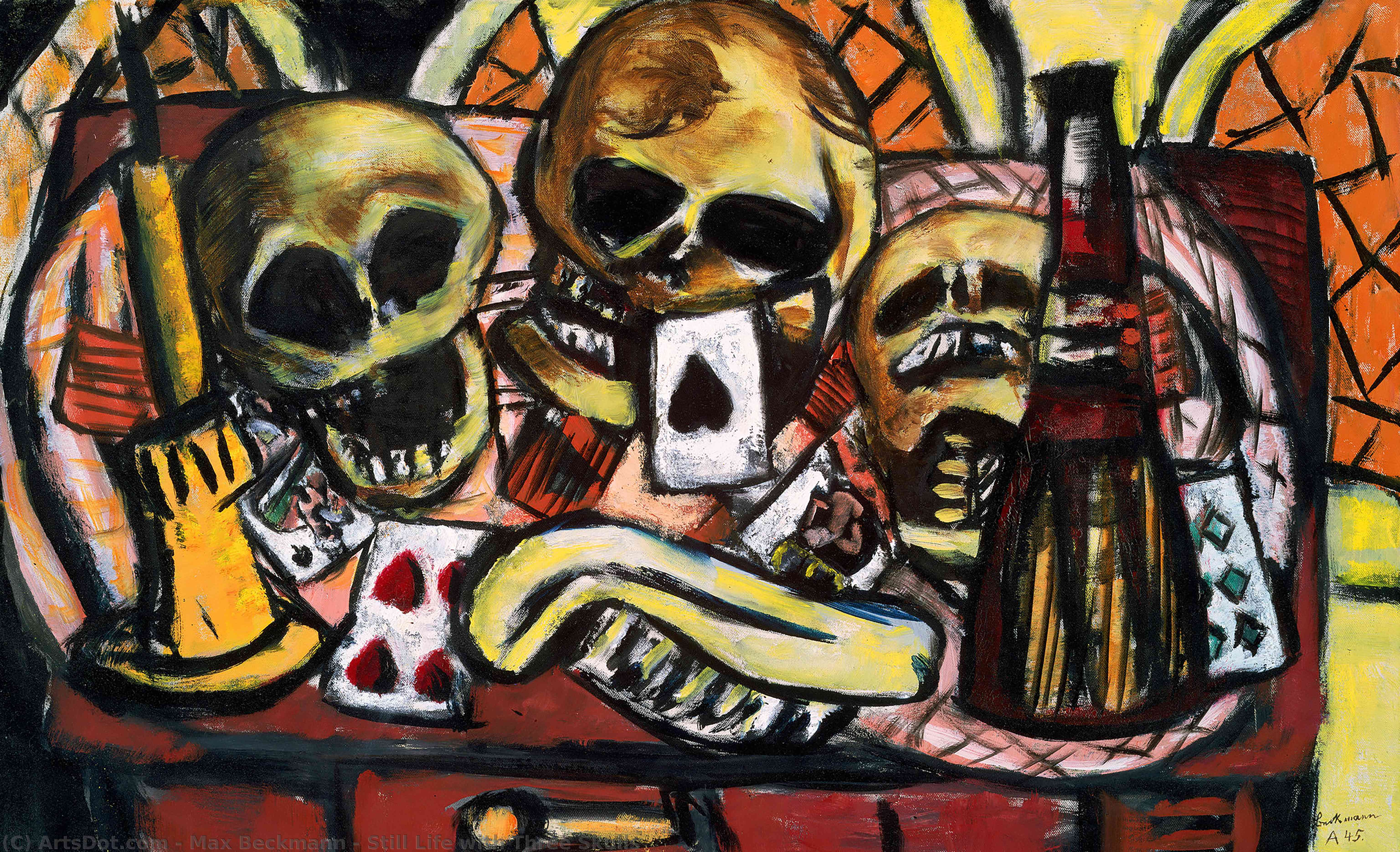
Still Life with Three Skulls
Afmetingen reproductie
In the hauntingly evocative Still Life with Three Skulls, the viewer is invited into a somber, introspective space where the boundaries between life and death blur through the lens of German Expressionism. Max Beckmann, a master of capturing the psychological weight of the human condition, presents a composition that transcends mere tabletop arrangement. The painting features three skulls arranged across a dark, textured surface, their hollow sockets staring back with an unsettling permanence. Interspersed among these skeletal remains are various bottles and a solitary knife, objects that ground the macabre subject matter in a domestic, almost mundane reality. This juxtaposition creates a profound tension, as the everyday items of life sit alongside the undeniable symbols of mortality.
The technique employed by Beckmann is nothing short of visceral. Eschewing the delicate smoothness of classical still lifes, he utilizes a bold, distorted approach to space and form that reflects his experience as a medical orderly during World War I. The brushwork feels heavy and deliberate, imbuing each object with a sense of sculptural weight. There is a rhythmic quality to the placement of the bottles—one perched in the upper right, another near the center, and a third anchoring the lower left—which guides the eye through a labyrinth of light and shadow. This use of chiaroscuro, reminiscent of the Old Masters like Rembrandt, serves to heighten the drama, pulling the skulls out of the darkness and forcing a confrontation with their stark, bony architecture.
To gaze upon this work is to engage with the ancient tradition of memento mori—the reminder that death is an ever-present companion. However, Beckmann breathes a modern, existential dread into this classical theme. The skulls are not merely decorative symbols; they represent the fragility of the human ego and the inevitable decay of all material things. The presence of the knife adds a layer of latent violence or perhaps the surgical precision of fate, while the bottles suggest the fleeting pleasures of the senses that cannot stave off the end. For the collector or interior designer, this piece offers more than just visual interest; it provides a profound intellectual anchor for a room, sparking conversation about the cyclical nature of life and the enduring legacy of human struggle.
For those seeking to integrate such a powerful work into a curated space, a high-quality reproduction of Still Life with Three Skulls serves as a centerpiece of immense character. It is an ideal selection for a study, a library, or a sophisticated gallery wall where art is intended to provoke thought and evoke emotion. The painting’s dark palette and commanding presence allow it to harmonize with rich textures like leather, dark wood, and velvet, creating an atmosphere of timelessness and intellectual depth. Owning this piece is an invitation to contemplate the beauty found within the shadows and to appreciate the raw, unfiltered truth of the human experience as captured by one of the twentieth century's most significant artistic voices.

Max Beckmann, a renowned german painter, draftsman, printmaker, sculptor, and writer, was born on february 12, 1884, in leipzig, saxony. his artistic journey began with academically correct depictions, which later transformed into distorted figures and spaces, reflecting his altered vision of humanity after serving as a medical orderly in world war i.
His formative years were marked by an initial adherence to traditional academic styles—a deliberate rejection of the expressive fervor championed by artists like Vincent van Gogh and Edvard Munch. However, this early inclination swiftly yielded to a profound shift in artistic sensibility, fueled by the harrowing realities of the Great War. Witnessing firsthand the devastation and suffering inflicted upon soldiers instilled within him a visceral understanding of human vulnerability and trauma—a perspective that would irrevocably reshape his oeuvre.
Beckmann’s distinctive aesthetic emerged from a confluence of artistic inspirations, notably Cézanne's geometric explorations and Rembrandt’s masterful use of chiaroscuro. He absorbed the brooding atmosphere of Blake’s visionary poetry and embraced the expressive dynamism of Rubens’ monumental canvases.
Furthermore, Beckmann drew heavily upon the iconography of medieval stained glass—a visual language characterized by vibrant colors and stylized forms—demonstrating a fascination with symbolism and spiritual contemplation. His artistic vision was profoundly shaped by artists of the late middle ages and early renaissance, including Bosch, Bruegel, and Matthias Grünewald, whose unsettling imagery conveyed moral judgments and explored themes of human folly.
Among Beckmann’s most celebrated creations is “The Bark,” acquired by the National Gallery in Berlin—a monumental canvas depicting a desolate landscape imbued with melancholic grandeur. Equally impactful is “Self-Portrait in Tuxedo,” purchased in 1928, which captures Beckmann's introspective gaze against a backdrop of muted hues.
His artistic reputation soared during the Weimar Republic, culminating in retrospectives at the Städelschule Mannheim (1928) and Basel & Zurich (1930), cementing his position as one of Germany’s foremost artists of the era. These exhibitions showcased the breadth and depth of his stylistic evolution—from early landscapes to psychologically charged portraits.
Beckmann's fortunes took a dramatic turn with the ascent of Adolf Hitler to power, triggering his expulsion from the art school in Frankfurt and resulting in the confiscation of over 500 of his artworks. Forced into self-imposed exile in Amsterdam for ten years, he struggled unsuccessfully to secure a visa for the United States—a poignant symbol of artistic freedom curtailed by political repression.
Despite facing considerable adversity, Beckmann continued to produce groundbreaking art during his exile—primarily in Amsterdam—where he created approximately 280 paintings—a third of his total output. His work stands as a testament to resilience and unwavering commitment to artistic integrity.
Beckmann’s influence extended beyond the confines of his own lifetime, shaping subsequent generations of artists who embraced Expressionism's uncompromising exploration of emotion and psychological complexity. He was honored with a professorship at Washington University in St. Louis and the Brooklyn Museum, and his retrospective in 1948 at Saint Louis cemented his enduring legacy as a pivotal figure in modern German art.

1884 - 1950 , Duitsland

Explore the profound symbolism of Vanitas art. From Dutch Golden Age masterpieces to the haunting beauty of Memento Mori, uncover how classical painters used skulls and hourglasses to reflect on life's transience through expert art history analysis.

Explore the raw emotion of German Expressionism through a definitive guide to Ernst Ludwig Kirchner. Discover how his bold colors and distorted forms redefined modern art history, from Berlin street scenes to iconic masterpieces.

Delve into the visceral world of German Expressionism. Explore the history, key artists like Kirchner and Kandinsky, and the movement's profound emotional impact through an expert art-history lens. Discover how bold colors and distortion redefined modern aesthetics.

 Voorvertoning
 Verstuur
 Delen
Delen
 Details bekijken

 Download
 Vergelijkbare items
 Röntgenonderzoek
 Diavoorstelling

 Lees meer







 De optie voor glas is alleen beschikbaar bij een formaat kleiner dan 110 cm.