


Ontvang een bestand dat klaar is voor drukwerk en de kwaliteit van het online voorbeeld ver overstijgt. Elke digitale afbeelding die wij verkopen, is afkomstig van een high-resolution master uit onze database — meestal tussen de 5.000 en 15.000 pixels breed — zodat u met vertrouwen groot kunt afdrukken, nauwkeurig kunt bijsnijden of fijne details kunt reproduceren.
Geen enkel bestand verlaat ons atelier onbewerkt. Een digitaal expert controleert de kleuren aan de hand van het originele schilderij en corrigeert deze indien nodig, om vervolgens de helderheid en details te verbeteren met professionele retoucheertechnieken — waarbij de penseelstreek en stijl van de kunstenaar altijd strikt worden gerespecteerd. Het resultaat is een afbeelding die oogt als het schilderij zelf, en niet als een gescande foto met een filter.
U keurt de afbeelding goed voordat de bestelling wordt afgerond: onze expert stuurt u binnen 72 uur een e-mail ter beoordeling. Niet tevreden? Vraag om aanpassingen of correcties, of vraag een terugbetaling aan als de kwaliteit niet aan de verwachtingen voldoet.
Dit is de kwaliteit waarop uitgevers, designstudio's, galeries en drukkerijen vertrouwen.
Download een bestand met hoge resolutie voor persoonlijke weergave, afdrukken en creatieve projecten. ( Schakel over naar print Bestel handgeschilderde reproductie)
Wanneer u kiest voor WahooArt.com, ontvangt u niet alleen een afbeelding – u krijgt een professioneel verbeterd digitaal kunstwerk, met precisie vervaardigd en voorzien van een tevredenheidsgarantie. Dit is alles wat automatisch bij uw bestelling is inbegrepen:
Uw hoogwaardige digitale afbeeldingsbestand wordt binnen 72 uur na bestelling naar u gemaild – klaar voor direct gebruik.
Uw kunstwerk wordt professioneel geoptimaliseerd met behulp van geavanceerde AI-tools en handmatige bewerkingen, waardoor maximale details, helderheid en kleurnauwkeurigheid worden gegarandeerd.
Je bestand per ongeluk verwijderd of kwijtgeraakt? Geen zorgen – we sturen het u op elk gewenst moment gratis opnieuw toe.
Geniet direct van uw kunstwerk zonder invoerrechten, belastingen of verzendkosten – digitale downloads zijn altijd belastingvrij.
Met behulp van professionele hulpmiddelen en kleurbeheer zorgen wij ervoor dat uw digitale afbeelding de originele kleuren zo nauwkeurig mogelijk weergeeft.
Mocht u niet tevreden zijn met uw digitale afbeelding, dan passen wij deze aan of storten wij 100% terug binnen 100 dagen – zonder vragen te stellen.
Niet tevreden? Ontvang een volledige terugbetaling binnen 100 dagen na ontvangst van uw digitale bestand – zonder vragen te stellen.
Koop 3 afbeeldingen, bespaar 10% - Koop 5, bespaar 15% - Koop 10+, bespaar 20%. Ideaal voor creatieve projecten, galerieën en bureaus.

Born in Neisse, Silesia – a region steeped in shifting borders and cultural exchange – Martin Bloch (1883-1954) emerged as a significant figure in 20th-century British art. Initially drawn to music and architecture, he ultimately found his voice and enduring legacy within the realm of painting, capturing the serene beauty of English gardens, bustling cityscapes, and intimate portraits with a distinctive blend of expressionism and impressionism. His work, often characterized by its luminous color palettes and subtle emotional depth, offers a poignant reflection on the changing landscape of Europe and the artist’s own journey of displacement.
Bloch's early life was shaped by the tumultuous political climate of pre-war Germany. Born into an assimilated Jewish family, he received a solid education that encompassed both classical studies and artistic pursuits. He began his artistic training in Munich, absorbing the influence of local artistic trends while simultaneously grappling with the rising tide of nationalism. This period proved formative, exposing him to new ideas and techniques before the increasingly hostile environment forced his emigration to England in 1934. This relocation marked a pivotal moment, not only for Bloch’s personal life but also for the evolution of his artistic style – he quickly adapted to the English landscape and its unique light.
Bloch's artistic development can be traced through several distinct phases. Initially influenced by the vibrant colors and bold brushstrokes of Munich’s Secessionist movement, his early works reflected a dynamic energy and a fascination with urban life. However, following his arrival in Paris, he encountered the Impressionists and Post-Impressionists – particularly Monet and Renoir – whose techniques profoundly impacted his approach to color and light. He began to prioritize capturing fleeting moments of beauty, employing broken brushstrokes and layering hues to create an atmospheric effect that conveyed a sense of tranquility and introspection. This shift culminated in his arrival in England, where he found inspiration in the meticulously cultivated gardens and quiet corners of the countryside.
A key element of Bloch’s style was his deliberate use of color. He eschewed traditional academic palettes, favoring instead a rich and often unconventional combination of hues – warm yellows and oranges juxtaposed against cool blues and greens, creating a sense of visual harmony and emotional resonance. His landscapes, in particular, are renowned for their luminous quality, capturing the subtle shifts in light and shadow that define the English countryside. He was particularly drawn to depicting subjects like laburnum trees, may trees, and cathedrals – motifs that became recurring themes throughout his oeuvre.
Bloch’s paintings are not merely representations of their subject matter; they are imbued with a quiet sense of melancholy and nostalgia. His works often evoke a feeling of longing for a lost past, reflecting the artist's own experiences as an immigrant and refugee. The influence of German Expressionism is evident in his use of distorted forms and emotionally charged colors, particularly in his depictions of cityscapes and portraits. However, he tempered this influence with a distinctly English sensibility, capturing the understated beauty of the British landscape and its inhabitants.
Beyond artistic influences, Bloch’s work was shaped by broader historical currents. The rise of fascism in Europe cast a long shadow over his life and career, forcing him to flee Germany and ultimately find refuge in England. This experience profoundly impacted his perspective, informing his paintings with a sense of displacement and uncertainty. His later works often explore themes of memory, loss, and the search for identity – reflecting the challenges faced by those who have been uprooted from their homes.
Despite facing significant obstacles throughout his career, Martin Bloch established himself as a respected and influential figure in British art. His paintings were exhibited regularly at leading galleries, including Ben Uri Gallery, and he taught at prestigious art schools such as Camberwell School of Arts and Crafts. His work is now held in numerous public and private collections across the United Kingdom, testament to its enduring appeal.
Bloch’s legacy extends beyond his individual artistic achievements. He played a crucial role in fostering a vibrant community of artists in post-war England, inspiring generations of painters with his innovative approach to color and composition. His paintings continue to resonate with viewers today, offering a poignant glimpse into the life and times of an artist who navigated the complexities of a rapidly changing world.
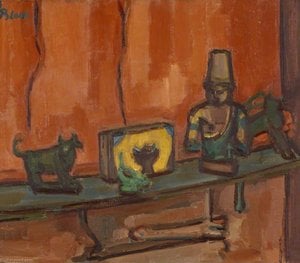
1883 - 1954
 Voorvertoning
 Verstuur
 Delen
Delen
 Details bekijken
 Gids
Gids

 Download
 Vergelijkbare items
 Röntgenonderzoek
 Diavoorstelling
 Vraag & antwoord
 Statistieken

 Lees meer


