

De kunstwerken die op deze pagina worden weergegeven, zijn beschermd door de auteursrechtwetgeving, wat betekent dat het ons wettelijk niet is toegestaan om identieke reproducties te maken of te verkopen. Deze bescherming wordt gehandhaafd onder internationale overeenkomsten zoals de Conventie van Bern en door nationale wetgeving, waaronder de bepalingen van de Amerikaanse auteurswet - Titel 17. Alle rechten voorbehouden. Reproduceren of distribueren van afbeeldingen is niet toegestaan zonder uitdrukkelijke schriftelijke toestemming van WahooArt.com en de rechthebbenden.
Deze methode voldoet volledig aan de auteursrechtwetgeving, omdat het niet gaat om het kopiëren of dupliceren van het beschermde kunstwerk. In plaats daarvan is er sprake van een creatieve herinterpretatie — een nieuw schilderij dat door het origineel wordt geïnspireerd, maar er niet identiek aan is.
Giclée- of canvasafdruk van museumkwaliteit met een snelle productie en flexibele afwerkingsmogelijkheden. ( Bestel handgeschilderde reproductie Schakel over naar digitale afbeeldingen)





























Kies uit onze vooraf ingestelde maten die overeenkomen met de originele verhoudingen van het kunstwerk.

Voer de gewenste breedte en hoogte in, passend bij uw lijst of muur. Een afdruk kan alleen worden ingekort en nooit groter worden gemaakt dan het origineel; een formaat met andere verhoudingen zal daarom een deel van de afbeelding verliezen. Wij sturen u een digitaal mockup ter goedkeuring voordat we tot drukwerk overgaan. De afbeelding op deze pagina toont niet de werkelijke uitsnede — dit is alleen te zien op het mockup.
Wereldwijde levering () binnen 2 weken in plaats van de standaard 4/5 weken. (8 november)
Untitled (18)
Afmetingen reproductie
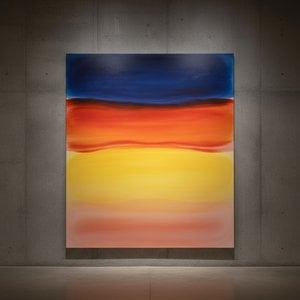
Mark Rothko’s “Untitled (18),” a painting shrouded in mystery yet profoundly resonant, stands as a cornerstone of Abstract Expressionism and a testament to the power of color to evoke complex emotional states. Created around 1948, this work embodies Rothko's signature style – vast fields of luminous color stacked vertically, creating an almost architectural presence on the canvas. It’s not merely a painting; it’s an invitation to contemplate the depths of human experience, a journey into realms of anxiety, introspection, and ultimately, a fragile sense of peace.
The photograph reveals a scene both unsettling and strangely compelling. A solitary figure, seemingly male, kneels on the ground, his hands clasped tightly over his head – an immediate gesture of distress or perhaps profound contemplation. Around him swirl other figures: one brandishing a knife, another bearing a bowl upon their head, elements that immediately introduce layers of symbolic interpretation. These aren’t simply decorative additions; they contribute to a narrative of disruption and the struggle for meaning within a chaotic world. The inclusion of trees, cacti, and a bird – rendered with a muted, almost dreamlike quality – anchors the scene in a naturalistic setting while simultaneously highlighting its surreal and emotionally charged atmosphere.
Rothko's technique was deliberately reductive. He eschewed traditional brushwork, opting instead for layers of thin paint applied with meticulous care to create the illusion of depth and luminosity. The colors – predominantly deep blues, greens, and reds – are not blended but rather juxtaposed, allowing them to bleed into one another subtly. This creates a vibrating effect, as if the canvas itself is alive with energy. He famously described his process as “making a stain,” emphasizing the importance of the material qualities of paint and its ability to evoke feeling directly. The scale of the painting – an unknown size but undeniably imposing – further intensifies this immersive experience, enveloping the viewer in a sea of color.
Crucially, Rothko wasn’t interested in depicting recognizable forms or narratives. Instead, he sought to create what he called “feeling” – pure emotional expression communicated through the interaction of color and shape. His work is deeply rooted in his belief that art should transcend representation and tap directly into the viewer's subconscious. The absence of a clear subject allows for individual interpretation; each observer brings their own experiences and emotions to bear on the painting, forging a unique connection with the artwork.
Born in Latvia in 1903, Mark Rothko's early life was marked by displacement and upheaval – experiences that profoundly shaped his artistic vision. His family’s journey to America, followed by the tragic loss of his father, instilled within him a deep sensitivity to themes of mortality, trauma, and the search for meaning. This existential angst permeates much of his work, particularly during the post-World War II era. “Untitled (18)” can be viewed as an embodiment of this struggle – a visual representation of the anxieties and uncertainties that characterized the period.
Rothko’s work gained prominence within the Abstract Expressionist movement, alongside artists like Jackson Pollock and Willem de Kooning. However, he deliberately distanced himself from the more overtly gestural styles of his contemporaries, focusing instead on creating a meditative space for contemplation. His later years were marked by a growing disillusionment with the commercialization of art, culminating in his decision to donate his paintings to museums rather than sell them for profit. “Untitled (18)” stands as a poignant reminder of this commitment to artistic integrity and the profound emotional depth that fueled Rothko’s extraordinary career.
“Untitled (18)” continues to captivate viewers with its enigmatic beauty and unsettling power. It's a painting that demands attention, inviting us to slow down, breathe deeply, and confront our own emotions. Reproductions offer a remarkable opportunity to experience this work’s immersive quality in one’s own space, bringing Rothko’s profound vision into the heart of the home. WahooArt offers meticulously crafted hand-painted reproductions that faithfully capture the luminosity, depth, and emotional resonance of this iconic masterpiece – allowing you to connect with its timeless message.
"Untitled (18)" door Mark Rothko is nog steeds auteursrechtelijk beschermd. De auteursrechtelijke bescherming loopt vanaf het overlijden van de kunstenaar, dat plaatsvond in 1970.
"Untitled (18)" toont man, distress, figures, trees, cacti, bird, clock, symbolism en de vastgelegde stemming is Calm.
De kunstenaar achter "Untitled (18)" is Mark Rothko. Het werk is gecatalogiseerd onder de naam van Mark Rothko.

1903 - 1970 , Letland

Explore the profound emotional depth of Color Field painting. Discover the history of mid-century abstraction, from Rothko to Newman, and learn how pure color transforms the viewer's experience through our expert art history guide.

Explore the profound history and emotional depth of Color Field painting. From Mark Rothko to Barnett Newman, discover how pure color redefined modern art through our expert-led guide for students and collectors alike.
Explore the profound emotional depth of Mark Rothko's abstract expressionism. Discover the history, techniques & lasting impact of this pivotal Color Field painter. Expert insights for collectors and art enthusiasts.

Ontdek de top 25 meesterwerken van Mark Rothko! Duik diep in zijn emotionele kleurveldschilderijen en abstract expressionisme. Vind museumkwaliteit Rothko reproducties & interieurinspiratie op WahooArt.com.

Ontdek de 10 meest invloedrijke werken van Abstract Expressionisme! Leer over Jackson Pollock, Mark Rothko & meer. Museumkwaliteit kunst reproducties voor uw interieur. Bekijk de collectie op WahooArt.com.
 Voorvertoning
 Verstuur
 Delen
Delen
 Details bekijken
 Gids
Gids

 Download
 Vergelijkbare items
 Röntgenonderzoek
 Diavoorstelling
 Vraag & antwoord
 Statistieken
 Lees meer









 De optie voor glas is alleen beschikbaar bij een formaat kleiner dan 110 cm.


