Bekijk op ware grootte Bekijk in AR Schakel over naar print Schakel over naar digitale afbeeldingen Verstuur
Details bekijken Gids Toevoegen aan favorieten Download Vergelijkbare items Röntgenonderzoek Diavoorstelling Statistieken

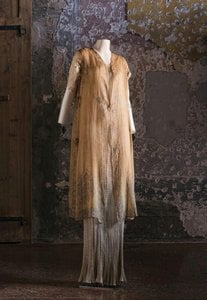
Experience Mariano Fortuny’s iconic Delphos gown, a luxurious 1910s pleated dress inspired by ancient Greece and celebrated for its flowing silhouette and shimmering textures – perfect for adding timeless elegance to your collection.

Mariano Fortuny (1871-1949) was a Spaanse designer en kunstenaar, bekend om zijn innovatieve stoffen, de beroemde Delphos gowns en revolutionaire theaterverlichting. Verken zijn Oriëntaalse invloeden, uitvindingen en blijvende nalatenschap in de kunstgeschiedenis.

Handgemaakte olieverfreproductie

Met de hand geschilderd in olieverf op canvas in uw gewenste maat en lijst, op bestelling gemaakt door onze kunstenaars. ( Schakel over naar print Schakel over naar digitale afbeeldingen)

P118B $10
P118H $10
P118W $10
P438Z $10
P508JH $12
P508YH $12
P805H $10
P805Z $10
P919BZ $10
P919G $10
P919XJ $10
P959ZH $10
P968JZ $12
W106C $8
W218G $10
W218JH $8
W218Y $10
W307PJ $10
W316G $10
W316PJ $8
W316Y $10
W398PJ $8
W4111J $10
W500HY $15
W500JH $15
W692G $12
W849H $8
W940BG $15
W953PJ $8

Standaardformaat
op maat gemaakt
CM
INCH

Kies uit onze vooraf ingestelde maten die overeenkomen met de originele verhoudingen van het kunstwerk.

breedte
hoogte

U kunt uw eigen afmetingen invoeren om in een specifieke lijst of ruimte te passen. Als de door u gekozen maat niet overeenkomt met de verhoudingen van het originele beeld, zullen we het kunstwerk bijsnijden of het schilderij uitbreiden met extra handgeschilderde elementen. Een digitale mockup wordt ter goedkeuring naar u verzonden voordat de productie begint.
Houd er rekening mee dat de preview op het scherm niet de werkelijke uitsnede of uitbreiding weergeeft. Alleen de mockup toont de uiteindelijke compositie nauwkeurig.
Hoewel aangepaste afmetingen mogelijk zijn, raden we aan een maat uit de vooraf gedefinieerde lijst te selecteren om de originele verhoudingen te behouden.

Voorbeelden van wat aangepast kan worden: Vervang het gezicht met een eigen foto; Voeg een huisdier toe (bijv. vervang de kat door een hond); Verwerk een verborgen boodschap in de achtergrond; Wijzig het landschap of andere elementen in de achtergrond.
Na de bestelling zal het team van WahooArt.com per e-mail contact opnemen met de klant voor instructies en een mockup-voorbeeld sturen.

Wereldwijde levering () binnen 3 tot 4 weken in plaats van de standaard 5 weken. (21 september). Zonder concessies aan de kwaliteit.

why_choose_icon
Gratis wereldwijde expressverzending
why_choose_icon
Hoogwaardig linnen canvas
why_choose_icon
Volledige verzendverzekering
why_choose_icon
Garantie op terugbetaling van invoerrechten
why_choose_icon
Garantie op exacte kleurweergave
why_choose_icon
Retourbeleid van 100 dagen (alleen bij defecten)
why_choose_icon
100% Geld-terug-garantie
why_choose_icon
Korting bij meerdere afnames

Totaalprijs

$ 272

reproduction

None

Reproductiemethode

Formaat reproductie

-

Totaalprijs

$ 272

An example of the renowned Delphos gown of the multifaceted artist Mariano Fortuny (1871–1949) came into the collection of the Museum of Applied Arts in 2001. The original owner of this casual dress made in the 1910s was Klára Zichy (1875–1946), the wife of Endre Hadik-Barkóczy and considered one of Hungary’s most beautiful women. This dress was considered a luxury item and was made fashionable by the famous celebrities of the day, the dancer Isadora Duncan and the actress Sarah Bernhardt. The person who dreamt up the Delphos gown was Fortuny’s wife, Henriette Negrin (1877–1965), and so the patent was registered under her name.This pleated dress created in 1907 and called the Delphos was probably inspired by the statue “The Charioteer of Delphi,” which was discovered in 1896 in three parts. The original purpose of this richly pleated dress was to show off the natural beauty of the female body without a corset. A genuine movement had begun in several areas of Europe to free women from this unhealthy piece of attire, however it remained in style despite this.This Greek-inspired dress was at first only worn as a housedress, but it proved to be too long for this. It was possible to adjust the length and width of the gown by pulling a cord adorned with glass Murano beads running along the side seams and the arm holes. The dense, vertical pleating, which may have contained as many as 450 folds, was first made by hand, and then by using heated copper or ceramic rods. Fortuny also designed dress materials himself. Besides black, the Delphos gown was also available in coral red or ultramarine blue. It was worn with a belt or some other Fortuny creation, such as a Knossos scarf or a tunic inspired by the Greek Peplos.

Biografie van de kunstenaar

Early Life and Inspiration

Mariano Fortuny, a name synonymous with theatrical innovation and opulent textiles, was born in Reus, Catalonia, Spain, on May 11, 1871. His early life was marked by profound loss – his father, Mariano Fortuny y Marsal, a respected genre painter, tragically passed away when the young boy was just three years old. This event spurred the family’s relocation to Paris, France, where his mother, a woman of considerable artistic sensibility, introduced him to the world of textiles and fabrics, an influence that would profoundly shape his future creative endeavors. From a remarkably young age, Fortuny demonstrated a prodigious talent for various art forms: he excelled in painting, photography, sculpting, architecture, etching, and even theatrical stage lighting design. His early years were steeped in artistic exploration, laying the foundation for his later revolutionary contributions.

Artistic Talents and Revolutionary Inventions

Fortuny’s artistic journey was characterized by a relentless pursuit of innovation. He quickly established himself as a skilled painter, demonstrating an ability to capture both realistic detail and evocative atmosphere. However, it was his inventive spirit that truly set him apart. Between 1901 and 1934, Fortuny patented over twenty groundbreaking inventions, fundamentally altering the landscape of theatrical design. Perhaps his most celebrated creation is the “fortuny cyclorama dome,” a quarter-dome structure constructed from plaster or cloth, ingeniously designed to diffuse light in a way that eliminated harsh shadows and created seamless transitions between scenes – a technique previously unattainable on stage. His treatise, "Eclairage Scenique" (1904), meticulously documented his revolutionary approach to lighting, detailing how reflecting light off various surfaces could dramatically alter its color, intensity, and overall effect. This wasn’t merely about illumination; it was about manipulating perception itself.

Collaborations and Recognition

Fortuny's work gained significant recognition in the 1920s, catapulting him to international fame. He forged remarkable collaborations with some of the most influential figures of his time. Richard Wagner, the German composer whose operas deeply resonated with Fortuny’s artistic sensibilities, commissioned sets for the premiere of Tristan und Isolde at La Scala opera house in Milan, adapting his dome system to accommodate the theater's vast scale and even inventing a sophisticated suction fan mechanism to maintain the dome’s taut structure. His work was also celebrated by Gabriele D’Annunzio, who greatly admired Fortuny’s innovative approach to stage design. Fortuny’s influence extended beyond opera; he designed sets for numerous theatrical productions across Europe, establishing himself as a leading figure in the burgeoning field of Gesamtkunstwerk – a holistic artistic vision that sought to unify music, drama, and visual spectacle.

Legacy and Lasting Influence

Mariano Fortuny passed away on May 3, 1949, in Venice, Italy, leaving behind a legacy that continues to inspire artists and designers today. His work profoundly influenced the French novelist Marcel Proust, who drew inspiration from Fortuny’s unique aesthetic vision. His life story was also depicted in Pere Gimferrer's novel "Fortuny," further cementing his place in cultural history. Beyond his theatrical innovations, Fortuny revolutionized the world of textiles, creating the iconic “Delphos gown,” a shimmering pleated silk creation that became a symbol of elegance and sophistication during the Art Deco era. His contributions to lighting design remain foundational, demonstrating a profound understanding of color theory, reflection, and the power of light to shape perception. Explore more about Mariano Fortuny’s inventions and designs at WahooArt's collection – a testament to his enduring legacy as a true visionary artist.

Mariano Fortuny

Mariano Fortuny

1871 - 1949 , Spanje

Snelle feiten

  • Artistic Movement Or Style: Orientalisme kunst
  • Artists Or Movements Influenced By This Artist: ['Marcel Proust']
  • Artists Who Influenced This Artist: ['Richard Wagner']
  • Date Of Birth: 11 juni 1871
  • Date Of Death: 3 mei 1949
  • Full Name: Mariano Fortuny y Marsal
  • Nationality: Spaans
  • Notable Artworks:
    • Teagown
    • Portret van Henriette Fortuny
  • Place Of Birth: Granada, Spanje
Ontdek kunstwerken georganiseerd op thema, stijl en kenmerk.