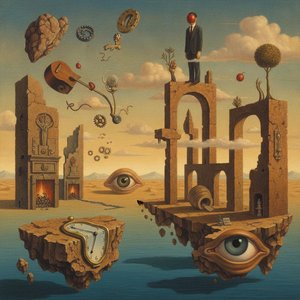
A Surrealist Dance Through Memory: Exploring Marc Chagall’s “The Acrobat”
To gaze upon Marc Chagall’s “The Acrobat,” painted in 1930, is to step through a portal into a realm where the laws of gravity are merely suggestions and the boundaries between reality and dream dissolve into a vibrant, chromatic haze. This masterpiece, born during the height of Chagall’s Surrealist experimentation, is far more than a mere depiction of a circus feat; it is a profound meditation on flight, vulnerability, and the elusive nature of human recollection. The central figure—a woman draped in striking, passionate red clothing—appears to defy the earth, poised precariously upon a pole as if suspended by the very threads of a dream. Her face, rendered in a ghostly white, provides a haunting contrast to the vivid hues surrounding her, inviting the viewer into a silent dialogue with the subconscious.
The composition is a masterful display of Chagall’s signature style, characterized by flattened perspectives and a whimsical, distorted landscape that feels both intimate and infinite. In the upper reaches of the canvas, a bird soars, serving as a recurring motif in Chagall's oeuvre to symbolize freedom, aspiration, and the spiritual transcendence of the soul. The scene unfolds against a backdrop of a quiet street corner, where the presence of buildings and a solitary clock hanging on a wall suggests the ticking of time amidst the timelessness of memory. Through his use of tempera on canvas, Chagall achieved a luminous, textured surface that captures subtle tonal variations, allowing the colors to glow with an inner light that breathes life into the surrealist landscape.
Symbolism and the Echoes of History
Every element within “The Acrobat” is imbued with deep symbolic resonance, reflecting the artist's complex identity and the turbulent era in which he lived. The vibrant red of the acrobat's dress acts as a pulse of vitality and passion against the more ethereal elements of the painting, while the pole she clings to represents a fragile sense of stability amidst a world of chaos. This tension between movement and stillness mirrors Chagall’s own life, shaped by the cultural richness of his Belarusian upbringing in Vitebsk and the profound upheavals of the early 20th century. The shadows of pogroms and the shifting political landscapes of the Russian Empire loom large in the historical context, adding a layer of emotional weight to the whimsical imagery.
For the discerning collector or interior designer, this piece offers an unparalleled emotional depth. It evokes a simultaneous sense of wonder and melancholy, compelling anyone who stands before it to confront questions of identity, loss, and the transformative power of the imagination. The painting does not merely decorate a space; it animates it, bringing a dynamic energy and a narrative complexity that sparks conversation and contemplation. Whether placed in a contemporary gallery or a curated private study, “The Acrobat” serves as a window into a universe where the spirit is free to wander through the beautiful, fragmented landscapes of the heart.
Vragen & Antwoorden
Welk gebruik en welke ruimte worden aanbevolen voor "The Acrobat" door Marc Chagall?
Gebruik (Accent) en ruimte (Living Room) zijn de twee aanbevelingen voor "The Acrobat" door Marc Chagall.
Welke sfeer straalt "The Acrobat" uit?
"The Acrobat" heeft een Romantic atmosfeer.
Uit welke periode stamt "The Acrobat"?
De historische periode van "The Acrobat" door Marc Chagall is Modern. Deze classificatie plaatst het werk binnen de kunstgeschiedenis.



 Bekijk op ware grootte
 Koop handgeschilderd kunstwerk
 Verstuur
 Delen
Delen
 Details bekijken
 Gids voor studentenkunstwerken

 Download
 Vergelijkbare items
 Röntgenonderzoek
 Diavoorstelling
 Statistieken


 Lees meer






































 De optie voor glas is alleen beschikbaar bij een formaat kleiner dan 110 cm.