Bekijk op ware grootte Bekijk in AR Koop handgeschilderd kunstwerk Schakel over naar digitale afbeeldingen Verstuur
Details bekijken Gids voor studentenkunstwerken Toevoegen aan favorieten Download Vergelijkbare items Röntgenonderzoek Diavoorstelling Statistieken

De Boom van Jesse

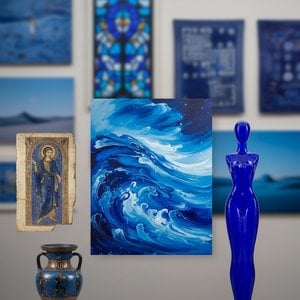
Een prachtige blauwe reproductie van 'De Boom van Jesse' door Marc Chagall uit 1975. Laat je betoveren door de kleurrijke symboliek en het persoonlijke visioen van deze iconische kunstenaar.

Ontdek Marc Chagall (1887-1985), een Russische kunstenaar die bekend staat om zijn droomachtige schilderijen, thema's uit het Joodse folklore en prachtige kleurrijke glaswerkkunst. Een artistieke erfenis die blijft inspireren!

De kunstwerken die op deze pagina worden weergegeven, zijn beschermd door de auteursrechtwetgeving, wat betekent dat het ons wettelijk niet is toegestaan om identieke reproducties te maken of te verkopen. Deze bescherming wordt gehandhaafd onder internationale overeenkomsten zoals de Conventie van Bern en door nationale wetgeving, waaronder de bepalingen van de Amerikaanse auteurswet - Titel 17. Alle rechten voorbehouden. Reproduceren of distribueren van afbeeldingen is niet toegestaan zonder uitdrukkelijke schriftelijke toestemming van WahooArt.com en de rechthebbenden.

Deze methode voldoet volledig aan de auteursrechtwetgeving, omdat het niet gaat om het kopiëren of dupliceren van het beschermde kunstwerk. In plaats daarvan is er sprake van een creatieve herinterpretatie — een nieuw schilderij dat door het origineel wordt geïnspireerd, maar er niet identiek aan is.

Giclée / Kunstafdrukken

Giclée- of canvasafdruk van museumkwaliteit met een snelle productie en flexibele afwerkingsmogelijkheden. ( Koop handgeschilderd kunstwerk Schakel over naar digitale afbeeldingen)

Corner sample of the P118B picture frame: gegoten polystyreen, 5 cm wide and 3 cm thick
P118B €10
Corner sample of the P118H picture frame: gegoten polystyreen, 5 cm wide and 3 cm thick
P118H €10
Corner sample of the P118W picture frame: gegoten polystyreen, 5 cm wide and 3 cm thick
P118W €10
Corner sample of the P438Z picture frame: gegoten polystyreen, 5.5 cm wide and 3.5 cm thick
P438Z €10
Corner sample of the P508JH picture frame: gegoten polystyreen, 7 cm wide and 3.5 cm thick
P508JH €12
Corner sample of the P508YH picture frame: gegoten polystyreen, 7 cm wide and 3.5 cm thick
P508YH €12
Corner sample of the P805H picture frame: gegoten polystyreen, 5 cm wide and 3.5 cm thick
P805H €10
Corner sample of the P805Z picture frame: gegoten polystyreen, 5 cm wide and 3.5 cm thick
P805Z €10
Corner sample of the P919BZ picture frame: gegoten polystyreen, 7 cm wide and 3.5 cm thick
P919BZ €10
Corner sample of the P919G picture frame: gegoten polystyreen, 7 cm wide and 3.5 cm thick
P919G €10
Corner sample of the P919XJ picture frame: gegoten polystyreen, 7 cm wide and 3.5 cm thick
P919XJ €10
Corner sample of the P959ZH picture frame: gegoten polystyreen, 5 cm wide and 3 cm thick
P959ZH €10
Corner sample of the P968JZ picture frame: gegoten polystyreen, 6 cm wide and 4 cm thick
P968JZ €12
Corner sample of the W106C picture frame: massief hout, 5 cm wide and 3 cm thick
W106C €8
Corner sample of the W218G picture frame: massief hout, 5 cm wide and 3 cm thick
W218G €10
Corner sample of the W218JH picture frame: massief hout, 5 cm wide and 3 cm thick
W218JH €8
Corner sample of the W218Y picture frame: massief hout, 5 cm wide and 3 cm thick
W218Y €10
Corner sample of the W307PJ picture frame: massief hout, 6 cm wide and 3 cm thick
W307PJ €10
Corner sample of the W316G picture frame: massief hout, 6 cm wide and 3 cm thick
W316G €10
Corner sample of the W316PJ picture frame: massief hout, 6 cm wide and 3 cm thick
W316PJ €8
Corner sample of the W316Y picture frame: massief hout, 6 cm wide and 3 cm thick
W316Y €10
Corner sample of the W398PJ picture frame: massief hout, 5 cm wide and 3 cm thick
W398PJ €8
Corner sample of the W4111J picture frame: massief hout, 6.5 cm wide and 3.5 cm thick
W4111J €10
Corner sample of the W500HY picture frame: massief hout, 7 cm wide and 5 cm thick
W500HY €15
Corner sample of the W500JH picture frame: massief hout, 7 cm wide and 5 cm thick
W500JH €15
Corner sample of the W692G picture frame: massief hout, 8 cm wide and 4 cm thick
W692G €12
Corner sample of the W849H picture frame: massief hout, 5 cm wide and 3 cm thick
W849H €8
Corner sample of the W940BG picture frame: massief hout, 7.5 cm wide and 4.5 cm thick
W940BG €15
Corner sample of the W953PJ picture frame: massief hout, 6 cm wide and 3.5 cm thick
W953PJ €8

Standaardformaat
op maat gemaakt
CM
INCH

Kies uit onze vooraf ingestelde maten die overeenkomen met de originele verhoudingen van het kunstwerk.

breedte
hoogte

Voer de breedte en de hoogte in die u nodig heeft, passend bij uw lijst of uw muur. Een afdruk kan alleen worden ingekort, nooit groter worden gemaakt dan het origineel, waardoor een formaat met een andere verhouding een deel van de afbeelding verliest. Wij sturen u een digitaal mockup ter goedkeuring voordat we iets drukken. De afbeelding op deze pagina toont niet de werkelijke uitsnede — dit is alleen te zien op het mockup.

Wereldwijde levering () binnen 2 weken in plaats van de standaard 4/5 weken. (22 oktober)

Gratis wereldwijde expressverzending
Hoogwaardig linnen canvas
Volledige verzendverzekering
Garantie op terugbetaling van invoerrechten
Garantie op exacte kleurweergave
Retourbeleid van 100 dagen (alleen bij defecten)
100% Geld-terug-garantie
Korting bij meerdere afnames

Totaalprijs

€ 60

De Boom van Jesse

Giclée / Kunstafdrukken

Formaat reproductie

-

Totaalprijs

€ 60

Belangrijkste kenmerken

  • Location: Collectie Musée d'Orsay, Parijs
  • Artist: Marc Chagall
  • Year: 1975
  • Notable elements or techniques: Gebruik van kleurrijke vormen en lijnen; Symbolische afbeeldingen
  • Dimensions: 130 x 81 cm
  • Movement: Expressionisme

Kunstquiz

Er is slechts één goed antwoord op elke vraag.

Vraag 1:
¿Cuál es el artista principal de esta obra?
Vraag 2:
¿En qué año fue creada esta pintura?
Vraag 3:
¿Qué elementos dominantes utiliza Chagall en esta composición?
Vraag 4:
¿Dónde nació Marc Chagall?
Vraag 5:
¿Qué simbolismo puede tener el árbol central de la pintura?

Een Symfonie van Kleur en Gebruik: Een Analyse van Chagall’s ‘Boom van Jesse’

De schilderij “Boom van Jesse” van Marc Chagall, voltooid in 1975, is meer dan alleen een prachtige kunstwerk; het is een visuele vertaling van een complexe emotionele reis en een bewijs van Chagall's unieke artistieke taal. Het grote blauwe doek vangt een wereld vol beweging en kleur, een wereld die zowel nostalgisch naar zijn Russische roots terugkijkt als optimistisch vooruitblickt naar de toekomst. Een kunstenaar wiens leven zelf een verhaal was van emigratie, oorlog en persoonlijke groei, Chagall gebruikte zijn kunst om deze ervaringen te verkennen en weergeven op een manier die zowel poëtisch als krachtig is.
  • Het Onderwerp: De afbeelding toont een majestueuze boom, een centrale figuur die symbool staat voor het voortbestaan van de joodse familiegeschiedenis en het beloofde land. Chagall’s keuze om deze boom centraal te plaatsen onderstreept het belang van traditie en genealogie binnen zijn kunstenaarschap.
  • Stijl: Chagall's stijl is kenmerkend voor zijn oeuvre – een combinatie van surrealisme en naïeve kunst. Zijn werken staan bekend om hun fantastische composities, gedragen door een gevoel voor beweging en licht dat vaak doet denken aan kinderlijk eenvoudige tekeningen. De kleuren zijn intens en expressief, gebruikmakend van een palet dat zowel warme als koele tinten bevat, waardoor een gevoel van dynamiek en emotionele lading wordt gecreëerd.
  • Techniek: Chagall gebruikte een combinatie van olie op doek en pasteltechnieken om zijn kunstwerken te creëren. Hij stond bekend om zijn gebruik van verschillende soorten penselen en kleuren, vaak met een laagjesmethode die het mogelijk maakte om complexe texturen en lichteffecten te bereiken. Deze techniek draagt bij aan de prachtige kwaliteit van de reproducties die vandaag de dag beschikbaar zijn.

Historische Context en Inspiratie

De schilderij ontstond tijdens een periode waarin Chagall’s kunstenaarschap werd gekenmerkt door een groeiende interesse voor religieuze thema's en een persoonlijke zoektocht naar spiritualiteit. Hij werd sterk beïnvloed door de Hebreeuwse traditie, met name het idee van Jesse, een oudtestamentelijke figuur die volgens het Bijbelverhaal de voorouders zou zijn van David en Salomon, koningen van Israël. Deze historische verwijzing geeft “Boom van Jesse” een diepere betekenis en nodigt uit tot contemplatie over thema’s als hoop, wedergeboorte en het voortbestaan van het joodse geloof. Daarnaast vond Chagall inspiratie in zijn eigen ervaringen met emigratie naar Parijs en later naar Israël, waardoor zijn kunstwerken vaak een gevoel van nostalgie en beweging bevatten.

Symbolisme en Emotionele Impact

De kleuren die Chagall gebruikte – rood, groen, geel en paars – zijn niet alleen mooi om te zien maar dragen ook belangrijke symbolische lading bij aan de emotionele impact van het kunstwerk. Het rode kleur staat voor leven en bloei, terwijl het groene symbool staat voor groei en natuurlijke kracht. Het gele licht vertegenwoordigt hoop en wijsheid, terwijl het paarse kleur vaak wordt geassocieerd met melancholie en nostalgie. De figuurlijke personen die rondom de boom zijn afgebeeld, dragen bij aan de emotionele expressie van het kunstwerk en nodigen uit tot een persoonlijke interpretatie. Chagall’s kunst spreekt tot het hart en biedt een prachtige manier om de schoonheid van het leven en de kracht van het bewustzijn vast te leggen. Een hoogwaardige reproductie kan een prachtige aanvulling zijn op elke ruimte, waardoor je kunt genieten van de magie en emotionele diepte van dit iconische werk.

Vragen & Antwoorden

Welke kleurverzadiging heeft "De Boom van Jesse" door Marc Chagall?

De kleuren van "De Boom van Jesse" door Marc Chagall hebben een Duidelijke kleurverzadiging verzadiging. Verzadiging beschrijft hoe levendig of gedempt de kleuren zijn.

Is "De Boom van Jesse" door Marc Chagall een schilderij, een tekening of een prent?

"De Boom van Jesse" door Marc Chagall wordt geclassificeerd als Wanddecoratie. De categorie beschrijft het type kunstwerk dat het origineel is.

Hoe komen stroming en tijdperk samen in "De Boom van Jesse" door Marc Chagall?

In "De Boom van Jesse" door Marc Chagall ontmoet de Surrealist Expressionism-stroming de Moderne tijd-periode.


Biografie van de kunstenaar

A Life Painted in Dreams: The World of Marc Chagall

Marc Chagall, born Moishe Shagal in 1887 in the small Belarussian town of Liozna near Vitebsk, wasn’t merely a painter; he was a poet of color, a weaver of dreams, and a chronicler of memory. His life, spanning nearly a century, mirrored the tumultuous currents of the twentieth century, yet his art remained steadfastly rooted in a deeply personal vision—one infused with the folklore of his Hasidic Jewish upbringing and an unwavering belief in the power of imagination. Vitebsk itself was more than just a birthplace; it became the emotional core of his artistic universe, a recurring motif populated by flying figures, whimsical animals, and the vibrant hues of remembered landscapes. The town’s unique blend of cultures—Russian Orthodox churches alongside bustling Jewish marketplaces—forged an aesthetic sensibility that would defy easy categorization throughout his long career. Though he sought formal training first with a local sign painter and later in St. Petersburg under Léon Bakst, and then in Paris at the Académie de la Grande Chaumière, Chagall never fully embraced any single artistic movement. He absorbed elements of Cubism, Symbolism, and Fauvism, but always filtered them through his own intensely personal lens, creating a style that was uniquely, unmistakably Chagall.

Early Influences and Artistic Beginnings

Chagall’s formative years were marked by the traditions of Vitebsk’s Jewish community—a vibrant tapestry woven with religious rituals, folk tales, and ancestral memories. These influences would permeate his artistic vision throughout his life, informing his use of symbolism and his fascination with biblical narratives. His initial training was modest, focusing on practical skills as a sign painter – a craft that instilled in him an appreciation for visual communication and meticulous attention to detail. However, he quickly recognized the limitations of realism and sought inspiration in the expressive techniques championed by Impressionists like Léon Bakst, whose theatrical productions captivated him with their bold colors and dynamic compositions. This exposure to avant-garde aesthetics broadened his artistic horizons and propelled him toward experimentation with new forms of expression. His early canvases—such as I and the Village (1911)—already demonstrated his ability to distill complex emotions into simplified visual language, prioritizing feeling over precise representation. The village isn’t rendered realistically but as a fragmented collection of recollections, imbued with symbolic meaning – a technique that would become central to his distinctive style.

The Symbolism of Flight and Memory

Chagall's artistic breakthrough arrived in the wake of World War I, during which he served briefly in the Russian army. This experience instilled in him a profound awareness of human suffering and loss—themes that would recur throughout his oeuvre. His paintings from this period are characterized by an ethereal quality, achieved through masterful use of color and perspective. Figures float effortlessly against backgrounds of luminous hues, defying gravity and logic – a deliberate departure from traditional artistic conventions. This fascination with flight symbolizes liberation from earthly constraints and represents Chagall’s yearning for transcendence—a recurring motif that appears in numerous works throughout his career. Equally important is his preoccupation with memory—the way in which past experiences shape our perceptions of the present. Landscapes are often depicted as dreamlike visions, blending elements of reality with fantastical imagery – reflecting Chagall's belief that art can capture the elusive essence of human experience.

Exploring Formal Movements and Personal Vision

Despite rejecting rigid artistic doctrines, Chagall remained attuned to developments in European modernism. He experimented with Cubist techniques—particularly in his early portraits—to dissect forms and explore multiple viewpoints simultaneously. However, he quickly abandoned this approach in favor of a more expressive style that prioritized emotional impact over intellectual rigor. His embrace of Fauvist color palettes – bold splashes of pigment divorced from naturalistic representation – further solidified his artistic identity. Yet, Chagall’s true genius lay in his ability to synthesize these influences into a wholly original vision—one rooted in his Jewish heritage and informed by the spiritual traditions of Vitebsk. He sought to convey not just what he saw but what he felt—a quest for beauty and truth that permeated every aspect of his artistic practice.

Later Years and Legacy

The Russian Revolution profoundly impacted Chagall’s life, returning him to Vitebsk where he established an art school dedicated to fostering creativity and cultural exchange. This period was marked by both artistic productivity and political disillusionment—a tension that would continue to shape his creative output. Following the outbreak of World War II, Chagall fled occupied France for New York City, where he found refuge amidst a thriving artistic community. During his time in America, he produced some of his most ambitious canvases – monumental works that explored themes of exile and displacement. He received numerous prestigious commissions, including the ceiling of the Paris Opera (1964), which showcased his unparalleled mastery of color and form—a testament to his enduring influence on subsequent generations of artists. Chagall’s stained glass windows for Jerusalem's Hadassah Hebrew University Medical Center synagogue stand as a poignant reminder of his commitment to Jewish faith and culture. His art continues to inspire awe and wonder, inviting viewers to contemplate the mysteries of existence and celebrating the transformative power of imagination. Marc Chagall died in 1985 at the age of 97, leaving behind an unparalleled legacy—a body of work that transcends stylistic boundaries and speaks directly to the human spirit.

Marc Chagall

Marc Chagall

1887 - 1985 , Belarus

Snelle feiten

  • Artistic Movement Or Style: Modernisme, Cubisme
  • Artists Or Movements Influenced By This Artist:
    • Surrealisme
    • Kunstenaars
  • Artists Who Influenced This Artist:
    • Bakst
    • Delaunay
    • Borovikovsky
  • Date Of Birth: 6 juli 1887
  • Date Of Death: 28 maart 1985
  • Full Name: Marc Chagall
  • Nationality: Russisch, later Frans
  • Notable Artworks:
    • I en het dorp
    • Over Vitebsk
    • Het witte kruis
  • Place Of Birth: Liozna, Belarus
Ontdek kunstwerken georganiseerd op thema, stijl en kenmerk.