

Giclée- of canvasafdruk van museumkwaliteit met een snelle productie en flexibele afwerkingsmogelijkheden. ( Bestel handgeschilderde reproductie Schakel over naar digitale afbeeldingen)





























Kies uit onze vooraf ingestelde maten die overeenkomen met de originele verhoudingen van het kunstwerk.

Voer de gewenste breedte en hoogte in, passend bij uw lijst of muur. Een afdruk kan alleen worden ingekort en nooit groter worden gemaakt dan het origineel; een formaat met andere verhoudingen zal daarom een deel van de afbeelding verliezen. Wij sturen u een digitaal mockup ter goedkeuring voordat we tot drukwerk overgaan. De afbeelding op deze pagina toont niet de werkelijke uitsnede — dit is alleen te zien op het mockup.
Wereldwijde levering () binnen 2 weken in plaats van de standaard 4/5 weken. (11 november)
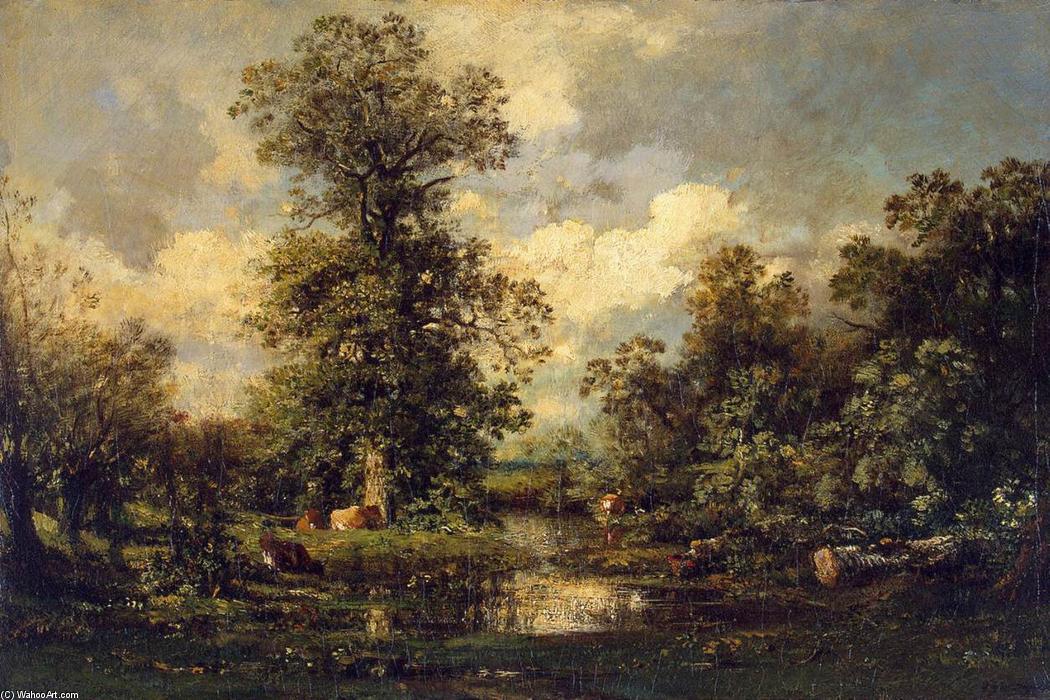
Forest Landscape
Afmetingen reproductie
Jules Dupré's "Forest Landscape," painted in 1840, isn’t merely a depiction of trees; it’s an immersion into the heart of the Barbizon School’s philosophy – a profound reverence for nature rendered with raw emotion and meticulous observation. This oil on canvas, currently residing within the esteemed Hermitage Museum in St. Petersburg, transcends simple landscape painting, offering a glimpse into the soul of 19th-century France and the artist's deeply personal connection to the natural world.
The Barbizon School, emerging from the shadow of Romanticism, rejected the idealized landscapes favored by earlier generations. Instead, they sought truth in the everyday – the weathered bark of a tree, the dappled sunlight filtering through leaves, the subtle shifts in color that define a fleeting moment. Dupré embodies this ethos with remarkable clarity. He doesn’t strive for picturesque beauty; he presents the forest as it *is*, imbued with a sense of quiet drama and timelessness. The composition is anchored by a winding river, its surface mirroring the sky above – a clever device that blurs the boundaries between earth and heavens, suggesting an infinite expanse.
Dupré’s masterful use of color is central to the painting's impact. He eschews bright hues in favor of a rich tapestry of earthy tones – deep greens, browns, ochres, and subtle blues – creating an atmosphere of profound tranquility and introspection. These aren’t merely colors; they are textures, evoking the dampness of moss, the roughness of bark, and the muted light of a forest floor. Notice how he employs loose brushstrokes, allowing the paint to flow freely across the canvas, capturing the movement of branches in the wind and the dappled patterns of sunlight. This technique contributes significantly to the painting’s sense of immediacy and vitality.
The sky itself is a study in atmospheric perspective – a swirling blend of clouds rendered with delicate washes of blue and gray. These aren't static formations; they seem to shift and change, mirroring the ever-changing moods of nature. The light filtering through these clouds casts a gentle illumination on the landscape below, highlighting the play of light and shadow in the foliage and along the river’s edge – creating an illusion of depth and volume that draws the viewer into the scene.
To fully appreciate “Forest Landscape,” it's crucial to understand its historical context. The Barbizon School, centered around the Forest of Fontainebleau, rejected the Parisian Salon’s emphasis on academic art and sought inspiration directly from nature. Artists like Dupré, Corot, and Millet spent countless hours observing and painting outdoors, capturing the essence of rural life and the beauty of the French countryside. Dupré's work is often interpreted as a reflection of his own emotional state – a yearning for simplicity, solitude, and connection with the natural world.
Symbolically, the forest itself represents a realm of mystery and introspection. It’s a place where one can escape the pressures of society and connect with something larger than oneself. The winding river serves as a metaphor for the flow of life – its constant movement reminding us to embrace change and accept the inevitable passage of time. The painting, therefore, is not simply a representation of a forest; it’s an invitation to contemplate our place within the grand scheme of nature.
Handmade oil painting reproductions of this beautiful work are now available for purchase at WahooArt.com, offering a tangible connection to Dupré’s artistic vision. Whether adorning your living room wall or serving as a focal point in a serene bedroom, “Forest Landscape” will undoubtedly evoke feelings of peace, tranquility, and wonder. Its timeless appeal ensures that it will remain a cherished addition to any art collection for generations to come.
In "Forest Landscape" gaat een Calm sfeer gepaard met een Tranquil emotie.
Er is een download beschikbaar voor "Forest Landscape": de Downloaden pagina van het kunstwerk biedt de mogelijkheid om een digitale afbeelding in hoge resolutie om te downloaden.
Over het algemeen wordt "Forest Landscape" geregistreerd als balanced. De waargenomen helderheid beschrijft hoe licht of donker het werk oogt.

Jules Dupré (1811–1889) staat als een hoeksteenfiguur binnen de Barbizon-school, een artistieke beweging die pleitte voor rauwe observatie en emotionele resonantie in de landschapsschilderkunst. In tegenstelling tot zijn tijdgenoten zoals Corot, die vaak zochten naar lyrische schoonheid en serene stilte, worstelde Dupré met de donkere, meer stormachtige kant van de natuur. Hij bezat het unieke vermogen om de woede van stormen, de melancholische grandeur van de schemering en de onstuitbare energie van de elementen vast te leggen, waarbij hij deze ervaringen met een ongeëvenaarde intensiteit overbracht. Geboren in Nantes, Frankrijk, begon Dupré's artistieke reis te midden van een groeiende fascinatie voor de natuurlijke wereld en haar vermogen om diepe, vaak turbulente, menselijke gevoelens op te roepen.
Zijn vroege jaren boden een fundament van nauwgezette aandacht voor detail en een waardering voor vakmanschap, kwaliteiten die werden geslepen door het porseleinbedrijf van zijn vader. Deze vormende ervaring zou later doorklinken in zijn eigen artistieke ondernemingen, wat vooral zichtbaar was in zijn vroege werken waarin hij de complexiteit van keramische decoratie verkende. Als leerling-porseleinschilder leerde hij de discipline van fijne lijnen en texturen, een vaardigheid die uiteindelijk zou evolueren naar zijn meesterlijke beheersing van atmosferische diepte en organische vormen.
Het verloop van Dupré's carrière werd onherroepelijk bepaald door zijn ontmoeting met de baanbrekende doeken van John Constable. Deze blootstelling aan de Engelse landschapstradities ontketende een verlangen om de essentie van de dynamiek van de natuur te vangen—het meedogenloze duwen en trekken van door de wind bewogen gebladerte en het dramatische samenspel van licht en schaduw tijdens de meest onstuimige uren van de dag. Tijdens zijn reis naar Groot-Brittannië in 1831 maakte Dupré diepgaande studies van deze Engelse meesters, waarna hij terugkeerde naar Frankrijk met een oeuvre aan beelden die zijn benadering van het landschap volledig zouden herdefiniëren.
Hij vond bijzondere inspiratie in de kustgebieden rond Southampton en Plymouth. Deze uitgestrekte watermassa's, waarin turbulente luchten werden weerspiegeld, boden hem het perfecte laboratorium om de stormachtige beweging van wolkenpartijen en de dynamiek van de zee te bestuderen. Zijn schilderijen uit deze periode zijn niet louter afbeeldingen van een landschap; het zijn viscerale expressies van stemming en gevoel, doordrenkt met een tastbaar gevoel van drama en zelfs droefheid. Door de esthetiek van de Barbizon-school te omarmen, gaf Dupré de voorkeur aan expressieve kleurenpaletten en gedurfde penseelstreken boven geïdealiseerde of gepolijste representaties, waardoor de textuur van de verf zelf de ruwheid van de aarde weerspiegelde.
Als een sleutelfiguur binnen de Barbizon-groep ontwikkelde Dupré nauwe banden met andere legendarische schilders, waaronder Théodore Rousseau. Zijn opkomst binnen de Franse kunstwereld werd gemarkeerd door belangrijke mijlpalen, zoals zijn acceptatie in de Salon en het ontvangen van officiële erkenning via medailles voor zijn landschappen. Zijn werk werd synoniem met een bepaalde sonore en resonerende kleurharmonie, waarbij het licht van een ondergaande zon of de dreiging van een naderende storm door de kijker evenzeer gevoeld als gezien kon worden.
Vandaag de dag wordt Jules Dupré herinnerd als een van de meest invloedrijke Franse landschapsschilders uit de 19e eeuw. Zijn bijdrage aan de kunst ligt in zijn vermogen om de kloof te overbruggen tussen pure observatie en romantische emotie. Door werken zoals La Petite Charrette,

1811 - 1889 , Frankrijk

Explore the profound legacy of the Barbizon School. Discover how masters like Corot and Monet revolutionized landscape painting through plein air techniques and the soulful depiction of nature's light and shadow in this expert art history guide.
 Voorvertoning
 Verstuur
 Delen
Delen
 Details bekijken
 Gids
Gids

 Download
 Vergelijkbare items
 Röntgenonderzoek
 Diavoorstelling
 Vraag & antwoord
 Statistieken


 Lees meer









 De optie voor glas is alleen beschikbaar bij een formaat kleiner dan 110 cm.


